


As generative artificial intelligence reshapes industries, a foundational legal question remains violently unresolved: If an algorithm creates it, who owns it?
We are living through the most explosive technological gold rush since the dawn of the internet. With a simple text prompt, users can now generate photorealistic art, draft complex legal contracts, compose symphonies, and write functional software code in seconds. Yet, beneath the veneer of limitless creativity lies a ticking legal time bomb that could stall the entire artificial intelligence revolution.
The core crisis doesn’t just concern the data used to train these models—though lawsuits from authors, artists, and news publishers are already piling up. The more insidious, forward-looking question is: Who actually owns the output?
The “Human Authorship” Wall
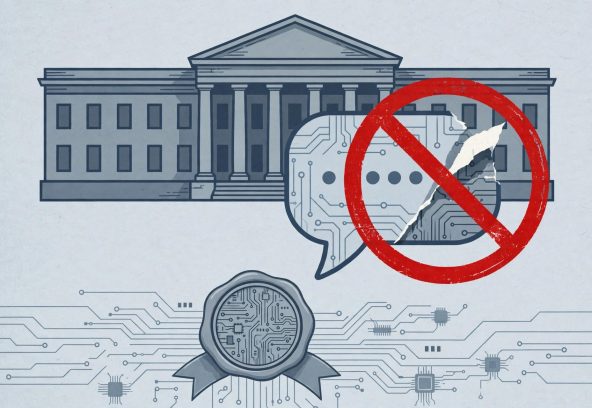
For centuries, copyright law has been built upon a fundamental premise: authorship requires a human heartbeat. In the United States, the Copyright Office has repeatedly doubled down on the stance that works generated entirely by machines—without human creative input—cannot be copyrighted.
A landmark precedent was set in the case of Stephen Thaler, whose AI-generated visual artwork, A Recent Entrance to Paradise, was denied copyright protection because it lacked “human authorship.” The courts agreed: no human, no copyright.
This creates a paradoxical legal vacuum for businesses and creators:
- If a corporation uses an AI to design a revolutionary new product logo, does that logo belong to the public domain the moment it’s generated?
- Can a competitor legally copy, paste, and profit from a commercial video game script written entirely by an LLM (Large Language Model)?
- If no one owns the output, what is the economic incentive for companies to invest billions into AI-driven workflows?
The Spectrum of “Human-in-the-Loop” Creation
The reality of AI generation is rarely as simple as typing a single sentence and hitting enter. Most professional workflows involve a complex interplay between human direction and machine execution—a spectrum known as “human-in-the-loop.”
Legal scholars and policymakers are currently wrestling with where to draw the line:
1. The Prompt Engineer vs. The Artist
Does writing a detailed, multi-paragraph prompt make someone an “author,” or is it merely giving instructions to a tool, akin to hiring an invisible digital assistant? Current legal consensus leans toward the latter. A prompt is viewed as an idea, and ideas themselves are not copyrightable—only the specific expression is.
2. Iterative Crafting and Modification
What happens when an artist generates an AI base image, paints over it, vectorizes it, collages it with traditional photography, and runs it through filters three more times? Here, the argument for human copyright becomes much stronger. The copyrighted work is not the raw AI output, but the human-modified derivative work.
“Copyright law has always adapted to new tools—from photography to digital synthesis. But generative AI breaks the paradigm because the tool is no longer passive; it makes autonomous creative choices.”
Global Jurisdictions Diverge
Adding to the chaos is a lack of international consensus. While the US maintains a strict human-authorship requirement, other nations are charting radically different paths to attract tech capital.
The United Kingdom, for instance, has long recognized copyright for “computer-generated works” where no human author can be identified, attributing ownership to the person who made the arrangements necessary for the creation of the work. Meanwhile, the European Union is pushing for strict transparency laws regarding training data, while leaving the copyright status of AI outputs largely murky and dependent on national courts.
This fragmentation creates a nightmare for multinational corporations trying to deploy AI-generated assets globally.
The Threat to the AI Revolution
Why does this copyright crisis threaten the AI revolution? Because capitalism relies on intellectual property (IP) to monetize innovation.
If venture capitalists and enterprises realize that the software, designs, and content generated by AI cannot be legally protected, licensed, or defended against infringement, investment could plummet. Why pay enterprise licensing fees for an AI tool if your competitors can legally steal and use every output the moment it is published?
Conversely, if courts swing the other way and grant broad copyright protections to raw AI outputs, we could see an unprecedented wave of copyright monopolization by big tech companies, effectively locking up vast swaths of machine-generated culture.
Conclusion: The Road Ahead
The copyright crisis surrounding AI outputs is not merely a legal footnote; it is the battlefield where the future of human creativity and commerce will be decided. Resolving it will require legislative modernization, international treaties, and a radical rethinking of what it means to “create.”
Until lawmakers and courts establish clear, modern definitions of ownership, the AI revolution will continue to operate in a legal Wild West—where everyone is racing to build the future, but no one truly knows who owns it.