


The most consequential AI order of the month was not announced when it was signed. It was signed in July, kept inside government for almost three months, and only became public on 19 October 2026, when the US Department of Homeland Security (DHS) filed a notice that federal civilian agencies must stop buying DeepSeek technology and remove DeepSeek products already in their systems.
That delay is the first thing to understand. The second is the scope: this is not a ban on DeepSeek for the American public, but a federal supply-chain order deciding what civilian agencies may buy and run — whose wording reaches beyond DeepSeek’s own app into third-party products built on its models. For any business selling software to government, that third-party clause is the part that matters most.
What happened, in plain terms
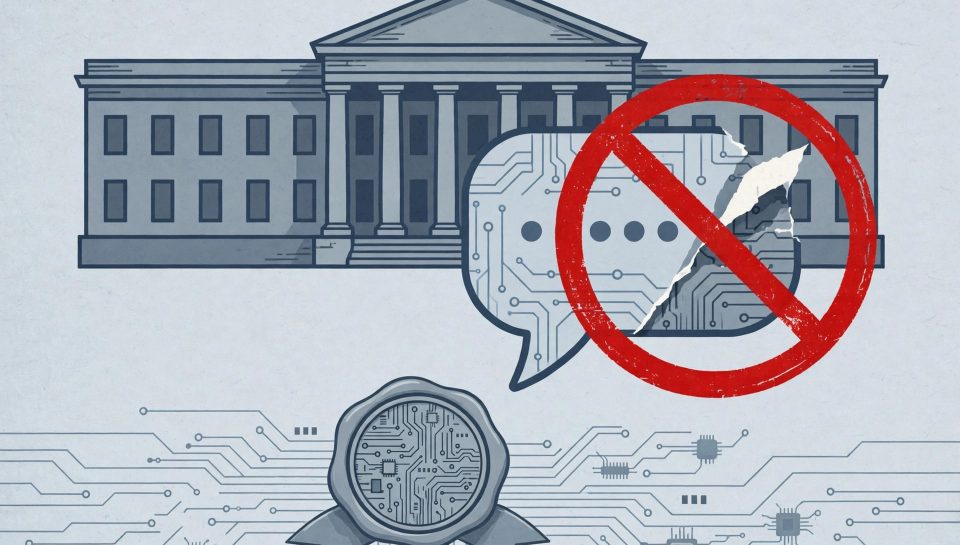
Homeland Security Secretary Markwayne Mullin signed Exclusion and Removal Order No. 2026-01 on 24 July 2026, under the Federal Acquisition Supply Chain Security Act of 2018 (FASCSA), after a recommendation from the Federal Acquisition Security Council. The Hacker News reports that DHS filed the public notice for inspection on 19 October, and the Federal Register published it on 20 October as document 2026-21447, under docket DHS-2026-0628. The order was therefore in force for nearly three months before anyone outside the executive branch could read the paperwork.
The notice does two things. First, exclusion: IT products and services developed by Hangzhou DeepSeek Artificial Intelligence Co., Ltd., including affiliated entities, are excluded from federal civilian agency procurements. Second, removal: all DeepSeek and DeepSeek-affiliate products, plus third-party products and services “developed using DeepSeek implementations,” must be removed from civilian agency IT.
That quoted phrase is the least defined part of the order. The published notice does not define what counts as a DeepSeek implementation, so agencies, vendors and lawyers must work out whether a tool that embeds, fine-tunes or routes prompts through a DeepSeek model falls inside the line. That ambiguity is the compliance problem.
Why DHS says DeepSeek is a risk
The Federal Register summary is written in dry procurement language and does not rehearse a long list of motives. Reporting on the signed order, however, quotes DHS describing DeepSeek’s models as presenting “multiple threat vectors” to civilian agency IT. TechRadar’s account says the order warns that use by government employees or vendors may result in the transfer of sensitive data to China, which, combined with public data, could produce “actionable intelligence on US persons and/or government agencies.” It also says the models “themselves may contain malware or other security vulnerabilities,” and notes open-source research finding multiple critical vulnerabilities in DeepSeek’s iOS app.
A simpler data point frames the concern: DeepSeek’s own privacy policy says it collects, processes and stores users’ personal data in China. DHS’s argument, as reported, is that data stored in China can be subject to Chinese national-security laws allowing the government to demand it. Treat that as DHS’s stated reasoning, not a proven finding about any particular product. China’s foreign ministry pushed back, telling Reuters that China “consistently opposes the over-generalization of national security as well as the politicization of science, technology and trade issues.”
Who is covered — and who is not
The order binds federal civilian executive-branch agencies — departments such as Treasury, State and Justice, and bodies such as the Internal Revenue Service, are the kinds of agencies reporting names as examples. It does not, by itself, bind the Department of Defense or the intelligence community, which operate under their own authorities and in several cases already had stricter DeepSeek restrictions. It does not cover national security systems or sensitive compartmented information systems. And it does not restrict private companies or the public: no rule in this order tells a US business to uninstall DeepSeek from its own commercial products, or tells an individual what app to use at home.
That last point is routinely lost in headlines calling this a “US DeepSeek ban.” It is a government-procurement ban. But the distinction collapses for vendors whose products are sold into civilian agencies: if your product is in a federal agency’s IT stack, the order reaches you even if your customer never bought anything directly from DeepSeek, because removal follows the model into third-party tools.
For purely commercial work, VentureBeat notes a business can, in principle, keep using DeepSeek for private customers while walling it off from government-facing work — but warns that sending export-controlled technical data to DeepSeek’s own China-hosted services could count as an export requiring a licence. That is a separate legal question, and one to take to counsel. The safe summary: the DHS order alone does not ban private use, but private use is not free of all other rules.
The three-month gap
An order signed on 24 July and published on 20 October creates an obvious problem with exceptions. Under the FASCSA regime, an agency can ask DHS in writing for an exception or compliance delay, with a “compelling justification” and proposed mitigations, and the Cybersecurity and Infrastructure Security Agency (CISA) handles those requests. Reporting says such requests had to be submitted within 60 days of issuance — and 60 days after 24 July is 22 September. On that arithmetic, the exception window had already closed weeks before the public ever saw the notice, and whatever exceptions exist were negotiated privately. Nothing in the published notice says they will be made public.
Reporting also notes no single public removal deadline: removal is directed, but the practical deadline is whatever the buying agency sets. Agencies learning of it in October should follow agency and CISA instructions.
Why the third-party clause changes everything
If the order had only banned DeepSeek’s own app and API, it would have been narrow. DeepSeek, however, releases its models as open weights. The same model can live inside another company’s product, under another company’s brand, running on another company’s servers — and a buyer may never see the name DeepSeek in the purchase paperwork.
That turns a product ban into a supply-chain audit. Agencies can no longer just check whether they bought something from DeepSeek; they must ask every AI vendor what model sits underneath the product, where it was trained, where prompts and data go, and whether any part of the pipeline touches a DeepSeek implementation. As SecurityAffairs puts it, the notice does not explain exactly what counts as a “DeepSeek implementation” — so agencies will need to ask suppliers whether their products fall under the ban.
Applying FASCSA — written for compromised hardware and backdoored software — to a frontier AI model is the step change: the “component” being excluded can be copied, fine-tuned and rebranded. Provenance, the documented lineage of a model and its data flows, becomes a procurement question in its own right. The same tightening is visible on the other side of the Pacific: days after the DHS notice, reporting showed Chinese developers including MiniMax and DeepSeek registering AI exports with China’s Ministry of Commerce, after Beijing made registration compulsory for 23 kinds of AI technology.
What this means if you are not a federal agency
Most readers are not running a US federal agency, but the order still matters. First, government customers set the template: when the world’s largest buyer asks for model lineage and data-residency statements, enterprise buyers tend to follow.
Second, the precedent is limited to DeepSeek by text, not by logic: its reasoning could be reused for another foreign model, and reporting already names Alibaba’s Qwen, MiniMax, Xiaomi’s MiMo and Moonshot’s Kimi as next candidates for scrutiny. Third, the trend converges with the agent backlash we have covered — websites and banks blocking AI agents, and Microsoft treating agents as insider threats. For businesses outside the US, including in Pakistan, the direct legal effect is nil, but if you sell into US-facing work, the order’s logic will reach you through that customer’s procurement terms.
A practical audit: five questions to ask this week
This checklist is practical guidance, not legal advice. If a federal contract is at stake, take the answers to counsel and to the buying agency.
- Inventory every model, not every vendor. List the model behind each AI feature you sell or use, including features buried inside a vendor’s product. If a vendor cannot name the model, that is itself a finding.
- Ask vendors in writing. Request a statement covering the base model and developer, whether any DeepSeek implementation is used, where prompts and data are processed and stored, and whether data leaves your environment. Keep the reply on file.
- Separate federal-facing from commercial stacks. Keep the two walled off, with no shared model endpoint, data store or credential. Mixed stacks are where a narrow ban becomes a broad problem.
- Check contracts, not just code. Look for flow-down clauses, approved-model lists and change-of-model notification duties. A vendor that swaps its underlying model without telling you can put your compliance at risk.
- Plan the replacement before you need it. Identify an alternative model for any DeepSeek-dependent feature, test it on your real workload, and record the cost and performance gap.
Two cautions: do not assume self-hosting escapes the order, since the notice does not clearly carve out a locally hosted copy; and do not assume removing DeepSeek once is enough, since supply chains change with every vendor update.
Covered vs. not covered
| Question | What the order does |
|---|---|
| Can a civilian agency buy a new DeepSeek product? | No — excluded from civilian procurement. |
| Must it remove DeepSeek already installed? | Yes — removal from civilian agency IT is directed. |
| Does it cover third-party tools built on DeepSeek? | Yes — “developed using DeepSeek implementations” are included. |
| Does it bind the Department of Defense? | No — separate authorities apply. |
| Does it ban private companies or the public? | No — it does not restrict them as such. |
| Can an agency get an exception? | In principle, by written request — but reporting says the 60-day window had closed before publication. |
| Does it name other Chinese models? | No — DeepSeek and affiliates only. |
What to watch next
Four developments will show whether this order is a one-off or a template: CISA guidance defining “DeepSeek implementations,” especially for self-hosted models; any published exception decision; parallel action on other foreign models (a bill to bar DeepSeek from government devices was introduced in Congress in February 2025, as The Neuron notes); and the commercial response, as vendors publishing clear model-lineage statements signal they expect procurement questions of this kind to spread.
The deeper shift: for years, procurement debated capability and price. The DHS order adds a third question — provenance. Where did this model come from, who can compel access to the data it touches, and can you prove the answer?
Frequently asked questions
Is DeepSeek banned in the United States?
No. It binds federal civilian agencies’ procurement and IT systems, not private companies or individuals, though other rules such as export controls can still apply.
Does the order cover tools that merely use DeepSeek under the hood?
On its face, yes: it includes third-party products “developed using DeepSeek implementations,” a phrase the notice does not define — so seek clarification rather than assume a narrow reading.
What if I run a DeepSeek model on my own servers?
That case is unclear from the published text. Do not assume self-hosting escapes the order for federal-facing work; ask the buying agency or CISA, and document the answer.
Why did it take three months to become public?
The order was signed on 24 July 2026 but filed for public inspection on 19 October and published on 20 October. The published materials do not explain the gap.
Does this affect other Chinese AI models?
Not directly — the order names DeepSeek and its affiliates only. But it establishes a FASCSA template that could, in principle, be applied to other models.
Should my business stop using DeepSeek entirely?
Not on this order alone, if you have no federal-facing work. But if you sell into government supply chains, or plan to, audit any DeepSeek dependency now and line up an alternative.
Conclusion
The DHS DeepSeek order is easy to misread as a headline — “America bans DeepSeek” — and that misreading misses the point twice over. It is narrower than a national ban, and broader than a product ban: narrower because it binds only civilian federal procurement and IT, broader because it follows the model into third-party tools that buyers may not even know contain it.
For agencies, the task is an audit with an undefined edge: find every DeepSeek implementation, including the hidden ones. For vendors, the task is transparency: say, in writing, which model powers your product and where customer data goes.
If you use AI tools day to day and want to compare them on more than marketing claims, start with a structured catalogue: our WebReOn Tools directory lists free utilities and tools in one place, and our guide to the best free AI tools for students shows the feature, pricing and data questions worth asking before adopting any tool. For the governance side of that shift, see also our recent coverage of websites blocking AI agents and Microsoft’s new AI agent controls.