Four volunteers have walked out of a simulated Mars base in Houston after 378 days in isolation, closing the latest chapter of the NASA CHAPEA Mars simulation programme. The crew of CHAPEA Mission 2 left the Mars Dune Alpha habitat at Johnson Space Center on Saturday, October 31, 2026, after entering it on October 19, 2025.
CHAPEA stands for Crew Health and Performance Exploration Analog. It is not a trip to Mars, and the crew never left Earth. It is a ground-based experiment built around a critical question: what happens to human health, teamwork and decision making when four people live for more than a year in a small habitat, on limited supplies, with messages from home delayed by up to around 22 minutes each way?
Summary: NASA’s CHAPEA Mission 2 crew spent 378 days inside a 1,700-square-foot 3D-printed habitat in Houston, growing crops, running simulated spacewalks and working under Mars-like communication delays. The mission ended on October 31, 2026, and the crew now faces two weeks of medical and performance evaluations before NASA publishes what the year of data actually shows.
Key takeaways:
- Crew entered Mars Dune Alpha on October 19, 2025, and exited on October 31, 2026, after 378 days in isolation.
- The mission tested health, performance, food systems and operations under Mars-like stressors.
- NASA says the data will feed into Artemis lunar missions and, eventually, a crewed Mars mission it hopes to fly in the 2030s.
- The exit ends data collection, not the science: results follow only after analysis.
What happened on Saturday
NASA streamed the exit ceremony live from Johnson Space Center at 3 p.m. Eastern Time on October 31. Center director Vanessa Wyche greeted the crew, and NASA astronaut Jack Hathaway joined the remarks before the four volunteers spoke.
Medical officer Ellen Ellis summed up the year in one line that travelled around the world: “It’s been a hell of a year, analog astronauts living in captivity of our own free will.” She added that the United States has a narrowing window to maintain its lead in space, urging the country to “seize the initiative, lead with science that will benefit our economy and ensure our legacy in space for our children’s children.”
Mission commander Ross Elder struck a more measured note. “For Mars, the risks are great,” he said. “But through seeking understanding, strong vision and leadership, creativity, fortitude, hard work and incredible foundation, the goal of putting humans on Mars is not only achievable, but rather inevitable.”
Wyche pointed to the communication delay as the detail that most shaped daily life. “These delays require patience, careful planning and greater independence, qualities that will be essential for future astronauts traveling millions of miles from home,” she said. The crew now faces two weeks of post-mission evaluations with NASA scientists.
Inside Mars Dune Alpha
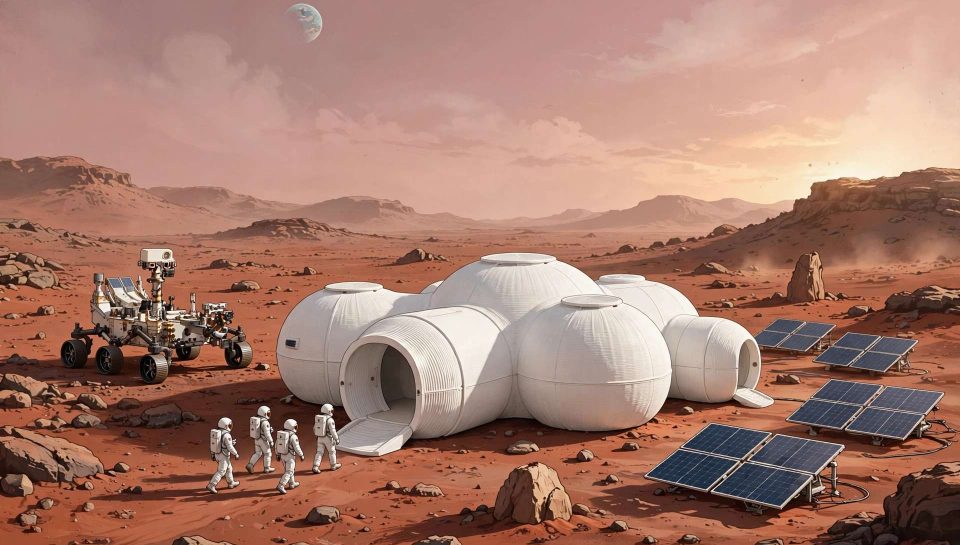
Mars Dune Alpha is a 1,700-square-foot habitat, roughly the size of a medium one-story house, built with 3D printing inside a hangar at Johnson Space Center. Each crew member had a small private bedroom, alongside shared living space, work areas, a medical bay and a plant-growing area.
Daily life was structured to feel like a real Mars surface mission. The crew grew crops in simulated Martian soil, maintained the habitat, exercised, operated robots and carried out simulated spacewalks, known as Marswalks, using virtual reality. Equipment failures and resource limits were built into the plan, so the crew had to stretch supplies and fix problems with what they had.
The communication delay is the most Mars-like feature of the experiment. A radio signal travelling between Earth and Mars takes up to around 22 minutes each way, depending on where the two planets sit in their orbits, so a question and its answer can be separated by the better part of an hour. Decisions cannot be referred back to mission control, and the crew must be trusted to act alone. NASA stresses that CHAPEA is human research first, not a technology demonstration: principal investigator Grace Douglas has described it as a deep look at what a full year on Mars would demand of people.
Meet the CHAPEA Mission 2 crew
NASA assigned the four volunteers roles that mirror a real deep-space crew, so each function of a Mars mission could be studied under isolation.
| Crew member | Role | What the role tests |
|---|---|---|
| Ross Elder | Mission commander | Decision making under long isolation |
| Ellen Ellis | Medical officer | Care with no real-time doctor on the line |
| Matthew Montgomery | Science officer | Experiments and sample work far from Earth |
| James Spicer | Flight engineer | Habitat systems with limited spares |
CHAPEA 1 and CHAPEA 2 side by side
Mission 2 is the second CHAPEA campaign in the same habitat. The first crew spent an identical 378 days inside, so the two missions together give researchers 756 days of observation, or just over 3,000 crew-days of data.
| CHAPEA 1 | CHAPEA 2 | |
|---|---|---|
| Dates | June 25, 2023 to July 6, 2024 | October 19, 2025 to October 31, 2026 |
| Duration | 378 days | 378 days |
| Commander | Kelly Haston | Ross Elder |
| Medical officer | Nathan Jones | Ellen Ellis |
| Science officer | Anca Selariu | Matthew Montgomery |
| Flight engineer | Ross Brockwell | James Spicer |
What NASA is actually studying
The research questions are practical. NASA’s Human Research Program wants to know how to keep a crew healthy, productive and able to make good decisions during a mission lasting years, and what countermeasures actually work against the risks of deep space.
Five areas dominate the data: physical health under confined living and a limited diet; behavioural health, sleep, mood and team friction over months without a break; food systems, including how much fresh food a crew can grow; operations under long message delays; and bandwidth, meaning how much data a Mars mission must send back through NASA’s Deep Space Network.
NASA says the same data will shape its nearer-term lunar plans, helping optimise food systems, crew time and communications for Artemis missions to the Moon, which are meant to come before any Mars attempt. Health monitoring in isolation is a wider question too: WebReOn recently covered how health teams track people in quarantine during the DRC Ebola outbreak.
Be precise about what has been published so far. NASA has not yet released the Mission 2 findings, and no publication date has been announced. The two weeks of evaluations now under way are the first step in analysis, not the conclusion of it. Any claim about what the mission “proved” goes beyond the evidence available today.
What a simulation cannot prove
CHAPEA has hard limits that honest coverage should state plainly. The crew lived under Earth gravity, breathed Earth air, and never faced Martian radiation, dust storms or the real danger of a spacecraft millions of miles from help. In a genuine emergency, they could have left the habitat. A real Mars crew cannot step outside for fresh air, and no simulation can reproduce that psychological fact.
The sample size is also small. Two crews of four is a start, not a population, and researchers must separate personality and group chemistry from the general effects of isolation. That is why NASA runs repeated campaigns rather than treating one mission as an answer.
What happens next
NASA’s next step is already sketched out. In a July 2026 notice, the agency announced a combined Moon and Mars Exploration Analog that merges elements of CHAPEA with its shorter HERA analog, with the first mission beginning no earlier than August 2027. The combined format will let researchers test scenarios spanning lunar and Martian operations, rather than treating the two destinations as separate problems.
The sequence beyond that runs through the Moon first. NASA has explored Mars with robotic rovers and orbiters, but its stated plan is to return astronauts to the Moon for the first time since 1972 under Artemis, and only then attempt a crewed Mars mission, which Reuters reports NASA hopes to fly in the 2030s. The technology for operating far from Earth is advancing on several fronts at once: WebReOn covered Google’s first AI reply from orbit earlier today in our report on Project Suncatcher.
Politics will shape the timetable as much as engineering, since the incoming United States Congress will have a direct say in what NASA can afford. Our guide to the 2026 US midterm elections explains what is at stake in that vote. The honest timeline is this: the debriefs have begun, the science will arrive in stages, and a human footstep on Mars remains a goal for the 2030s, not a date on a calendar.
Frequently asked questions
What is NASA’s CHAPEA mission?
CHAPEA, pronounced cha-pea-ah, is NASA’s Crew Health and Performance Exploration Analog: year-long simulations in which four volunteers live in isolation inside Mars Dune Alpha, a 3D-printed habitat at Johnson Space Center in Houston, while researchers study their health and performance.
Did the CHAPEA crew actually go to Mars?
No. The crew never left Earth. They lived in a hangar in Houston under simulated Mars conditions, including delayed communications and limited resources. The experiment studies how people cope, not how spacecraft fly.
When will NASA publish the CHAPEA Mission 2 results?
NASA has not announced a publication date. The crew began two weeks of post-mission evaluations and debriefings after exiting on October 31, 2026, and the health and performance data will be analysed before findings are released.
When will humans actually go to Mars?
NASA hopes for a crewed Mars mission as early as the 2030s, according to Reuters, but no firm date is set. Astronauts return to the Moon first under Artemis, and the next analog mission begins no earlier than August 2027.
Conclusion
Four people gave NASA a year of their lives inside a printed box in Houston, and in return the agency holds one of the richest data sets ever collected on long-duration isolation. Its value will be measured quietly, as researchers work out what 378 days of data say about food, health, teamwork and autonomy. Mars is still a long way off. This mission brought the questions into focus, and that is exactly what it was designed to do.
Sources and Further Reading
- NASA: CHAPEA mission overview — the agency’s mission page, including the Mission 2 crew and habitat details.
- NASA, October 19, 2026: Simulated Mars crew marks one year inside habitat — crew roles, daily tasks and the two-week evaluation plan.
- NASA media advisory, October 2026: Crew completion of yearlong Mars simulation — exit date, ceremony details and the follow-on analog programme.
- Reuters via The Express Tribune, November 2, 2026: Crew from NASA’s simulated Mars mission emerges after 378 days in isolation — exit reporting and crew quotations.
- The Times of India, November 1, 2026: NASA’s simulated Mars mission crew emerges after 378 days in isolation — syndicated Reuters reporting confirming dates, roles and the debrief plan.
- NASA podcast, October 2026: CHAPEA 2 audio log 4 — final crew reflections and principal investigator Grace Douglas on the study’s purpose.