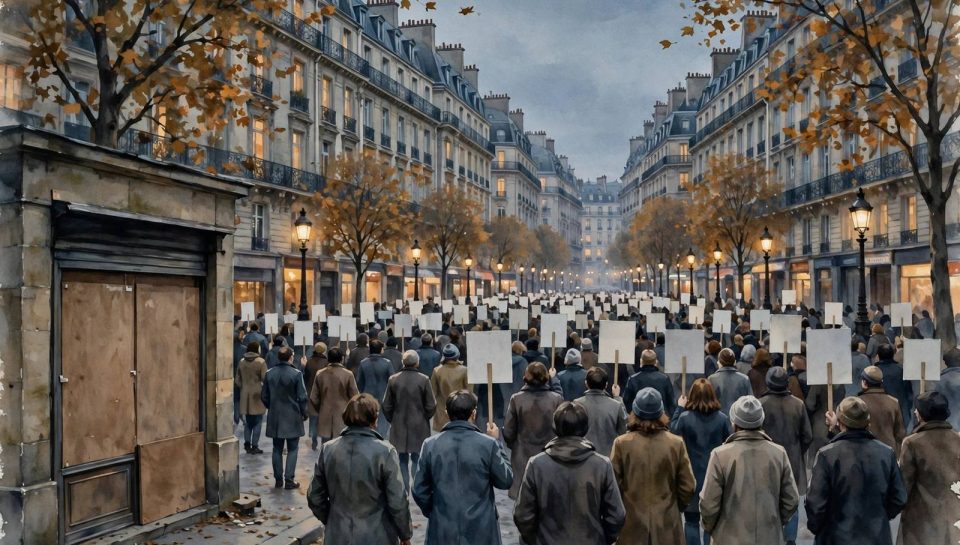
On Saturday, 31 October, hundreds of thousands of people marched across France for the third weekend in a row — some in Halloween costumes, carrying placards reading “Dressed up as an angry citizen for Halloween”. By nightfall, the Interior Ministry said 565 people had been arrested, police had fired tear gas and water cannon in Paris, Lyon and Toulouse, and an officer had been set alight by a Molotov cocktail. It was the latest chapter in an autumn of protest stretching from Lisbon to Berlin — and it is far from over, with a nationwide strike called in France for 5 November and further strike days announced in Spain, Italy, Portugal and Belgium.
This is not one movement. There is no single leader, no shared manifesto, and no coordination between countries. What the protests share is a grievance: that wages have not kept up with prices, that housing has become unaffordable, and that public services — above all schools — are visibly deteriorating. For business owners, that matters directly: the unrest is already closing shops on Saturdays, disrupting transport, and pushing governments towards policies that will land on employers, insurers and anyone who trades with Europe. Here is what actually happened, why it is spreading, and what to watch next.
What happened on Saturday in France
France’s Interior Ministry put the nationwide turnout at 320,000 people, including 70,000 in Paris, according to AFP reporting carried by Channel NewsAsia. Youth organisations gave a higher figure — nearly half a million nationwide, including 200,000 in Paris, as Al Jazeera reported. The gap between official and organiser counts is normal at large demonstrations; both figures describe a very large mobilisation, smaller than the two weekends before it.
The day began peacefully. Thousands marched through eastern Paris, some in costume. The Paris march had been pushed to the capital’s edge — a single outer-boulevard route, from Porte de Bagnolet to Porte de Charenton — after police banned city-centre marches and barred entry to Place de la République and Les Halles, both hit by rioting on 17 October, between 11 p.m. and 6 a.m. on Saturday and Sunday nights.
Clashes broke out as the procession reached its final destination. AFP journalists reported dozens of masked people in black using hammers to pry up paving stones and hurl them at police; officers responded with tear gas and baton charges. In Lyon, protesters threw projectiles at police, who fired tear gas. In Toulouse, police used water cannon against an unauthorised protest of several thousand. The Interior Ministry said “radical elements” in Bordeaux, Toulouse and Marseille had tried to enter city centres “with the aim of carrying out vandalism and looting”.
Interior Minister Laurent Nuñez said the marches had been largely orderly but denounced an “extraordinary” level of violence from some protesters, blaming far-left extremist groups. He called the Molotov cocktail attack on a riot officer in Paris an “attempted murder”, adding that the officer escaped with minor injuries. Four police officers and one gendarme were injured in Paris, three of them burned by Molotov cocktails. Far-right leader Marine Le Pen called the images of the officer in flames “unbearable” and said those responsible must be “punished with the utmost severity”.
Around 70,000 police officers and gendarmes were deployed across France, after Nuñez warned of a “very high risk” of disorder, especially after dark on Halloween. One protester, video game developer Alice Hien, told AFP that pushing demonstrations outside city centres and banning so many protests “is really an attack on freedom” — a complaint that has become a demand in its own right, as the movement broadens from living costs to civil liberties.
Three weekends, one escalating pattern
Saturday’s march was the third consecutive weekend of nationwide protest in France, and the numbers trace an arc:
- 17 October — about 550,000 marchers by government count. The day turned into some of France’s worst rioting in years, with shops looted and damage the Associated Press now puts at more than €1 billion.
- 24 October — about 410,000 marchers. Largely peaceful, but police made more than 1,300 arrests.
- 31 October — 320,000 marchers officially, with 565 arrests by late Saturday. Smaller, but still marked by serious violence on the margins.
The movement began in September with high school students protesting school conditions — teacher shortages, overcrowded classrooms and dilapidated buildings — then broadened as unions, university students and Yellow Vest activists joined, adding demands over housing, purchasing power and public services. That student core has not gone away: Student Union spokeswoman Sabrine Kharbach said students would blockade schools and universities from Tuesday and again on Thursday, before joining the union demonstration on 5 November.
The political backdrop raises the stakes. Presidential elections are less than six months away, and Le Pen is topping opinion polls, according to AFP. At the same time, as CNA notes, the eurozone’s second-largest economy is on the brink of recession and under pressure to rein in its debt, leaving the government little room to buy calm with spending. Prime Minister Sébastien Lecornu has met student unions several times this week, but no cost-of-living package has yet been announced.
Beyond France: the same anger, different streets
France has the largest rallies, but it is not alone. Across the continent, overlapping and uncoordinated protests are driven by the same pressures — inflation, housing, wages and public services — with local triggers in each country:
| Country | What is happening | Key detail reported |
|---|---|---|
| Germany | Youth-led rallies in around 30 cities (“Gen Z regelt”) | Over 160,000 expected on Saturday; demands cover education, housing, climate and opposition to conscription |
| Italy | Nationwide strike on 30 October (USB union federation) | Rome, Milan, Naples, Turin, Venice, Palermo; inflation 4.2% in September vs the eurozone’s 3.8% |
| Spain | Housing protests and a tent encampment in Madrid | Outrage followed the eviction of an 87-year-old woman from her lifelong home on 23 September after a sharp rent rise; Madrid teachers began an indefinite strike |
| Portugal | Housing demonstrations in Lisbon and Porto | House prices more than doubled since 2017; rents on new contracts nearly doubled; inflation 3.6% in September |
| Belgium | Youth protests in Brussels and Liège over education costs | Tear gas and water cannon in Brussels; 45 detained in Liège, including 12 minors |
The pattern rules out the simplest explanations: this is not a French story, a student story or a single-party story. As Geneviève Pons of the Jacques Delors think tank told CNA, sluggish economic growth is one factor feeding the discontent — the same squeeze wearing different clothes in each country. As one survey of the November calendar puts it, this is “neither a Europe-wide general strike nor a single movement coordinated across the continent”.
Governments are answering with the law, not just the wallet
With spending room tight, several governments are reaching for legal tools instead. In France, the Senate this week approved a measure, by 229 votes to 105, that would let the state recover riot damage from the families of those involved — including from housing aid — and make anyone who knowingly joins a group preparing violence liable for up to €10,000 for damage caused by others, according to Associated Press reporting. The same bill would let authorities demand removal of certain online calls to violence or looting without prior court approval, with action against platforms if posts stay up over 24 hours.
The context is the size of the bill: the AP puts estimated damage from the October unrest at more than €1 billion, with thousands of shops looted or damaged and the 19th-century city hall in Limoges gutted by fire. After the 2023 riots, insurers paid €793 million on 16,400 claims, according to France Assureurs. Italy has taken a parallel path, with 500 army troops deployed alongside police in Milan until the end of the year after looting there.
These measures are themselves becoming part of the dispute. United Nations experts have raised concern over what they describe as excessive force used by French authorities against recent student demonstrations, a warning reported on 1 November. And regulating protest calls online — Spanish fact-checker Maldita.es found calls for Halloween protests in 46 cities in at least nine European countries — raises a question that will matter far beyond France: where does stopping incitement end and restricting protest begin?
What this means for your business
If you trade with, sell into, or operate in Europe, this is an operational variable for the rest of the year. Five practical takeaways:
- Plan around the strike calendar, not just the headlines. France’s nationwide union demonstration is on 5 November, according to a published November strike calendar. Spain’s 24-hour general strike is set for 11 November; Italy’s CGIL strike and a Portuguese public-administration strike for 20 November; Portugal’s CGTP Lisbon demonstration for 21 November; Belgium’s union mobilisation for 23 November. Transport, schools, hospitals and public services face the most disruption.
- Protect the Saturday shopfront. The most immediate, measurable cost so far is lost weekend trade. In eastern Paris, café employee Wael Boubaker boarded up his storefront and summed it up: “Everyone is staying home. No one is going to come and buy anything.” If your business depends on city-centre footfall, treat protest Saturdays as closure-risk days: move promotions online, warn staff early, and check whether your insurance covers riot and civil-commotion damage — do not assume it does.
- Expect wage and price pressure to stay in the room. Every demand in this wave — higher wages, affordable housing, lower energy costs, more school funding — points the same way: upward pressure on labour costs and continued political pressure on prices. If you set prices or negotiate pay in Europe, budget for a winter in which “cost of living” is a picket-line slogan, not an abstract statistic.
- Watch the regulatory spillover. France’s riot-damage bill, Italy’s security decree and the push to take down protest calls online all signal a harder line on public order that could reach platform rules, event licensing and employer obligations. If a protest hashtag or call to action touches your brand, you should already have a plan — not improvise one mid-crisis.
- Keep your team informed, not alarmed. If you have staff or customers travelling in France, Germany, Italy, Spain, Portugal or Belgium, share practical information — strike days, restricted routes, curfew zones — rather than dramatic summaries. The large majority of these demonstrations are peaceful; the risk concentrates in specific places at specific hours, usually after dark.
What to watch next
The dates that matter:
- 3–5 November: student blockades of French high schools and universities, building towards the nationwide union demonstration on 5 November.
- 11 November: Spain’s announced 24-hour general strike.
- 20 November: Italy’s CGIL general strike and Portugal’s public-administration strike.
- 21 November: Portugal’s CGTP nationwide demonstration in Lisbon.
- 23 November: Belgium’s nationwide trade union mobilisation.
Two other things to watch: whether Lecornu’s talks with student unions produce a package strong enough to take the students, the movement’s original core, off the streets; and whether the Senate’s riot-damage bill survives the legislative process and becomes a template other governments copy.
Frequently asked questions
How big were the French protests, really?
On 31 October, the Interior Ministry counted 320,000 nationwide, including 70,000 in Paris; youth organisations claimed nearly 500,000 and 200,000 respectively. The trend across the three weekends — 550,000, then 410,000, then 320,000 officially — suggests mobilisation is easing but remains very large.
Is it safe to travel to Paris or other European cities right now?
Most demonstrations are peaceful and concentrated in specific areas, often city centres and, for the worst disorder, after dark. Check local transport and police guidance for the day you travel, avoid protest routes and curfew zones, and expect disruption on strike days. This is not travel advice — check your government’s official guidance before you go.
Will the unrest affect prices or the economy?
It already is, at least locally: closed shops, disrupted transport and higher insurance claims are real costs. Nationally, the question is whether governments respond with spending (constrained by debt and recession risk in France), wage measures, or tougher public-order laws. None of those paths is quick, so plan for disruption into the new year, not a single bad weekend.
The bottom line
Europe’s autumn of protest is not a single event to be filed away, but a season — and seasons change policy. The students who started it wanted better schools. The crowds that joined them want a life their wages can actually pay for. Governments, squeezed between debt, recession risk and elections, are answering with talks, troops and bills that make someone else pay for the damage. The practical response is unglamorous: know the strike dates, protect the shopfront, check the insurance wording, and watch 5 November. That is the day we find out whether France’s streets are winding down — or just warming up.
Tools that keep working when the news does not: WebReOn Tools (17 free browser tools) and WebReOn Chat (several AI models in one workspace). Students may also like our guide to the best free AI tools for students. For the wider picture, see our Strait of Hormuz draft deal and our tampered Claude Code extension.