


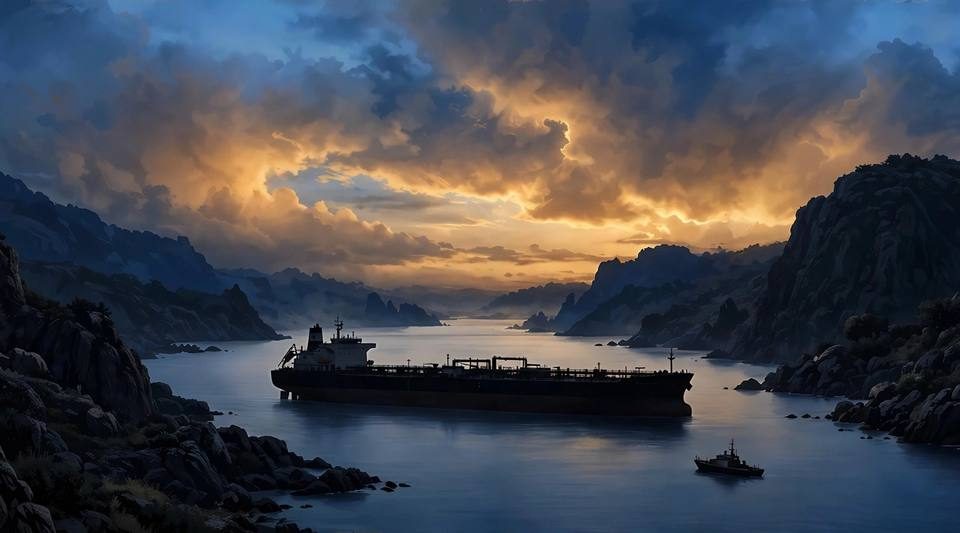
On Saturday, two contradictory stories arrived from the same narrow stretch of water — and both could be true at once. In Doha, mediators were reported to be carrying a draft framework that could reopen the Strait of Hormuz within seven days. At sea, tankers were catching fire, a crew of 25 was being pulled off a burning ship by Oman’s navy, and the United States and Iran were publicly disagreeing about whether the world’s most important oil chokepoint is mined, clear, or something in between.
That contradiction is the story. The Strait of Hormuz is only about 39 kilometres wide at its narrowest point, yet roughly a fifth of the world’s oil normally passes through it. When it is disrupted, the effects do not stay in the Gulf: they show up in freight rates, in Brent crude above $110 a barrel, and eventually in fuel, food and manufacturing costs thousands of miles away. This article separates what is confirmed, what is reported, and what is still disputed — and explains what each possible outcome would mean for your business.
The draft deal, as reported
The most consequential report of the weekend came from Al Arabiya English, which said it had obtained the key points of a preliminary draft framework for negotiations between the United States and Iran. According to that reporting, the framework proposes transferring Iran’s highly enriched uranium stockpile to a mutually agreed third country, or reducing its enrichment level, while reopening the Strait of Hormuz to international maritime traffic within seven days of an initial understanding. The New Indian Express carried the Al Arabiya report, noting that China could potentially act as a guarantor for the implementation and sustainability of any agreement.
Several elements of the reported framework are worth noting because they reveal how a deal would actually have to work. First, it is phased: concessions from either side would be linked to independently verified commitments from the other, rather than delivered all at once. Second, it includes a dispute-resolution mechanism involving mediators and guarantor parties, designed to deal with delays or violations before they trigger renewed military escalation. Third, the venue matters: direct US-Iran negotiations would be held in Doha rather than Istanbul, and Iranian negotiators were reported to have flown to Doha for further talks with Qatari mediators. UNI reported that a US delegation was expected to join them, citing the Qatari newspaper Al-Araby Al-Jadeed and mediation efforts led by Qatar and Pakistan.
There is also a reported American gesture behind the diplomacy. According to the same coverage, a letter from US Vice President JD Vance to Iranian security official Mohsen Rezaei, delivered by Qatari envoys, was welcomed in Tehran as proposing a fresh diplomatic pathway to prevent further American military strikes. None of this is confirmed by either government as a signed agreement.
Two versions of the same strait
While diplomats talked, the waterway itself told a messier story. On Friday, Oman’s Maritime Security Centre said its navy had evacuated 25 crew members from the Panama-flagged merchant ship RITI after it was attacked and caught fire; the crew received medical care, and ship-tracking data identified the vessel as a crude oil tanker. Khaleej Times reported the rescue alongside Iran’s statement that three oil tankers had been halted while crossing the strait.
Iran’s Islamic Revolutionary Guard Corps (IRGC) said the tankers had tried to use a route it considers unauthorised — a southern corridor closer to Oman’s shores — after switching off their navigation and positioning systems, and that they encountered incidents, including what it described as mine strikes. In a later statement, the IRGC said a supertanker carrying two million barrels of oil had stopped after an explosion following a mine strike on that route. A day earlier, Iran’s armed forces had said at least four tankers had stopped in the area after hitting mines.
US Central Command (CENTCOM) tells a different story. Its chief, Admiral Brad Cooper, said in a video released on Friday that US forces had “successfully cleared the strait’s internationally recognised primary transit routes of Iranian sea mines” and remain present to keep them free and clear. CENTCOM has called Iran’s mine reports false, and says more than 3,000 commercial vessels have transited the strait with US support over six months, helping Gulf partners export more than 1.5 billion barrels of crude since the summer.
Both accounts cannot be fully right, and the honest position is that the truth is probably partial on both sides. Independent maritime monitors have confirmed separate incidents off Khasab, Oman — including vessels burning and sinking — but have not confirmed mines as the cause, using terms like “projectile” and “undetermined cause” instead. The British maritime security agency UKMTO reported a vessel 40 nautical miles south of Iran’s Lavan Island struck by an unknown projectile that caused a fire. What is confirmed is that ships are being hit; what caused each hit, and on which route, remains disputed.
Why this waterway moves your fuel bill
The Strait of Hormuz matters because there is no cheap substitute for it. Before the war that began on 28 February with US-Israeli strikes on Iran, roughly 17 million barrels of oil a day moved through the strait. Recent readings put flows at around 11–12 million barrels a day — roughly 70% of the pre-war baseline — with bypass routes and ship-to-ship transfers in the Gulf of Oman making up part of the gap. The International Energy Agency’s October report put Hormuz flows at about 10.9 million barrels a day, with roughly another 970,000 barrels a day bypassing the strait.
The cost of moving that oil has exploded. Goldman Sachs reportedly estimates that average global crude freight has risen to around $20 a barrel, from about $3 a barrel a year ago — a sevenfold increase. Its breakdown attributes roughly $7 of that to a Hormuz war-risk premium, $4 to ship-to-ship transfers, $4 to higher maritime fuel prices, $3 to inefficient tanker allocation and diversions, and $2 to restrictions on the Iranian tanker fleet. The Economic Times carried the Goldman analysis, which also noted Brent crude trading around $111 a barrel and war-risk insurance reaching 10% of a cargo’s value, up from about 3% before the war.
At the extreme end, very large crude carrier (VLCC) rates on the Saudi Arabia–China route hit an all-time high of $1.33 million per day, according to Lloyd’s List, while the Joint Maritime Information Centre put commercial transits through the strait in single digits per day against a pre-war baseline of roughly 138. That is the paradox of the current moment: headline export volumes have partly recovered, yet the logistics chain carrying them is anything but normal. Citigroup described the recovery as “volumetric rather than logistical” — producers can load cargoes again, but those cargoes no longer move through the normal low-cost delivery chain. When freight alone adds $20–35 a barrel to delivered crude, the pain eventually reaches petrol stations, airlines, manufacturers and importers everywhere — including in Pakistan, where fuel prices feed directly into transport and food costs.
The politics around the table
The diplomacy is unfolding against a hard political deadline: the US midterm elections on Tuesday, 3 November. Regional governments have anticipated that President Donald Trump, who has held off on strikes during the run-up to the vote, could restart attacks once voting is over. US Secretary of State Marco Rubio, speaking at a G20 foreign ministers’ meeting in Atlanta on Saturday, said Trump “hasn’t made a decision” on fresh strikes — but added that the United States “can achieve military objectives if we seek to” and would prefer a diplomatic solution. The Times of Israel reported Rubio’s remarks, including his statement that he would not characterise the progress of talks or any timeframe for them.
Rubio also said something easy to miss: that diplomatic contacts with Iran have “never stopped”, taking place both directly and, more frequently, through intermediaries. That reframes the weekend’s reports — not as a sudden breakthrough from silence, but as the surfacing of a channel that has been running throughout. At the same time, pressure is building from the other direction. Axios reported that Israeli Prime Minister Benjamin Netanyahu is pressing Trump for a joint military operation against Iran immediately after the midterms, while Iran’s Supreme Leader Mojtaba Khamenei on Saturday ordered senior commanders to respond to any new attack with what was described as an “immediate, effective, and unrestricted geographical response”. The National’s coverage of Rubio’s G20 remarks also noted the divisions at the summit itself, where European representatives objected to Russia’s presence strongly enough that the traditional group photo was skipped.
The wider picture reinforces why the stakes extend beyond the Gulf. The Straits Times’ overnight roundup noted that the EU and Canada announced a new alliance on 30 October, including a €90 billion support loan for Ukraine, and that the US approved a $2.1 billion sale of 500 Patriot missiles to Kyiv. The world’s major powers are simultaneously rearming allies, redrawing partnerships, and negotiating over the strait — and businesses should expect volatility across all three fronts at once.
Three ways this week could go
| Scenario | What would signal it | Likely market effect |
|---|---|---|
| A Doha understanding holds | Direct talks announced; Hormuz transits rise; mine warnings fade | Freight and war-risk premiums unwind; Brent eases from $110+ |
| Stalemate drags on | Talks continue with no agreement; incidents continue sporadically | Freight stays near $20/bbl; costs stay embedded in fuel and goods |
| Strikes resume after the midterms | US or Israeli action; Iranian retaliation against shipping | Sharp oil spike; shipping disruption; regional escalation risk |
No scenario can be assigned a probability with confidence today. What can be said is that the market is currently priced for the middle scenario: expensive, dangerous, but functioning. Either of the other two outcomes would move prices sharply, in opposite directions.
What businesses should actually do
- Budget for fuel volatility, not a single price. If your costs depend on diesel, petrol, freight or imported goods, plan around a range — with Brent above $110 and freight adding $20+ a barrel — rather than assuming today’s price holds.
- Build lead time into Gulf-linked supply chains. Ship-to-ship transfers and naval-escort convoys have stretched round trips from about 10 days to roughly 23 days on some routes. Order earlier and hold a little more buffer stock where you can.
- Watch transits, not just headlines. Daily Hormuz transit counts and VLCC day rates are the earliest real-world signals of whether the strait is normalising or deteriorating — they move before official statements do.
- Use AI tools to track fast-moving news. A daily briefing habit — for example, asking an assistant to summarise overnight shipping and energy headlines each morning — beats reacting to each alert. WebReOn Chat and the free utilities in WebReOn Tools can help you build that routine without adding another subscription.
- Do not mistake a draft for a deal. The reported framework is preliminary and unconfirmed. Treat any “deal announced” headline as unverified until both governments confirm it — markets have already had a brutal week on AI-spending doubts, and a false dawn on Hormuz could whipsaw prices just as fast.
Frequently asked questions
Is the Strait of Hormuz closed?
Not formally, and not completely. Iran has restricted traffic and demanded vessels use designated routes since the war began, and commercial transits have fallen sharply — but oil still flows, under naval escort and via bypass routes. The dispute is over how safe the recognised routes are, not whether any ship moves at all.
Has the US-Iran deal been agreed?
No. What has been reported is a preliminary draft framework, not a signed agreement. Its key points — uranium transfer or dilution, Hormuz reopening within seven days, Doha talks, and possible Chinese guarantees — come from Al Arabiya’s reporting and have not been confirmed by either government.
Will oil prices fall if a deal is reached?
Probably, but not instantly. Freight and insurance premiums unwind only when shipowners and insurers believe the route is genuinely safe over time. Expect a fast initial move in crude, followed by a slower normalisation of shipping costs.
What should ordinary readers watch for next?
Three things: whether direct US-Iran talks in Doha are formally announced; whether daily Hormuz transits rise back toward pre-war levels; and what happens after Tuesday’s US midterms, when the political constraint on renewed strikes lifts.
The bottom line
The Strait of Hormuz this weekend is a study in how modern crises work: a draft deal and a burning tanker on the same day, two governments describing the same waterway in opposite terms, and a market charging $20 a barrel just to move oil through the uncertainty. The draft framework, if it holds, offers a genuine off-ramp — uranium out, shipping back, verification at each step. But it is still only a draft, the mines are still disputed, and the decision that matters most has, by Washington’s own account, not yet been made. For businesses and households alike, the prudent move is the same: plan for volatility, watch the ships, and wait for confirmation before celebrating a peace that has not yet been signed.


