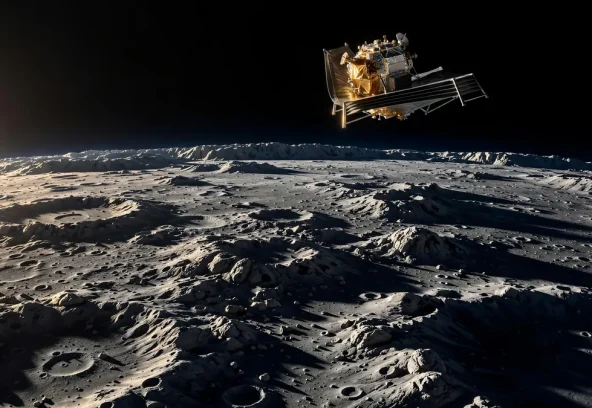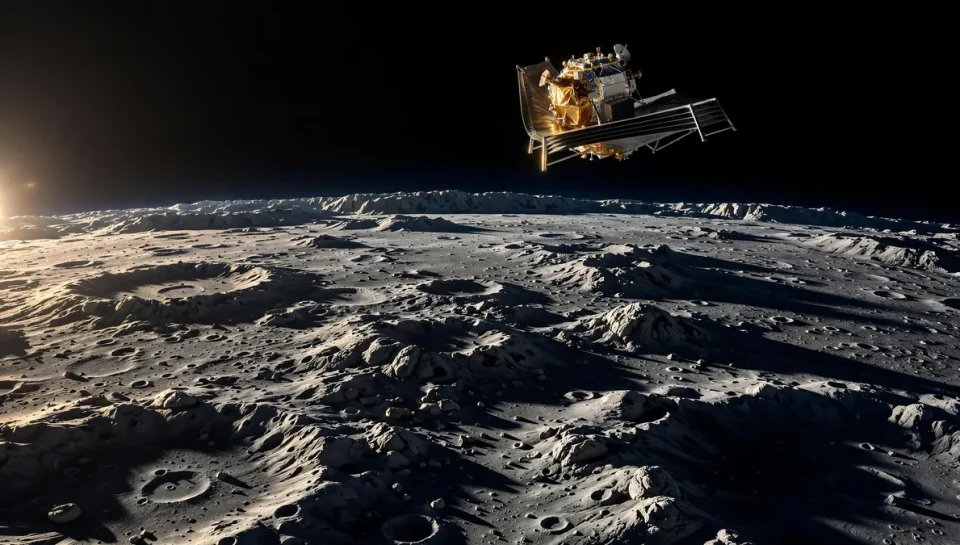
After eight years in space, the European and Japanese BepiColombo mission entered Mercury orbit on Saturday 21 November 2026. The European Space Agency confirmed the capture after its mission control team at the European Space Operations Centre in Darmstadt, Germany, received the spacecraft’s signals and analysed the first data. BepiColombo is only the second mission ever to orbit Mercury, and once its two orbiters separate in December it will be the first to fly two spacecraft around the planet at the same time.
The arrival ends one of the longest and most demanding journeys in planetary exploration. BepiColombo launched on 20 October 2018 and travelled nearly 10 billion kilometres through the inner Solar System, using nine planetary flybys to shed speed on its way to the Sun’s closest planet. The science does not start yet: the two orbiters stay joined together for now, separate on 9 to 10 December, and begin their science operations on 6 April 2027.
Key takeaways
- BepiColombo entered orbit around Mercury on 21 November 2026, confirmed by ESA after several hours of checks at its control centre in Darmstadt, Germany.
- Four thrusters on ESA’s Mercury Planetary Orbiter fired to slow the spacecraft enough for Mercury’s weak gravity to capture it into an elliptical polar orbit of 590 by 11,640 kilometres.
- ESA’s Mercury Planetary Orbiter and JAXA’s Mio stay joined until they separate on 9 to 10 December 2026.
- Science operations begin on 6 April 2027, after the Mercury Planetary Orbiter descends to its low final orbit by March 2027.
- The mission will study Mercury’s oversized core, its magnetic field, polar water ice and its surface, including southern regions that NASA’s MESSENGER never mapped well.
What happened on 21 November
The Mercury orbit insertion was planned for 18:24 UTC on Saturday 21 November. Four of the Mercury Planetary Orbiter’s thrusters fired to slow the spacecraft stack as it approached Mercury’s south pole on the planet’s night side, letting Mercury’s weak gravity capture it into orbit. ESA said the spacecraft initially entered an elliptical polar orbit measuring about 590 by 11,640 kilometres.
Confirmation took several anxious hours. At the time of the burn, BepiColombo was about 152 million kilometres from Earth, and flight controllers in Germany had to pore over the data streaming back before they could be sure the capture had worked. Early on 22 November, ESA Operations posted that flight dynamics had confirmed orbital capture and that the spacecraft was back in contact with the ground, with teams assessing the telemetry.
BepiColombo is only the third spacecraft to visit Mercury at all. NASA’s Mariner 10 flew past the planet three times in the mid-1970s, and NASA’s MESSENGER entered orbit in 2011, worked until 2015 and then crashed into the surface after running out of fuel. BepiColombo is the first visitor to Mercury in more than a decade, and the mission is named after Giuseppe “Bepi” Colombo, the Italian mathematician who worked on the Mariner 10 team.
Why reaching Mercury took eight years
Mercury is the closest planet to the Sun, but it is one of the hardest to reach. A spacecraft falling towards the Sun picks up speed, so BepiColombo had to brake for most of its journey rather than accelerate. It did that with a slow, looping route: one flyby of Earth, two of Venus and six of Mercury itself, each pass using the planet’s gravity to adjust its speed and direction. All those loops put more than 10 billion kilometres on the odometer.
The journey also ran almost a year late. An electrical issue affecting the spacecraft’s ion thrusters limited their thrust and pushed the arrival back, and the mission team replanned the cruise around the reduced power. The final step before arrival came on 3 September 2026, when the Mercury Transfer Module, the propulsion stage that had carried the two science orbiters for eight years, separated from the stack and left them to make the final approach on their own. It is a different kind of long journey from the one NASA’s Voyager 1 is on: that spacecraft recently became the first human-made object more than one light-day from Earth, still travelling outward after nearly half a century in space.
Two orbiters, two jobs
BepiColombo is really two spacecraft travelling as one. ESA’s Mercury Planetary Orbiter is the surface-facing half: it carries 11 instruments, including cameras, spectrometers, a laser altimeter, a magnetometer and a radio science experiment, and it will study Mercury’s surface, interior and composition. JAXA’s Mercury Magnetospheric Orbiter, known as Mio, is the space-weather half: it spins at about 15 revolutions per minute and swings far out from the planet to study Mercury’s magnetic environment and how it interacts with the solar wind.
Flying together, the pair can measure the magnetosphere from inside and outside at the same time, something a single spacecraft cannot do. Lead project scientist Geraint Jones said the mission will provide the ability to compare unprecedented measurements taken by two spacecraft at the planet at the same time. Mio carries five instrument groups, with 15-metre wire antennas and 5-metre magnetometer booms that must be extended over about a month after separation.
After the two orbiters separate on 9 to 10 December, Mio will settle into its own elliptical orbit, tracing paths between about 500 and 11,000 kilometres above the surface. The Mercury Planetary Orbiter will then perform many more burns over the following months, gradually descending until it reaches its final science orbit, between about 400 and 1,500 kilometres, by March 2027. The commissioning phase continues through March, and science operations for both spacecraft begin on 6 April 2027.
What BepiColombo will study
Mercury is the least understood planet in the inner Solar System, and it holds several puzzles that a single orbiter could not solve. The mission’s science goals cluster around five questions: where Mercury came from, whether there is really water on the planet, whether Mercury is geologically dead or alive, why it is so dark, and why it has a magnetic field at all.
The biggest question is Mercury’s interior. The planet is more massive than you would expect for a body of its size, which means it has an oversized iron core taking up most of its volume. The leading theory is that Mercury was hit by something very large in the distant past and its outer rocky mantle was stripped away. The Mercury Planetary Orbiter’s radio link, accelerometer, laser altimeter and magnetometer will all help probe the interior and how it generates the planet’s magnetic field, the only global magnetic field on a rocky planet besides Earth’s.
Water is the second surprise. Radar data point to water ice sitting in permanently shadowed craters near both poles, even though daytime temperatures on Mercury can pass 427 degrees Celsius. MESSENGER mapped the north polar region well but covered the south poorly, so BepiColombo’s orbit should give much better southern coverage, and its cameras and spectrometers will scan the polar regions for ice. A modelling study published in May 2026 suggested that one large impact, comparable to the one that formed Mercury’s Hokusai crater, could have spread water vapour around the planet and trapped much of it in polar craters.
The mission will also map a surface shaped by massive impact craters, volcanoes, cliffs and vast volcanic plains, with mountain ridges rising as high as 4.5 kilometres, and look for anything that has changed since MESSENGER visited a decade earlier. One curiosity the team hopes to revisit is MESSENGER’s own resting site: when the NASA spacecraft ran out of fuel in 2015, it struck Mercury at about 3.9 kilometres per second, and NASA estimated the crater it left at about 16 metres wide. The Mercury Planetary Orbiter could image that site.
En route, the mission already proved some of its instruments work. Scientists pointed the Mercury Imaging X-ray Spectrometer, known as MIXS, at the Crab Nebula, the remnant of a supernova seen from Earth in 1054. MIXS is the first X-ray imaging device ever sent on an interplanetary mission.
From launch to science: the road ahead
| Date | Milestone |
|---|---|
| 20 October 2018 | BepiColombo launches on an Ariane 5 rocket from Kourou, French Guiana |
| 3 September 2026 | Mercury Transfer Module separates from the two science orbiters |
| 21 November 2026 | Mercury orbit insertion confirmed: BepiColombo is captured into a 590 by 11,640 kilometre orbit |
| 9 to 10 December 2026 | Mercury Planetary Orbiter and Mio separate and take up their own orbits |
| 16 December 2026 | Mercury Planetary Orbiter releases Mio’s sunshield, then starts lowering its orbit |
| March 2027 | Mercury Planetary Orbiter reaches its final science orbit, 400 to 1,500 kilometres |
| 6 April 2027 | Science operations begin for both orbiters |
There are still risks in the months ahead. The spacecraft operates in sunlight up to 10 times as intense as at Earth, and keeping the spacecraft and its instruments as cool as possible is a huge technical challenge in itself, according to Jones. Each separation event leaves holes in the thermal coverings that must close again. Ignacio Tanco of ESA’s Inner Solar System Missions Unit warned that if they do not close, the impact could be severe, and the team has rehearsed contingency procedures for the separations.
ESA will brief journalists on the arrival on Friday 27 November, in a hybrid media briefing held online and at the Science Museum in London. The mission is designed to keep going for at least one Earth year, the equivalent of four Mercury years, and its two-spacecraft view of the innermost planet should finally give scientists the paired measurements they have waited eight years for. The arrival caps a remarkable week for science, which also brought Google’s Willow quantum result and a machine-checked proof of the Riemann hypothesis. For a planet that has had only three visitors in half a century, that is a long-overdue close look.
Frequently asked questions
When did BepiColombo reach Mercury?
BepiColombo entered Mercury orbit on Saturday 21 November 2026. ESA confirmed the capture after its control centre in Darmstadt, Germany, received the spacecraft’s signals and analysed the first data. The insertion burn was planned for 18:24 UTC.
Why did the journey take eight years?
Mercury is close to the Sun, so a spacecraft falling towards it picks up speed and risks flying straight past. BepiColombo had to slow down, using one Earth flyby, two Venus flybys and six Mercury flybys to shed speed, plus an electrical issue with its ion thrusters that delayed arrival by almost a year.
When will BepiColombo start doing science?
Science operations begin on 6 April 2027. Before that, the two orbiters separate on 9 to 10 December 2026, and the Mercury Planetary Orbiter spends several months descending to its final low orbit of 400 to 1,500 kilometres.
Was BepiColombo the first spacecraft to orbit Mercury?
No. It is the second mission to orbit Mercury, after NASA’s MESSENGER, which orbited from 2011 to 2015. BepiColombo is the first mission to fly two spacecraft around Mercury at the same time, and only the third spacecraft to visit the planet at all, after Mariner 10 and MESSENGER.
Sources and Further Reading
- ESA — BepiColombo entering orbit around Mercury
- ESA — Media invitation: briefing on BepiColombo arrival at Mercury on 27 November
- Sky and Telescope — BepiColombo Arrives at Mercury After 8-Year Odyssey, 21 November 2026
- Nature — BepiColombo finally reaches Mercury after eight-year odyssey, 21 November 2026
- Gulf Times — ESA announces successful insertion of BepiColombo mission into Mercury Orbit, 22 November 2026
- Arab News (Associated Press) — Little Mercury gets its first visitor in years as a pair of spacecraft loop into orbit, 22 November 2026
- EarthSky — BepiColombo went into orbit around Mercury yesterday!, 22 November 2026