


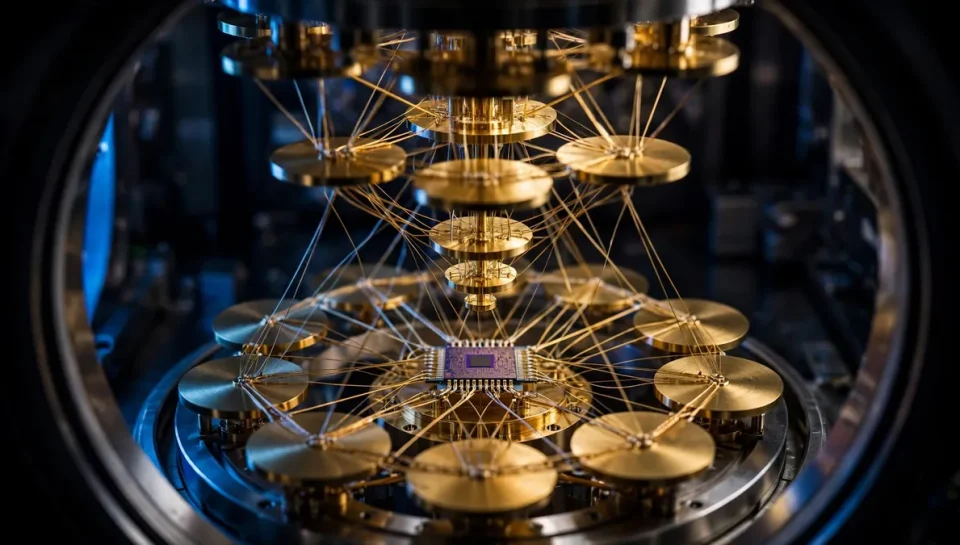
Google Quantum AI has shown that quantum contextuality, a property many physicists believe powers certain quantum algorithms, survives at scale on its Willow superconducting processor. In research published on the cover of Science on 19 November 2026, the team won a coordination game 98.3 percent of the time, far above the 88.9 percent ceiling for any classical strategy, and beat classical limits in tests running on up to 105 qubits. The result is a hardware benchmark rather than a useful quantum computer, but it gives engineers a sensitive new way to measure and improve real quantum chips.
Key takeaways
- Google Quantum AI published peer-reviewed research on the cover of Science on 19 November 2026, showing quantum contextuality at scale on its Willow processor.
- In the Mermin-Peres magic square game, four qubits won 98.3 percent of the time against a classical ceiling of 88.9 percent, over 900,000 trials.
- A Kochen-Specker-Bell test scored 5.618 against a classical bound of 4.0 and a quantum ceiling of 6.0.
- Multi-player parity games beat the classical win rate at every size tested up to 71 qubits, and a hidden linear function task returned valid answers more than half the time at up to 105 qubits.
- The work is a benchmark for quantum hardware, not a working quantum advantage for real problems, and the size of any advantage in the largest test remains an open question.
What quantum contextuality means
Entanglement usually gets the spotlight when people explain what makes quantum computers different. Google’s paper turns to a deeper property called contextuality. In simple terms, contextuality means that a quantum system’s properties are not fixed in advance. What you measure depends on which other compatible measurements you make alongside it. A measurement result has no preassigned value waiting to be read off; the context of the measurement is part of the outcome.
Theorists have long argued that this property, rather than entanglement alone, is what powers certain quantum algorithms. It is also the resource behind so-called magic states, the special quantum states needed for fault-tolerant quantum computing. Until recently, though, contextuality had mostly been demonstrated in small systems of just a few particles. The open question was whether the effect would survive as engineers scaled up to dozens or hundreds of qubits on noisy real hardware. Google’s answer, published in Science, is that it does.
The work was first posted as a preprint in December 2025. The November 2026 development is peer-reviewed publication in a journal, not a new experiment, and the article should be read in that light: the tests are now validated science, and the numbers below are the published results.
The magic square game: 98.3 percent against a classical ceiling
The clearest experiment in the paper is a coordination game called the Mermin-Peres magic square. Two players are given separate assignments on the same three-by-three grid. A referee picks a row for one player and a column for the other. Each player fills their three squares with either plus one or minus one. The row must contain an even number of minus signs, and the column must contain an odd number. The row and column share exactly one square, and to win, both players must put the same number in that square, without communicating and without knowing which row or column the other player was assigned.
The rules contain a built-in contradiction. A fixed answer for each square cannot satisfy every row and every column at once: the rows demand an even total and the columns demand an odd total for the same grid. The best any classical strategy can do is win on eight of the nine equally likely assignments, a ceiling of 88.9 percent.
Google gave each player one qubit from each of two entangled pairs, four qubits in total. Depending on the assignment, each player made a different set of measurements on their two qubits, and entanglement linked the results so the answers agreed at the shared square far more often than any classical plan allows. The team ran each of the nine assignments 100,000 times, 900,000 trials in total, and won 98.3 percent of the time, with an uncertainty of plus or minus 0.01 percent. In an ideal, error-free system the quantum strategy would win every time; the gap from 100 percent reflects real hardware errors, which is itself part of the point.
A second, sharper test: the Kochen-Specker-Bell score
The team measured the same property a second way, using the same grid arrangement of rows and columns. They carried out sequences of measurements on two qubits, using a third qubit as an ancilla to record the results without disturbing the register. On this Kochen-Specker-Bell test, any model in which every measurement has a fixed value independent of what else is measured can score at most 4.0. The quantum ceiling is 6.0. Willow scored 5.618, plus or minus 0.005, across 540 sequential quantum nondemolition measurements. The team attributed the gap from the ideal score to experimental errors.
The two tests together make the claim hard to dismiss. The magic square game shows the effect in a coordination task with a precise classical limit, and the Kochen-Specker-Bell score quantifies the effect directly. Both point the same way: contextuality is present on the hardware, and it can be measured.
Scaling up: 71 qubits in a team game, 105 in a maths problem
The more important question was scale. The team ran a multi-player parity game, the Greenberger-Horne-Zeilinger game, in which each player receives a zero or a one and returns a zero or a one, with the referee guaranteeing that the number of ones sent out is even. The players win when the parity of their answers matches a rule set by the inputs. With error-free hardware, a shared GHZ entangled state would produce the right combination every time. The classical ceiling is 75 percent with three players and decays toward 50 percent as players are added. On Willow, the winning rate stayed above the classical ceiling at every size tested, up to 71 qubits, although the margin shrank as the team added qubits. In a separate analysis, the researchers verified that as many as 45 qubits were genuinely entangled as a group.
The final experiment moved from games to a mathematical problem, the two-dimensional hidden linear function. The chip received a table of zeros and ones specifying a set of relationships, and had to return a string satisfying them. Running four layers of operations linking neighbouring qubits, Willow returned valid answers more than half the time at every size from 9 to 105 qubits. A 2018 theoretical study showed that, for sufficiently large versions of this problem, a quantum circuit can solve it in a fixed number of layers while a restricted kind of classical circuit needs more layers as the problem grows. That proof gives a meaningful comparison at tens of thousands of qubits. For the experiments at up to 105 qubits, the team proposed an estimate of the classical requirement, and that estimate rests on a conjecture. The size of any quantum advantage in this largest test is therefore an open question, and this article does not present it as a proven advantage.
Why this matters for building better quantum computers
The most practical value of the work is as a benchmark. The tests are sensitive to small, systematic errors in how the chip carries out its instructions. Because the structured parity and hidden-function tests require exact agreement across many qubits, they expose small coherent over-rotations that tests based on randomly chosen operations tend to average out. Google reports that the larger experiments detected errors that had escaped those random-operation tests. That makes contextuality tasks a fixed physical ceiling against which future processors can be calibrated, and a way to track hardware improvements over time: the narrowing winning margin at 71 qubits is itself a measure of the gap engineers need to close.
There is also a longer-term thread. Contextuality is linked to the non-Clifford magic states that fault-tolerant quantum computing needs, and the paper’s editor summary notes a Perspective by Barbosa in the same issue of Science. Google says the tests could help pave the way for real-world applications such as chemistry and materials science, where structured quantum simulations matter. That is a direction of travel, not a result delivered today.
The result also sits in a wider research picture. Quantum computing is the reason researchers are stress-testing today’s encryption: our earlier report on DeepMind’s analysis of RSA-1024 encryption weaknesses explains why the field takes the long-term threat seriously, and Google DeepMind has already used AI agents to formally verify Signal encryption code against that future. Willow’s benchmark does not change encryption today, but it is part of the same steady advance in quantum hardware that makes the verification work worth doing.
What this result is not
Three limits deserve plain stating. First, this is not a useful quantum computer, and it is not a demonstration of quantum advantage for a real problem. The test circuits are Clifford-based, which means they can be simulated efficiently on a classical computer with tools such as Stim. The quantum edge here is in beating classical limits on specific coordination tasks, not in solving a practical problem faster than a classical machine.
Second, the magic square game itself has no practical use. It is a diagnostic instrument, like a tuning fork: it tells engineers how well the hardware holds a delicate quantum property, and it does not do useful work on its own. The hidden linear function task is closer to a real computation, but its advantage claim at 105 qubits is explicitly conjectural.
Third, the news is the peer review, not a breakthrough announced this week. The experiments were shared as a preprint in December 2025, and the Science publication on 19 November 2026 is the field’s formal validation. That is how fundamental physics moves: a striking laboratory result, a year of scrutiny, then publication. Peer-reviewed results of this kind are the backbone of science coverage, as in our report on the LHCb observation of the rarest particle decay, another laboratory result that reached the journals before it reached the headlines.
Frequently asked questions
What is quantum contextuality in simple terms?
It is the idea that a quantum measurement does not simply reveal a value that was already there. The result depends on which other measurements are made at the same time. Two measurements that can be made together form a context, and the outcome of one can change with the context, even though nothing was communicated between them.
Does this mean Google has a working quantum computer?
No. Willow is a research processor, and these experiments are benchmarks, not useful computations. A working quantum computer that solves real problems faster than classical machines would need far more qubits, far lower error rates, and fault-tolerant error correction. This result shows that a key quantum property survives at scale on real hardware, which is a step toward that goal, not the goal itself.
Why does the 105-qubit result come with a caveat?
The hidden linear function experiment returned valid answers more than half the time at up to 105 qubits, but judging how much better that is than a classical computer requires knowing how many steps a classical circuit would need. At that scale the comparison rests on a conjecture rather than a proven bound, so the size of any advantage is still an open question. The game results at 4 and 71 qubits carry no such caveat, because their classical limits are exact.
What happens next for Willow and contextuality research?
Google proposes using these games and the hidden linear function problem to track hardware improvements, with the narrowing margin at larger qubit counts as the measure to watch. The tests also give other hardware teams a fixed benchmark to run on their own processors. The next results to look for are the same tests on larger chips, with smaller errors, and the first signs that the diagnostic is catching faults in real error-correction work.
Sources and Further Reading
- Quantum-classical separation in bounded-resource tasks arising from measurement contextuality, Science, 19 November 2026 — the peer-reviewed paper (DOI 10.1126/science.aec3042), with an editor’s summary and a Perspective by Barbosa.
- Testing quantum contextuality at scale on Google processors, Google blog, 19 November 2026 — Google Quantum AI’s announcement of the Science cover research.
- Google Quantum AI Demonstrates Measurement Contextuality Across 105 Qubits on Willow Processors, Quantum Computing Report, 19 November 2026 — detailed breakdown of all four experiments with the figures table.
- Google’s Quantum Chip Beats Classical Limits in Tests of Teamwork, The Quantum Insider, 19 November 2026 — plain-language explainer of the games and the conjecture caveat.
- Google Research blog, technical deep dive on the contextuality experiments, November 2026 — named citation; the deep dive was referenced by Google’s announcement and the trade coverage.


