



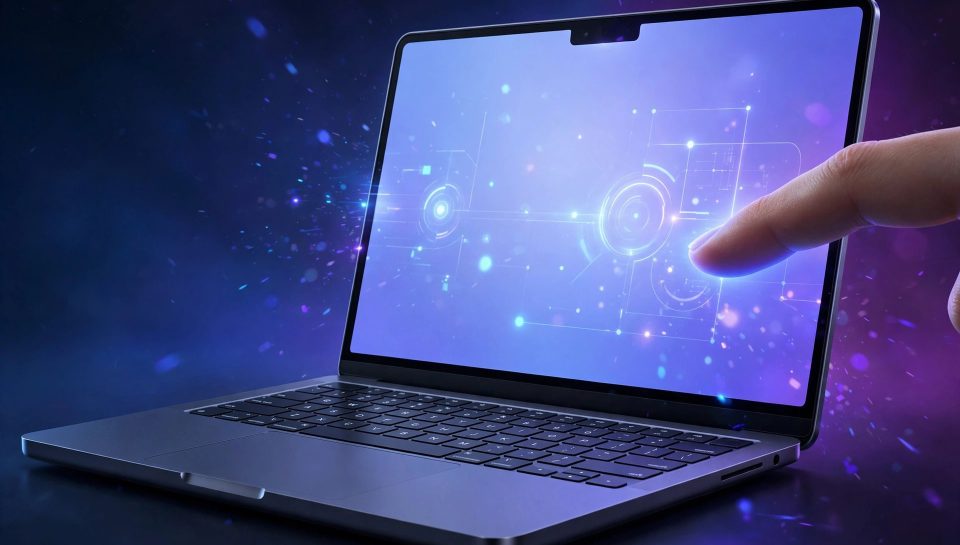
After more than fifteen years of telling the world that touchscreens do not belong on a laptop, Apple is about to eat those words. The company has invited media to a product “experience” in Los Angeles on October 28, teasing new devices under the tagline “Pro and tell” — and every report points to the same headline act: the first-ever touchscreen MacBook Pro.
If the reporting is accurate, Apple will unveil redesigned 14-inch and 16-inch MacBook Pro models with OLED touchscreens, a Dynamic Island camera cutout, and a significantly lighter chassis. Alongside them, expect an entry-level 14-inch MacBook Pro and a refreshed 24-inch iMac with the new M6 chip, plus an iPad mini with an OLED display. This is one of the most consequential Mac updates in a decade — not because of the chips, but because it reverses a design philosophy Apple defended for years. Here is everything the reports say to expect, what remains unknown, and how to decide whether this is the Mac to wait for.
Why a touchscreen Mac is such a big deal for Apple
To appreciate the significance, you need the backstory. When Steve Jobs unveiled the iPad in 2010, he argued that vertical touchscreens on computers were ergonomically awful after “tons of user testing” — touching a vertical screen for extended periods causes fatigue, the famous “gorilla arm” problem. Apple’s position only hardened over the years. In 2018, software chief Craig Federighi said the company had no interest in touchscreen Macs, insisting that the Mac was designed for indirect interaction while the iPad was built for touch from the ground up. Even the Touch Bar — Apple’s one concession to touch on the keyboard deck — was eventually removed from the MacBook Pro, which many took as the final word.
That is why a touchscreen MacBook Pro is not a spec bump; it is a strategic reversal. Apple kept the Mac and iPad on parallel, non-intersecting tracks: the iPad got touch, the Mac got trackpads. Fold that line and several things change at once. App developers must start thinking about touch targets on macOS. Accessory makers get a new interaction surface to design around. And Apple itself concedes something the rest of the industry conceded a decade ago: users reach for the screen regardless of the ergonomics argument.
The timing is also revealing. Windows laptops have had touchscreens for years, and 2-in-1 devices proved the demand. With OLED panels reaching maturity and the Mac lineup already riding the Apple silicon performance wave, touch is the one frontier left for differentiation in the premium laptop market.
Everything expected at the October 28 “Pro and tell” event
Here is the full rumored lineup, based primarily on Bloomberg‘s Mark Gurman, who reported on the event’s date and product slate after Apple began inviting media on October 15.
| Product | What the reports say | Chip |
|---|---|---|
| MacBook Pro 14″/16″ (redesigned) | OLED touchscreen, Dynamic Island replaces the notch, thinner and significantly lighter chassis, reinforced hinge | M5 Pro / M5 Max |
| MacBook Pro 14″ (entry-level) | Same exterior design, chip refresh | M6 |
| iMac 24″ | Same design, chip refresh | M6 |
| iPad mini | OLED display, front camera moved to the landscape edge, redesigned speakers | Not yet reported |
The event itself takes a now-familiar format for Apple: an in-person hands-on “experience” in Los Angeles rather than a traditional keynote broadcast, similar to the company’s smart-home showcase earlier in October where it introduced the HomeView display, HomePod mini 2, and an updated Apple TV. Apple’s marketing chief Greg Joswiak teased the date on X with the line “Can’t wait to pro and tell next week,” alongside artwork of the Apple logo swiping across a screen — a not-so-subtle wink at touch.
One naming rumor is reportedly dead: an earlier wave of speculation suggested the touchscreen machines might ship as “MacBook Ultra.” Gurman now reports they will keep MacBook Pro branding — the same pattern as the long-rumored “iPhone Ultra” ultimately shipping as the foldable iPhone Duo, which goes on sale this Friday, October 23.
The redesigned touchscreen MacBook Pro
The headline machines are the redesigned 14-inch and 16-inch MacBook Pros. The reports paint a consistent picture: OLED displays with direct touch input, an iPhone-style Dynamic Island cutout replacing the display notch, a thinner and “significantly lighter” body, and a reinforced hinge. That last detail is the one engineers will judge Apple on — a touchscreen laptop with a wobbly screen is a deal-breaker, and Apple reportedly redesigned the hinge specifically to stay stable when you tap the display.
On chips, the redesigned Pros are expected to run M5 Pro and M5 Max — matching the current-generation MacBook Pros introduced in March — rather than jumping to the new M6. That makes the lineup moment genuinely confusing for buyers: the premium redesigned models carry older silicon names while the cheaper base models get the newest chip. More on that below.
OLED is itself a first for the Mac. Current high-end MacBook Pros use mini-LED panels, which are excellent, but OLED brings deeper blacks, higher contrast, and richer colors — a meaningful upgrade for video editors, photographers, and anyone working in HDR. One caveat, reported by analysts: OLED does not always match mini-LED for peak brightness, so creative professionals will want to wait for independent display testing.
M6 Macs: entry-level MacBook Pro and iMac
The less glamorous but likely best-selling announcements are the M6 refreshes. The entry-level 14-inch MacBook Pro and the 24-inch iMac are both expected to keep their current designs and simply gain the new M6 chip. For students, office workers, and anyone buying a Mac for everyday work rather than heavy creative workloads, these are the models to watch — and the ones least likely to carry a price increase.
iPad mini with OLED
The compact tablet is overdue for a refresh and the reports are generous: an OLED screen, a front-facing camera repositioned for landscape video calls, and a redesigned speaker system. That combination would make the iPad mini the most dramatically improved small tablet in years — arguably, as one analyst put it, the potential sleeper hit of the event. One report also claims an A20 Pro chip and even a fully waterproof body, but treat those details with more skepticism until Apple confirms them.
What touch means for macOS
Hardware is only half the story. A touchscreen Mac only works if macOS embraces touch, and there are already hints that Apple’s software team has been preparing. MacRumors notes that the upcoming macOS release includes features that point toward touch support: direct interaction with macOS elements when an iPad is used as a display via Sidecar, and a pull-to-refresh gesture added across built-in apps including Safari, Mail, News, Podcasts, and Calendar. None of these confirms a touchscreen Mac on its own, but together they suggest the operating system groundwork is further along than Apple has admitted.
For developers, the implication is immediate: macOS apps will need larger touch targets, gesture support, and interface elements that work with both a pointer and a fingertip. Apple’s own apps will lead the way at the event, and third-party developers should expect updated Human Interface Guidelines to follow. If you build for the Mac, now is the time to audit your app’s hit areas — WebReOn Tools offers free utilities that web and app developers can use in that workflow.
For users, the more interesting question is how macOS avoids becoming a worse desktop. Apple’s likely answer is restraint: touch as an additional input alongside the keyboard and trackpad, not a replacement. The trackpad and keyboard are not expected to change, and nobody is predicting a full iPad-style interface on the Mac. The best touchscreen laptop experiences — and the worst — come down to whether the software respects that distinction.
Pricing and availability: what we know and what we don’t
Here is the honest state of play. Apple has confirmed the event date, October 28, and Bloomberg has reported that retail stores are preparing to begin selling new products on Friday, November 6. Beyond that, almost every number is unconfirmed.
Pricing is the biggest open question. OLED panels and touch digitizers add real cost, and some analysts estimate a significant premium over the current MacBook Pro lineup — but those are estimates, not leaks. The $2,499 starting price of the current high-end models is the baseline; the touchscreen redesign will almost certainly sit above it. Exact configurations, battery life figures, and dimensions are all unconfirmed, and Apple has confirmed none of the reported specifications.
What this means in practice: if you need a Mac now, wait eight days. The event will settle the lineup and the pricing at once, and either the new models will be worth the premium or the outgoing models will drop in price.
Should you buy now or wait?
The lineup as reported creates a genuinely strange buying moment. Consider the scenarios:
- You want the best screen and newest design: wait for the touchscreen OLED MacBook Pro — but be prepared to pay a premium and to live with M5-class silicon while base models move to M6.
- You want the best value: the M6 entry-level 14-inch MacBook Pro looks like the smart pick. Same design, newest base chip, and likely the friendliest price in the Pro lineup.
- You are a student or buying for school: the current models will almost certainly see discounts once the new lineup lands — and our guide to the best free AI tools for students pairs well with whichever Mac you choose.
- You develop for the web: touch-enabled macOS desktops change how you test. If you were already considering a Mac upgrade, the October 28 event is worth waiting for — and the hardware questions pair naturally with the ones our morning coverage raised about what’s new in WordPress 7.2 for local development workflows.
And a word of caution that applies to every Apple rumor cycle: everything above about the products themselves comes from reporting, not from Apple. The event date and the “Pro and tell” tagline are official. The touchscreen MacBook Pro, the OLED displays, the chips, and the November 6 sales date are all reported — credibly reported, by journalists with strong track records, but reported nonetheless. The only way to know for sure is to watch what Apple actually puts on stage.
Frequently asked questions
When is Apple’s October 2026 event?
Apple’s “Pro and tell” product experience is scheduled for Wednesday, October 28, 2026, in Los Angeles. It is an in-person media event rather than a traditional streamed keynote, though Apple will almost certainly publish press releases with full details the same day.
Is Apple really making a touchscreen MacBook Pro?
Apple has not confirmed it. But Bloomberg‘s Mark Gurman — who first reported the October 28 date and the “all-day product launch experience” for touchscreen MacBooks, a new iPad mini, and M6 Macs — has an excellent record on Apple hardware, and multiple outlets have corroborated the details. The artwork Apple itself posted, showing its logo swiping across a screen, is hard to read any other way.
Will the touchscreen MacBook Pro be expensive?
Almost certainly. Pricing is unconfirmed, but OLED displays and touch digitizers add manufacturing cost, and the redesigned models sit at the top of Apple’s laptop lineup. Expect a premium over the current $2,499 starting price — how large a premium is the unknown.
When will the new Macs be available to buy?
Bloomberg reports that Apple retail stores are preparing to begin selling new products on Friday, November 6. Availability of individual models will depend on what Apple announces on October 28.
What about the iPad mini?
The iPad mini is expected to gain an OLED display, a landscape-positioned front camera for video calls, and redesigned speakers. It may be the most improved product-for-the-money of the event.
Does a touchscreen Mac mean macOS is becoming iPadOS?
No. Touch is expected as an additional input option alongside the keyboard and trackpad, with macOS remaining a desktop operating system. Expect Apple to keep the two interfaces distinct, just closer than ever before.
The bottom line
Apple’s October 28 event marks the end of an era that began with Steve Jobs insisting you would never touch a Mac screen. Whether driven by competitive pressure, maturing OLED supply chains, or a genuine change of heart about how people use laptops, the touchscreen MacBook Pro is the clearest sign yet that the wall between Apple’s devices is coming down. The chips and the displays matter, but the philosophy change matters more — it is the first time Apple has publicly rethought what a Mac is allowed to be in over a decade.
Watch for the official announcements on October 28, the hands-on reports that follow, and the November 6 retail date. We will update this coverage when Apple confirms the lineup. In the meantime, if you are weighing an upgrade, the smartest move is the simplest one: wait one more week. The decision you make on October 29 will be better informed than any you can make today.