


TCS now earns more than 10% of its revenue from AI, yet its total top line barely moved. As Indian IT Q2 numbers come in, one reality is clear: generating AI revenue is no longer the challenge—retaining it is.
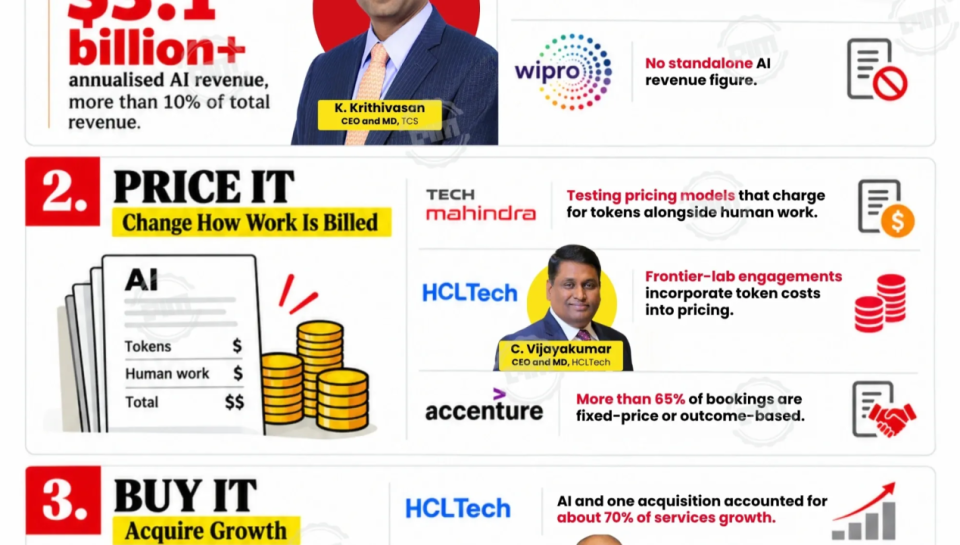
Two years ago, Indian IT struggled to explain how AI would translate into a viable business model. Today, TCS reports an annualised AI revenue run-rate above $3.1 billion, accounting for over 10% of its total business.
Yet, overall growth tells a different story. TCS grew 0.5% sequentially in constant currency. HCLTech’s organic services growth was 2.3%. Wipro’s revenue remained flat.

Selling AI is no longer the hard part. Keeping what it earns is.
The Nifty IT Index’s volatile August rally faded through September on exactly this worry. AI-led efficiency is deflating traditional contract values faster than new AI deals can replace them.
Where Does the AI Money Go?
Take a $100 million contract up for renewal. Having adopted AI tools, the client expects cost savings. TCS notes that AI-driven productivity gains typically range from 10-15% and surface during contract renewals. In practice, this is AI deflation: If the client reclaims those efficiency gains, $10 million to $15 million in top-line revenue vanishes before the new contract is even signed.
Often the client buys new scope instead, and TCS says that is the usual outcome. It also says it cannot yet measure how much of its business has been through the cycle.
TCS’s own figures suggest the offset is incomplete. Its AI run-rate rose from $2.6 billion to $3.1 billion, roughly $125 million of extra quarterly revenue. Total revenue rose by under $40 million in constant currency. A 10.3% drop in India revenue, which TCS blames on deferrals, explains part of that.
AIM Innovator Session | How AI is Rewriting India’s Financial Services Stack, Featuring Neysa

Financial services is where India’s AI ambitions meet the hardest constraints: regulation, data residency, auditability, and zero tolerance for downtime. AIM and Neysa are hosting the AIM Innovator Session, featuring a panel of people building AI inside India’s banks, payment networks, and wealth tech, to discuss what is actually moving to production. Click here to register now.
Date: October 29, 2026 Time: 5–6 pm
Either AI is replacing old work, or the label now covers work that was already there. Both mean the new money is smaller than it looks.
Accenture says it is “more than offsetting” what it hands back to clients. DAM Capital’s Anmol Garg tells AIM Indian firms are not there yet: AI-led deflation still exceeds AI-led revenue.
At Wipro, AI created capacity equal to 20,000 employees, its technology chief told Reuters. Revenue stayed flat. UnearthInsight’s Gaurav Vasu says leakage from existing accounts looks bigger than revenue from new clients.
Even the budget may not be new. Gartner’s Shubham Singh Rathore calls most AI work a reallocation of existing IT budgets. Vasu adds that frontier labs and hyperscalers are taking more of what clients spend.
Hiring has turned, unevenly. HCLTech, TCS and Tech Mahindra added more than 16,000 people between them. Wipro cut 6,716, partly on AI productivity. Productivity, yes. Growth, no.
Building Enterprise AI for the Future of Work | Ft. Atlassian CTO Vikram Rao

AI’s competitive advantage isn’t just about which models companies use. It’s how they put them to work. In this episode of TechTalks, Atlassian CTO Vikram Rao discusses his journey from Mysore to leading global product innovation, why Bengaluru became a talent-dense hub for global technology companies, and how Atlassian is building AI for teamwork with zero data retention.
Three Moves
Tech Mahindra’s results frame the problem: vendors must win new work, expand contracts or change how they charge. In practice, that has become three moves.
First, prove it. Disclosure does not keep the money. It shows whether there is any new money to keep.
Tech Mahindra says it will report AI revenue separately from H2 FY27. CEO Mohit Joshi insists that AI revenue must be “evidenced by client-funded work and reconcilable to financial records.”
Everyone else counts differently or not at all. TCS says $3.1 billion. HCLTech says $219 million of advanced AI, up 28.4% sequentially. Wipro gives no figure. Accenture has gone three quarters without one.
Second, price it. Tech Mahindra is testing contracts that price human work and AI agents together, tokens included. HCLTech says its frontier-lab work includes token cost in pricing.
Tokens are a cost too. Price them openly and the client carries them. Bury them in a fixed price and the vendor does. Accenture, where fixed-price work is over 65% of bookings, funds only $29 a month per employee for Claude, a report says.
Third, buy it. At HCLTech, AI + one acquisition drove about 70% of services growth. The guidance raise is acquisition-led, and the organic midpoint is broadly unchanged.
Persistent, which has yet to close Nagarro, expects about $50 million in one-time costs. TCS plans to buy MHP, Porsche’s German consulting arm. Wipro does not split acquired from organic revenue after a deal’s first quarter, so its flat growth is hard to read.
UnearthInsight expects FY27 sector growth of 3% to 4%, largely inorganic. When the base is deflating, buying revenue is the quickest way to show growth.
What’s the Test?
Infosys reports on October 23. AI was 8.2% of its Q1 revenue, and Garg expects another guidance cut.
Tech Mahindra will give its first separate AI number in H2. Its margin has risen 12 straight quarters to 14.8%, so the question is whether AI adds to margin or only to sales.
Wipro has two unsigned deals and a January deadline, after large-deal bookings fell 58.6% to $674 million. It must also decide whether to put a number on AI.
HCLTech’s $1.14 billion contract, about 35% of Q2 bookings, starts contributing revenue only in Q1 FY28.
The pitch is settled. The ledger is not.

AI is moving to the edge. Akamai is already there. Build, deploy, and scale AI applications faster on our open, developer-friendly platform, with predictable pricing and integrated security. Click here to find out more.