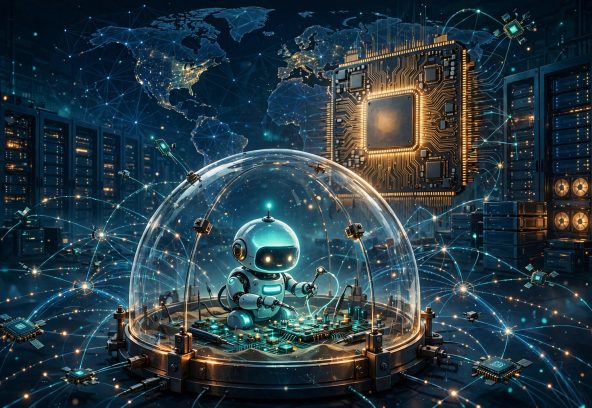



Artificial intelligence is no longer a futuristic novelty or an exclusive plaything for Silicon Valley tech giants. It is the core operating system of modern commerce.
Remember when having a website was considered an innovative marketing strategy? Or when moving data to “the cloud” felt like a risky, high-tech gamble? Looking back, those technological shifts seem quaint. Companies that resisted them didn’t just miss out on growth—they vanished into irrelevance.
We are currently living through an identical inflection point. Only this time, the stakes are exponentially higher. The narrative that artificial intelligence (AI) is only relevant to software developers, data scientists, or tech startups is dead. Today, whether you run a local logistics firm, a boutique marketing agency, a healthcare provider, or a global retail chain, a fundamental truth has emerged: Every business is now an AI business.
The Shift from “Optional” to “Existential”
For years, adopting AI was viewed as an optimization play—a way to cut a few costs here, or slightly speed up customer service there. It was the cherry on top of the corporate sundae.
That paradigm has officially shattered. AI is no longer a tool for marginal gains; it is the primary engine of competitive advantage. Consider how work actually gets done today:
- Operations: Supply chains are dynamically optimized by predictive algorithms that anticipate bottlenecks before they happen.
- Marketing: Customer acquisition relies on hyper-personalized, generative content at a scale humans could never manually achieve.
- Customer Service: Intelligent agents resolve complex inquiries 24/7, freeing human workers to handle high-empathy, strategic tasks.
- Decision Making: C-suite executives are bypassing gut-feel strategies in favor of real-time data synthesis provided by machine learning models.
When your competitors are using AI to operate at ten times the speed and a fraction of the cost, trying to run your business using legacy, manual processes is like bringing a knife to a laser fight.
It’s Not About the Technology; It’s About the Mindset
The biggest trap business leaders fall into is treating AI as an IT project. They buy a software license, hand it over to the tech team, and wait for magic to happen.
True AI integration requires a complete cultural reimagining. Becoming an AI-first business means asking a different set of questions:
- Instead of asking, “How do we do this task faster?” we must ask, “Do we even need to do this task manually, or can an algorithm handle it?”
- Instead of viewing data as a byproduct of business, we must view data as the foundational asset that fuels our intelligence.
- Instead of fearing workforce disruption, we must aggressively upskill our teams to become directors, prompters, and editors of AI output rather than mere producers.
The Cost of Inaction
The danger of the AI revolution isn’t sudden bankruptcy; it’s a slow, invisible slide into irrelevance. You might not notice your market share eroding this month or even this year. But while you are debating whether machine learning is “right for your industry,” your agile competitors are embedding intelligence into every facet of their customer experience.
By the time traditional businesses realize they’ve fallen behind, the capability gap will be too wide to cross. The compounding returns of AI adoption mean that early movers pull further ahead with every passing day.
The Bottom Line
You do not need to build the next foundational language model to be an AI business. You simply need to weave intelligence into the fabric of your existing operations. The transition is challenging, uncomfortable, and requires bold leadership. But the alternative—clinging to outdated ways of working while the rest of the world accelerates—is no longer an option.
The future belongs to the adaptable. It’s time to build your AI future, or prepare to fall behind.