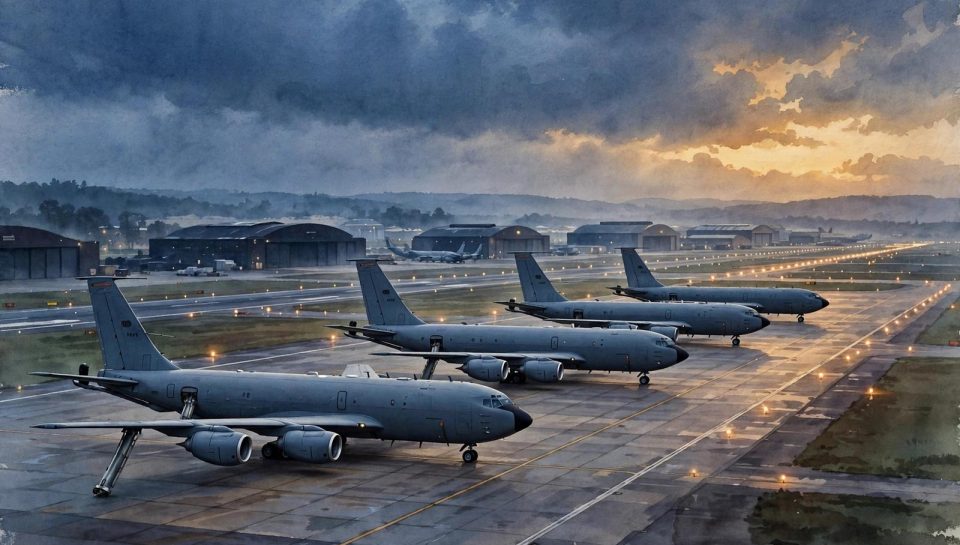
The United States evacuated at least 12 military aircraft from RAF Mildenhall in eastern England on Monday 10 November after intelligence warned of a possible Iranian drone attack on the base, according to reports from The Wall Street Journal, CNN and the BBC. The move, described by American officials as a temporary relocation, is the second time in six weeks that the US has pulled aircraft from a British airbase over an Iran-linked threat.
Flight-tracking data shows ten KC-135 Stratotanker refuelling aircraft leaving Mildenhall on Monday, joined by three Osprey transport aircraft, with a further tanker departing on Tuesday afternoon. The base and the nearby RAF Lakenheath were both raised to FPCON Charlie, the Pentagon’s second-highest force protection level. The precise nature of the threat has not been confirmed by officials, and Iran has not publicly responded to the claims.
Summary: The US moved at least a dozen aircraft out of RAF Mildenhall on 10 November after intelligence suggested Iran was preparing a drone attack on the base. It follows a withdrawal of B-1 bombers from RAF Fairford in October after an alleged Iranian plot there, and comes as President Donald Trump says he sees “positive momentum” towards ending the conflict with Iran.
Key takeaways
- At least 12 US aircraft left RAF Mildenhall on Monday 10 November after a threat from Iran that American intelligence judged credible.
- The aircraft, mostly KC-135 refuelling tankers, were flown to bases in Germany, Spain and Scotland, with three Ospreys moved to nearby RAF Lakenheath.
- Mildenhall and Lakenheath were raised to FPCON Charlie, the second-highest Pentagon threat level, which applies when terrorist action is considered likely.
- It is the second such withdrawal in six weeks, after B-1 bombers left RAF Fairford in October following an alleged Iranian drone plot and a series of arrests.
- Officials have not confirmed the exact nature of the threat, and it is unclear whether Iran has the capability to carry out the plots US intelligence says it has discussed.
What happened at RAF Mildenhall
RAF Mildenhall, in Suffolk about 130 kilometres north of London, is a Royal Air Force station operated by the United States Air Force. It hosts the 100th Air Refueling Wing, the only permanent refuelling wing in Europe, along with special operations aircraft, and about 3,000 military personnel are stationed there. Its tankers keep American and allied aircraft flying across Europe, the Middle East and Africa.
The Wall Street Journal first reported the evacuation on Monday, citing people familiar with events, and said the precise nature of the Iranian threat remained “under discussion” among US officials. CNN, citing a person familiar with the intelligence, reported that the threat was deemed credible and that the US intelligence community had in recent weeks picked up a wide range of “varied, extensive, and specific” plots being discussed by Iranians against American targets.
A US official told CNN the aircraft had been removed as a “temporary relocation” but declined to comment on any threat. A spokesperson for US European Command said the military was taking “coordinated and appropriate” security steps and declined to discuss specific force protection measures, adding that Mildenhall and Lakenheath “remain vigilant”. A spokesperson for British Prime Minister Andy Burnham told CNN the UK was in “constant communication with” the US, “sharing intelligence and accessing threats together”, and that the protection of British bases was a top priority. Downing Street has insisted British air bases are safe.
Sources told The National that there was likely “credible intelligence” indicating Iran “was preparing to engage in a drone attack targeting Mildenhall”, and that the alleged threat involved a plan to strike the base with kamikaze drones. That detail has not been confirmed by any government, and it should be treated as reported rather than established. CNN has reached out to the Iranian Embassy in London for comment.
Where the aircraft went
Open-source flight tracking gives the clearest picture of the scale of the move, because neither government has published a full list. The counts differ slightly between trackers and by the time of reporting, which is normal for a movement still under way.
| Aircraft | Number | Destination | Source |
|---|---|---|---|
| KC-135 Stratotanker | 4 | Spangdahlem Air Base, Germany | CNN flight-tracking analysis |
| KC-135 Stratotanker | 4 | Morón Air Base, Spain | CNN flight-tracking analysis |
| KC-135 Stratotanker | 1 | Ramstein Air Base, Germany | CNN flight-tracking analysis |
| KC-135 Stratotanker | 1 | Glasgow Prestwick Airport, Scotland | CNN flight-tracking analysis |
| CV-22 Osprey | 3 | RAF Lakenheath, England | Sky News and flight-tracking data |
Altogether, the BBC’s verification team counted ten KC-135 tankers leaving Mildenhall through Monday, while Sky News reported 12 aircraft in total, nine tankers and three Ospreys. Dawn reported ten refuelling tankers and three Ospreys had left since early Monday, and The Nation reported that a further KC-135 left on Tuesday afternoon heading for Germany. Two tankers already en route to Mildenhall on Monday morning were diverted to Germany instead. The Ospreys, operated by the 352nd Special Operations Wing, were moved the short distance to Lakenheath, about 10 kilometres away.
What FPCON Charlie means
Alongside the evacuation, the US raised the security status at Mildenhall and Lakenheath to FPCON Charlie, the second-highest level in the Pentagon’s force protection system. The level is set when intelligence indicates that some form of terrorist action or targeting is likely, and it triggers tighter access controls, heavier armed patrols and restrictions on movement around a base.
The step is a measure of how seriously the threat was taken. FPCON Charlie sits one step below Delta, the highest level, which is reserved for a specific threat against a specific location or an attack in progress. The Associated Press reported that the Military Air Tracking Alliance, a team of open-source analysts, confirmed the alert level had been raised at Mildenhall. Officials have stressed that the relocation was proactive rather than reactive: nothing was attacked, no aircraft was damaged and no casualties were reported. The story is about a threat and a precaution, not an incident.
The Fairford pattern: a second base in six weeks
Mildenhall is the second British airbase from which the US has withdrawn aircraft over an Iran-linked threat in six weeks, and the parallel with RAF Fairford is what makes the latest move significant rather than routine. Fairford, in Gloucestershire, had been used by US B-1 bombers to carry out strikes on Iran. In the early hours of 27 September, five men were arrested outside the base, and seven people were arrested in total over an alleged plot to target it. British police later charged two British nationals under the National Security Act, saying they were suspected of assisting Iran. Prime Minister Andy Burnham has said Iran’s Revolutionary Guards “almost certainly directed” the plot, and the B-1 bombers were withdrawn from Fairford in early October on security grounds.
On Tuesday 10 November, US prosecutors accused the imprisoned commander of an Iranian terrorist proxy group of helping to direct the failed Fairford plot, according to CNN, though the details of the US case have not been made public in full. The two episodes share a shape: an alleged Iranian plan against a US-operated base in England, arrests or intelligence warnings, and a precautionary withdrawal of the aircraft the plot was said to target. The difference is that at Fairford there were arrests and charges, while at Mildenhall the public evidence so far consists of the evacuation itself, the raised alert level and the intelligence assessments described to reporters.
What is confirmed and what is still alleged
Because the underlying intelligence has not been published, it is worth separating what is established from what is reported or claimed.
| Status | Detail |
|---|---|
| Confirmed | At least 12 US aircraft left RAF Mildenhall on Monday 10 November, verified by flight-tracking data analysed by CNN, the BBC and AFP; Mildenhall and Lakenheath were raised to FPCON Charlie. |
| Confirmed | B-1 bombers were withdrawn from RAF Fairford in early October after arrests outside the base on 27 September, and two British nationals have been charged under the National Security Act. |
| Reported | The threat to Mildenhall came from Iran and was judged credible, according to the Wall Street Journal and a source who spoke to CNN; sources told The National the alleged plan involved a kamikaze drone attack. |
| Reported | US intelligence has picked up a range of Iranian plots against American targets, including drone attacks on bases and assassination plots, according to a source who spoke to CNN. |
| Unconfirmed | Whether Iran has the capability to carry out the plots discussed, and whether any specific attack was imminent; CNN’s source said this was unclear. Iran has not responded publicly. |
The caution around capability is important. CNN’s source said it was unclear whether the Iranians actually had the means to act on the threats, which ranged from drone attacks on US bases to assassination plots, and that several threats were also made against targets inside the United States. The plots were described as “varied, extensive, and specific”, with “specific targets and methods in mind”. Specificity of intent is not the same as capability, and the reporting so far does not settle that question.
The wider US-Iran standoff
The evacuation sits inside a much larger confrontation. The conflict between the US and Iran began after President Donald Trump launched strikes on Iran in late February alongside Israel, according to Dawn. On Monday, Trump said Washington was “seeing positive momentum toward an end” to the conflict, a notably upbeat note struck on the same day his military was moving aircraft out of harm’s way in England.
The tension between those two signals captures the uncertainty of the moment. The US has not said the threat to Mildenhall is connected to any specific development in the wider standoff, and officials have declined to discuss the intelligence behind it. What is clear is that American planners are treating Iranian threats against US targets as a live and continuing problem, not a single incident confined to Fairford. The episode also lands in a changed political landscape at home: last week’s midterms delivered a sharp rebuke to Trump and congressional Republicans, and the Senate voted 73-25 on Monday to advance a sweeping energy permitting bill, the first major action since the vote. See our coverage of the US midterm results and the Senate permitting bill for the domestic context.
What happens next
Three things will determine how this story develops. First, whether the aircraft return to Mildenhall and how quickly. American officials called the move a temporary relocation, which suggests a return once the threat picture changes, but no timetable has been given and the FPCON Charlie alert level remains in place.
Second, whether the intelligence behind the warning becomes public in any form. The Fairford case produced arrests and charges, which gave the public a verifiable record; the Mildenhall warning so far rests on anonymous briefings. Any charges, official statements or declassified detail would change the picture substantially, in either direction.
Third, whether the pattern continues. Two withdrawals from two British bases in six weeks is a pattern, and if a third base is affected, or if a plot is disrupted rather than merely warned about, the story will shift from precaution to confrontation. Britain and its allies are managing several crises at once: the COP31 climate summit is under way in Antalya, with the US absent after leaving the Paris Agreement, while American forces are on alert at home. See our report on COP31 opening in Antalya and our earlier coverage of international upheaval in Paraguay.
For now, the facts are these: the aircraft are safe, the bases are on heightened alert, the threat is described as credible but its details are undisclosed, and Iran has not responded publicly. Until one of those facts changes, the evacuation is best read as a precaution taken seriously, not as evidence of an attack about to happen.
Frequently asked questions
Why did the US evacuate aircraft from RAF Mildenhall?
The US moved the aircraft after intelligence warned of a possible Iranian drone attack on the base. The Wall Street Journal first reported the evacuation, and a source familiar with the intelligence told CNN the threat was deemed credible. Officials have not confirmed the precise nature of the threat.
How many aircraft left RAF Mildenhall?
At least 12: ten KC-135 Stratotanker refuelling aircraft on Monday 10 November, plus three CV-22 Osprey aircraft moved to nearby RAF Lakenheath, and a further KC-135 on Tuesday afternoon. Counts vary slightly between trackers because the movement continued into Tuesday.
Where did the Mildenhall aircraft go?
Four KC-135 tankers went to Spangdahlem Air Base in Germany, one to Ramstein Air Base in Germany, four to Morón Air Base in Spain and one to Glasgow Prestwick Airport in Scotland. The three Ospreys were moved to RAF Lakenheath, about 10 kilometres from Mildenhall.
What is FPCON Charlie?
FPCON Charlie is the second-highest level in the Pentagon’s force protection system. It applies when intelligence indicates that terrorist action or targeting is likely, and it brings tighter access controls and heavier patrols. It sits one level below Delta, the highest level, used when a specific threat exists or an attack is under way.
Is this connected to the RAF Fairford incident?
The two episodes share a pattern but involve different evidence. At Fairford in September, five men were arrested outside the base and two British nationals were later charged under the National Security Act over an alleged Iranian plot, after which B-1 bombers were withdrawn. At Mildenhall there have been no reported arrests, and the case rests on intelligence assessments described to reporters rather than charges.
Sources and Further Reading
- The Wall Street Journal, via The National, 10 November 2026: first report of the evacuation and the Iranian threat. Iran threat forces US aircraft out of second British airbase
- CNN, 10 November 2026: flight-tracking analysis of the ten relocated tankers, FPCON Charlie, and the intelligence source on Iranian plots. US evacuates aircraft from British military base after threat from Iran
- Dawn, 11 November 2026: EUCOM statement, the Fairford background and the count of aircraft moved. US withdraws 12 planes from British base
- BBC, via The Nation, 11 November 2026: flight-tracking verification and Downing Street’s position. More than 12 US military aircraft leave second UK base
- Channels TV, 10 November 2026: Sky News flight-tracking count of 12 aircraft. US Withdraws Military Aircraft From Second UK Airbase
- The Associated Press, via The Week, 10 November 2026: the US official’s account and the FPCON Charlie alert level. US Air Force evacuates aircraft from base in England because of threat, US official says