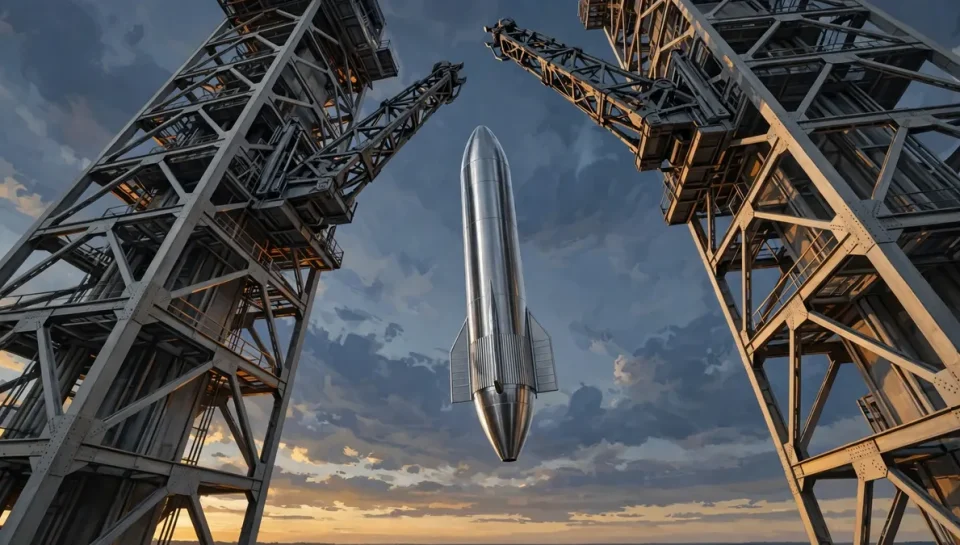
SpaceX Starship Flight 15 ended with a first on Saturday 14 November 2026: a Starship upper stage returning from orbit was caught by the launch tower’s arms at Starbase, Texas. Ship 42 came home after 22.5 hours and 14 orbits, delivering 26 Starlink V3 satellites. The flight was only half a success: the Super Heavy booster was lost over the Gulf of Mexico minutes after liftoff, when its return burn ended early on a low-fuel alarm.
It was the 15th full-scale Starship flight since 2023 and only the second to reach orbit. SpaceX had planned a double catch; instead, it achieved one half of that plan and lost the other, moving the programme closer to full reusability without yet proving it.
Key takeaways
- Ship 42 is the first Starship upper stage ever caught after returning from orbit, and the first catch at Starbase’s Pad 2 tower.
- The ship flew 14 orbits over about 22.5 hours and deployed 26 Starlink V3 satellites, taking the total from the two orbital flights to 52.
- Booster 22 was destroyed over the Gulf of Mexico after its boostback burn ended early on a low-fuel alarm; the root cause is still under investigation.
- No caught Starship has flown again yet, and both stages have never been caught on one flight, so full reusability remains unproven.
- SpaceX shares closed on Friday at $139.11, about 38 percent below their June high.
SpaceX Starship Flight 15 at a glance
| When | What happened |
|---|---|
| Friday 13 November, 5:47 p.m. EST | Starship V3 lifts off from Pad 2 at Starbase, Texas |
| Minutes after liftoff | Booster 22 aborts its tower catch and is destroyed over the Gulf of Mexico |
| About 27 minutes after liftoff | Ship 42 reaches orbit and begins deploying 26 Starlink V3 satellites |
| 14 orbits, about 22.5 hours | Ship 42 circles Earth, then fires a single engine for its deorbit burn |
| Saturday 14 November, about 4:20 p.m. EST | Mechazilla catches Ship 42, the first ship catch from orbit |
How Mechazilla caught a ship from orbit
The tower’s two mechanical arms, nicknamed chopsticks, had caught Super Heavy boosters three times before, but never an upper stage coming in from orbit: the ship had to survive re-entry at orbital speed, steer itself back to the launch site, and arrive slow enough for the arms to take its weight.
After a long coast around Earth, Ship 42 relit a single Raptor engine for its deorbit burn, flew back over Mexico, swung out over the Gulf, and lined up on the tower it had left 22.5 hours earlier. Breaking through the clouds, it lit three Raptor engines for a landing flip and slow descent into the waiting arms. SpaceX launch commentator Dan Huot summed up the moment on the company’s webcast: “We caught a Starship, and now everything changes.”
It was also a first for the tower: Pad 2 had never caught anything before. The 52-metre ship hung in the arms overnight, was lowered on Sunday and moved to a hangar. Musk climbed the tower to inspect it, later writing that he had hugged Ship 42 on its return, and said the heat shield looked great overall.
The booster that did not come home
The other half of the plan failed within minutes of launch. After hot-staging separated the two stages, Booster 22 turned to head home and relit 32 of its 33 Raptor engines for the boostback burn. The burn ended early because the booster was running low on fuel, according to SpaceX. Its guidance system then aborted the tower approach automatically and steered the booster offshore. There it completed a landing burn, hovered, and was destroyed by its flight termination system a few feet above the Gulf about six and a half minutes after liftoff.
SpaceX’s account shifted over the weekend: Huot first pointed to a guidance issue, then walked that back, and Kate Tice later said the boostback burn ended early on a low-fuel-mass alarm, with the root cause still under investigation. Musk attributed the shortfall to slight engine underperformance and said mitigations were already in place, without changing the timeline for high-volume reusable flights.
Why the catch matters
Starship is designed to be caught and launched again without being rebuilt, and catching the ship was the recovery step never before demonstrated. The previous orbital flight, Flight 14 in late September, reached orbit and deployed 26 Starlink V3 satellites, but its ship ended the flight in the ocean. Flight 15 is also the longest Starship flight to date, at about 22.5 hours against roughly three hours in September.
The milestone matters well beyond SpaceX: NASA is paying billions for Starship to carry astronauts to the Moon later this decade under the Artemis programme, where reusability is central to the economics, as our earlier report on the NASA PROMISE lunar rover shows.
Even so, the limits should be stated plainly: no caught Starship has flown a second time, and nobody outside SpaceX knows how much work Ship 42 needs. Shotwell said the company hoped to refly an upper stage early in 2027, and Musk said Ship 42 could probably fly again after a few weeks of refurbishment, but no reflight has been announced.
What the flight means for Starlink
The flight was also a working satellite delivery. Ship 42 deployed all 26 Starlink V3 satellites within 1 hour 17 minutes of liftoff, and all 26 are healthy and raising their orbits, according to Starlink engineering lead Michael Nicolls. Together with the 26 from Flight 14, there are now 52 V3 satellites in orbit.
The V3 satellites are a step change: they fly closer to Earth than earlier versions, and SpaceX says one Starship can carry up to 60 of them. The Starlink account said the Flight 15 batch adds up to 26 terabits of capacity, and the satellites could serve customers within a few weeks. That delivery rate is the commercial reason Starship exists. Starlink ended September with 13.6 million consumer subscribers, up from 7.2 million a year earlier.
What it means for SpaceX the public company
SpaceX listed on the Nasdaq in June 2026 at $135 a share, valuing the company at about $1.75 trillion. The shares closed on Friday 13 November at $139.11, about 3 percent above the IPO price and roughly 38 percent below the $225.64 high of 16 June, and at $137.36 on Monday.
Analysts moved quickly: Citi raised its price target, and Wells Fargo said the catch came ahead of its first-half 2027 expectation and could accelerate the path towards partial reusability, according to The Fly.
SpaceX reported third-quarter 2026 revenue of $14.6 billion, up 161 percent year on year, and net income of $4.4 billion, its first profitable quarter as a public company. The connectivity business, which is Starlink, generated $5.25 billion of revenue, up 69 percent, and operating income of about $2.37 billion, up 99 percent. The Super Intelligence division, built on xAI and the Cursor acquisition and including the SpaceXSI Grok Partner Network for enterprises, generated $7.56 billion of revenue and $431 million of operating income. Starlink produced about 85 percent of group operating income on about 36 percent of revenue: the satellite business, not the rockets, currently carries the company’s earnings.
What happens next
No date has been announced for Flight 16, but the next flight is expected to try for both catches again once the booster investigation is settled. Musk also sketched a longer Starship V4, about 70 metres long with nine engines, carrying more than 60 percent more propellant.
The immediate question is the condition of Ship 42: a reflight in weeks would turn a first catch into a first reuse, while heavy refurbishment would leave the catch as a recovery milestone only.
SpaceX Starship Flight 15 changed the shape of the programme: a spaceship has now come home from orbit and been caught by its own launch tower. The next flight has to catch both stages, and then fly one of them again. Until then, reusability is a demonstrated catch, not yet a demonstrated routine. For context, our reports on Voyager 1 reaching one light-day from Earth and NASA ESCAPADE’s Mars flyby show what sustained exploration looks like.
Frequently asked questions
Was SpaceX Starship Flight 15 a complete success?
No. SpaceX caught a Starship upper stage from orbit for the first time and deployed 26 Starlink V3 satellites, but it lost the Super Heavy booster over the Gulf of Mexico. Full reusability remains unproven.
Has a caught Starship flown again?
Not yet. Musk said Ship 42 could probably fly again after a few weeks of refurbishment, but no reflight has been announced.
What caused the booster loss?
SpaceX says the boostback burn ended early on a low-fuel-mass alarm, and the root cause is still under investigation. Musk attributed the shortfall to slight engine underperformance.
What did the flight deliver for Starlink?
Twenty-six Starlink V3 satellites, all healthy and raising their orbits, taking the total from the two orbital flights to 52. One Starship can carry up to 60 V3 satellites.
Sources and Further Reading
- SpaceX, Starship Flight 15 mission summary — primary source: liftoff, booster boostback, 26 Starlink V3 satellites deployed, deorbit burn, Mechazilla catch, full flight timeline
- USA Today, Watch the moment SpaceX catches Starship after historic launch, 16 November 2026 — catch details, booster abort, three previous booster catches
- Phys.org, Baby, she’s back: SpaceX catches a Starship from orbit for first time, 16 November 2026 — first orbital catch, 22.5-hour flight, booster fuel alarm, root cause under investigation
- The Register, SpaceX catches Starship on the first try, 16 November 2026 — 32 of 33 engines relit, flight termination over the Gulf, 26 satellites deployed
- Nature World News, Half the Double Catch Worked as Starship Flight 15 Brings Ship Home From Orbit for the First Time, 17 November 2026 — catch time 3:20 p.m. CST, booster timeline, shifting SpaceX explanation
- The Motley Fool, Why SpaceX Could Be the Best Buy-and-Hold Stock of the Decade, 10 November 2026 — third-quarter 2026 segment results, Starlink subscribers, SPCX close 16 November
- Asianet Newsable, SPCX Stock: Wells Fargo Says Starship Catch Could Accelerate SpaceX’s Path To Full Vehicle Reusability, 17 November 2026 — Citi price target raise, Wells Fargo reaction, SPCX close 13 November