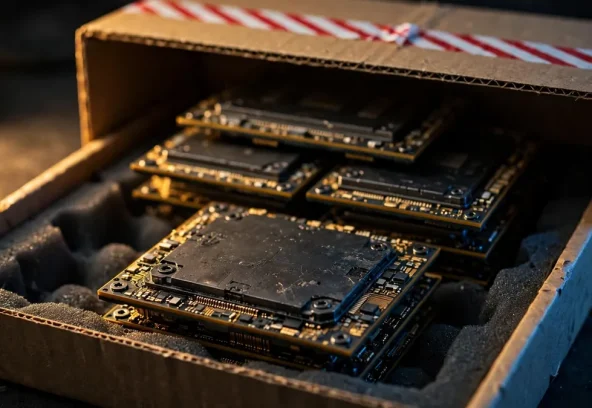
South Korea is about to join one of the smallest clubs in world trade. After exporting 930 billion dollars worth of goods in the first ten months of 2026, the country needs only 70 billion dollars more to record 1 trillion dollars in annual exports for the first time, and its trade ministry says that milestone is almost certain to fall in November.
In short: October exports reached 115.28 billion dollars, up 93.7 percent on a year earlier, driven overwhelmingly by semiconductors for artificial intelligence infrastructure. Chips alone accounted for almost half of October exports, while cars, computers and cosmetics also grew. The result is not yet a completed record, because the 1 trillion dollar figure is a forecast based on the current pace, not a total already banked.
Key takeaways
- South Korea exported 930 billion dollars from January to October 2026, passing 900 billion dollars for the first time.
- October exports of 115.28 billion dollars were the second-highest monthly total on record, after September.
- Semiconductor exports reached 56.44 billion dollars in October, up 259.4 percent year on year and almost half of the monthly total.
- Only the United States, China and Germany have previously recorded 1 trillion dollars in annual exports.
- The milestone is expected in November, but the October figures are preliminary and the chip-heavy surge carries concentration risk.
What the numbers show
The figures come from South Korea’s Ministry of Trade, Industry and Energy, published on 1 November 2026 as provisional October trade data. Yonhap News Agency, the Korea Herald and the Korea JoongAng Daily all reported the same headline totals, which gives the core numbers a solid cross-check. One caution matters from the start: provisional customs data can be revised until annual statistics are finalised, a process reported to run to February 2027, so small details may move even if the overall picture does not.
October was exceptional by almost any measure. Exports rose 93.7 percent from October 2025 to 115.28 billion dollars, the sharpest year-on-year gain reported since January 1974 according to Reuters reporting cited by Business News Malaysia, and slightly above the 93.2 percent median forecast in a Reuters poll of economists. It was the second-highest monthly total on record, behind only September 2026, and the second consecutive month above 110 billion dollars.
| Measure | Figure | Change year on year |
|---|---|---|
| October exports | 115.28 billion dollars | Up 93.7 percent |
| January to October exports | 930 billion dollars | Up 60.6 percent |
| Still needed for 1 trillion dollars | 70 billion dollars | Less than one recent month of exports |
| October imports | 72.78 billion dollars | Up 36 percent |
| October trade surplus | 42.5 billion dollars | Second straight month above 40 billion dollars |
The arithmetic behind the November forecast is straightforward. South Korea has exported more than 110 billion dollars in each of the last two months. If November lands anywhere near that pace, the remaining 70 billion dollars is covered with room to spare. Trade Minister Kim Jung-kwan put it plainly, saying annual exports were almost certain to reach 1 trillion dollars within November. That is a ministerial forecast, not a completed result, and this article treats it as such.
Why chips are doing the heavy lifting
Semiconductors are the story. October semiconductor exports surged 259.4 percent year on year to 56.44 billion dollars, the second-highest monthly semiconductor total on record and the second straight month above 50 billion dollars. At 48.9 percent of October exports, chips alone were nearly half of everything South Korea sold abroad that month.
The ministry attributes the surge to continued investment in artificial intelligence facilities by global big technology companies, which has kept both export prices and volumes high. That explanation fits the wider pattern: computer exports jumped 496.6 percent to 5.85 billion dollars, driven by expanded server infrastructure investment and demand for server solid-state drives. South Korea is not simply selling more chips in isolation; it is selling into a global build-out of AI data centres.
That context is familiar from recent technology business news. The same AI infrastructure boom sits behind Marvell’s 115 billion dollar acquisition of Lumentum, a bet on the optical links inside AI data centres, and behind the cloud spending surge in Alphabet and Microsoft’s latest quarterly results. South Korea’s export figures are, in effect, the trade-statistics version of that investment cycle, with memory chips at the centre.
Beyond chips: cars, computers and cosmetics also grew
A chip-only boom would be fragile on its own, so the breadth of October matters. Exports rose in 18 of the top 20 major product categories, and exports excluding semiconductors still rose 34 percent year on year, according to ministry data reported by Newspim and Yonhap Infomax.
Automobile exports gained 18.1 percent to 6.55 billion dollars, the highest October figure on record, helped by strong demand for petrol hybrid models and by more working days than in October 2025, when the Chuseok holiday fell in October rather than September. Petroleum products jumped 80 percent to 6.92 billion dollars, petrochemical products rose 27.5 percent to 4 billion dollars, and steel rose 22.3 percent to 2.29 billion dollars. Cosmetics exports shot up 57.5 percent to 1.44 billion dollars on rising demand in China, the United States and the European Union.
None of those categories comes close to chips in scale, and that imbalance is the central tension of the milestone. The Korea Times made the same point in an editorial, noting that chip products, from high-bandwidth memory to DRAM, account for about 50 percent of the export surge. The milestone is real, but it is not evenly spread.
Where the exports are going
By destination, China remained South Korea’s largest export market in October, with shipments up 133.6 percent to 26.98 billion dollars, the fifth consecutive month above 20 billion dollars. The United States was close behind, with exports surging 185.8 percent to 24.9 billion dollars, supported by demand for semiconductors, computers and electrical equipment used in AI infrastructure.
The China detail deserves a careful read. Yonhap reported that semiconductor exports to China surged 331 percent year on year to 14.8 billion dollars during the first 25 days of October. That is a partial-month figure, not a full-month total, and it should not be compared directly with full-month totals for other destinations. What it does show is the same AI-driven pattern on both sides of the Pacific: the largest markets are buying the same kinds of products, for the same infrastructure build-out.
How South Korea joins a very small club
If the November forecast holds, South Korea will become only the fourth country ever to record 1 trillion dollars in exports in a single year, after the United States and Germany in 2006 and China in 2007. The journey is part of the story: South Korea first passed 100 million dollars in annual exports in 1964, passed 100 billion dollars in 1995, and reached a then-record 709.3 billion dollars in 2025, the first time it had passed 700 billion dollars.
The comparison with the existing members of the club is instructive. China took 13 years to grow annual exports from 100 billion dollars to 1 trillion dollars, while Germany took 30 years and the United States 31 years. South Korea, which passed 100 billion dollars in 1995, would reach the milestone 31 years later, but after a much faster final leg: from 709.3 billion dollars in 2025 to a projected 1 trillion dollars in 2026, a jump of roughly 40 percent in a single year if the forecast is met. That final-leg speed is also why the milestone should not be read as a normal year of growth.
President Lee Jae Myung, speaking to parliament on 2 November 2026 about a 2027 budget that raises government spending by 12.8 percent to 820.9 trillion won, described 1 trillion dollars in exports as now within reach and argued that South Korea must invest boldly to strengthen long-term growth potential. The political message and the trade data point in the same direction: the milestone is a platform to build on, not a finish line.
What could still slow it down
Three risks stand out, and each is documented rather than speculative. First, concentration. When one product category supplies almost half of a month’s exports, a cooling in that category moves the national total. The Bank of Korea, in a written response to the National Assembly in October, said semiconductor exports next year could fall as much as 100 billion dollars below its existing forecast if AI investment by United States big technology companies slows. That is a conditional warning about 2027, not a prediction that the 2026 milestone will fail.
Second, the investment cycle itself has already shown it can correct. A recent AI market sell-off hit chip and cloud stocks even as infrastructure spending rose, a reminder that export volumes and share prices do not move together. OpenAI’s move to buy Google’s TPU chips shows the same scramble from the buyer side: everyone is securing compute, and supply chains are being rearranged in real time.
Third, the data are provisional, and November trade has not happened yet at the time of writing. A weaker-than-expected November would push the milestone into December, not cancel it, given the 70 billion dollar gap against a recent monthly pace above 110 billion dollars. But until customs data confirm it, the honest wording is “expected” and “almost certain”, not “achieved”.
What happens next
Watch for the November trade release in early December, which will confirm whether the 1 trillion dollar line was crossed in November or slipped to December. The more important signals will be inside that release: whether semiconductor exports hold above 50 billion dollars for a third straight month, whether non-chip exports keep growing at the 34 percent pace seen in October, and whether shipments to China and the United States stay balanced or tilt sharply one way.
Beyond the monthly data, watch the Bank of Korea’s updated forecasts and any sign that United States big technology companies are slowing AI infrastructure orders. If chip demand cools, South Korea’s challenge will be to show that cars, computers, cosmetics and the other growing categories can carry more of the load. If it does not cool, the country will have to manage a different problem: an export economy running at a pace that strains capacity, pricing and trade politics all at once.
Frequently asked questions
Has South Korea already exported 1 trillion dollars in 2026?
No. As of the 1 November 2026 ministry release, cumulative exports for January to October stood at 930 billion dollars. The 1 trillion dollar figure is expected in November based on the current monthly pace, but it had not been reached in the published data at the time of writing.
Why are South Korean exports growing so fast?
Primarily because of semiconductors for artificial intelligence infrastructure. October chip exports of 56.44 billion dollars, up 259.4 percent year on year, supplied almost half of the month’s total, while computer exports for AI servers also surged. Other categories grew too, but none at anything like the chip pace.
Which countries have exported 1 trillion dollars in a year before?
Three: the United States and Germany, both in 2006, and China in 2007. South Korea would become the fourth if its November forecast is confirmed.
What is the biggest risk to the milestone?
Concentration in chips. The Bank of Korea has warned that semiconductor exports next year could fall as much as 100 billion dollars below forecast if United States big technology investment in AI slows. A cooler chip market would not erase the 2026 milestone, which is close, but it would change the outlook for 2027.
Conclusion
South Korea’s path to 1 trillion dollars in exports is a story about one sector lifting a whole economy, and about how quickly that can happen when a global technology cycle lines up behind a national strength. The numbers are striking, the breadth beyond chips is encouraging, and the risks are clearly labelled in the central bank’s own warnings. Whether November confirms the milestone or December does, the more durable question is what South Korea builds on top of it: a broader export base, or a deeper dependence on the chips that got it there.
This article reports trade and economic data for information only and is not financial advice.
Sources and Further Reading
- Korea Herald, 1 November 2026: South Korea’s monthly exports hit 115.3 billion dollars in October on strong chip sales
- Korea JoongAng Daily, 1 November 2026: Driven by AI chip boom, Korea poised to become world’s fourth 1 trillion dollar exporter
- Seoul Economic Daily, 2 November 2026: Korea nears 1 trillion dollars in annual exports
- SBS News, 1 November 2026: South Korea nears historic 1 trillion dollar export milestone
- Korea Herald Business, 1 November 2026: South Korea’s exports top 900 billion dollars for first time
- Yonhap Infomax, 1 November 2026: Annual exports near 1 trillion dollars as semiconductors exceed 50 billion dollars for second consecutive month
- Korea Times editorial, 2 November 2026: 1 trillion dollars in annual exports
- Newspim, 1 November 2026: October exports hit 115.3 billion dollars, second highest on record
- UrduPoint, 1 November 2026: Korea’s exports hit 115.3 billion dollars in October, via Yonhap
- JawaWa, 2 November 2026: South Korea unleashes huge AI budget, targets 1 trillion dollars in exports, reporting President Lee Jae Myung’s 2 November parliament speech