


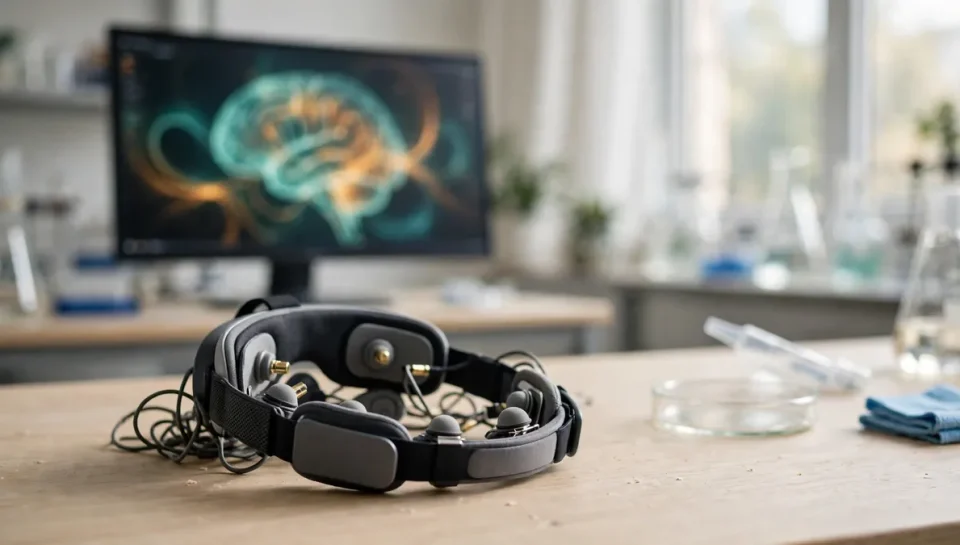
A noninvasive form of deep brain stimulation improved depression scores in people with subclinical depression, according to a study published in Science Translational Medicine on 18 November 2026. Researchers led by Professor Tu Yiheng of the Institute of Psychology at the Chinese Academy of Sciences used a technique called temporal interference stimulation to target a reward-processing circuit in the brain, without surgery and without implants. In a randomised, double-blind, sham-controlled trial of 69 people, three consecutive days of stimulation at 10 Hz produced significantly greater reductions in depression scores than a sham treatment at a seven-day follow-up. The result is early: the study was small, the participants had subclinical symptoms rather than a clinical diagnosis, and the authors say larger clinical studies are needed before the approach can be called a therapy.
Key takeaways:
- A technique called temporal interference stimulation, or tTIS, delivered gentle electrical currents through electrodes on the scalp to reach a deep brain region, the ventromedial prefrontal cortex.
- In healthy adults, stimulation at 10 Hz selectively improved reward learning, while stimulation at 5 Hz showed no comparable benefit.
- In 69 people with subclinical depression, three days of 10 Hz stimulation reduced depression scores more than a sham treatment at a seven-day follow-up.
- The approach is not surgery, not an implant, and not a brain-computer interface.
- Larger clinical studies are still needed, and the technique is not an approved treatment for depression.
What is noninvasive deep brain stimulation?
Deep brain stimulation usually means electrodes implanted in the brain during surgery, a treatment used for movement disorders such as Parkinson’s disease and, in limited settings, for severe depression that has not responded to other treatments. The new study takes a different route. Temporal interference stimulation, known as tTIS, delivers two or more high-frequency electrical currents through electrodes placed on the scalp. Where those currents overlap deep inside the brain, they interfere with each other and create a lower-frequency beat, in this case 10 Hz, that can modulate activity in a targeted region. The scalp itself experiences only the high-frequency currents, which is what makes the approach noninvasive.
The idea is not new in principle, but applying it to a specific circuit involved in depression is. The team first had to find the right target, and that is where brain imaging came in.
How the team found the target
The researchers combined functional magnetic resonance imaging, electroencephalography and computational modelling to map a reward-processing circuit connecting the ventromedial prefrontal cortex, or vmPFC, with the ventral striatum. The work sits alongside other recent studies that map biology at fine resolution, including research that reads DNA cell by cell to find disease variants. Reward learning, the process of adapting behaviour based on expected and actual outcomes, relies on interactions between brain regions involved in motivation and decision-making. Disruptions in these circuits are associated with depression.
The team also found that theta-band and alpha-band neural oscillations in the vmPFC were associated with reward prediction errors, the signals the brain produces when an outcome is better or worse than expected. That finding pointed to the vmPFC as the stimulation target and to the theta band, around 10 Hz, as the stimulation frequency. In other words, the stimulation protocol was designed from the brain signals themselves, rather than chosen by trial and error.
Why 10 Hz worked and 5 Hz did not
Before testing the approach in people with depressive symptoms, the researchers tested it in healthy adults. Stimulation at 10 Hz selectively enhanced reward learning and altered interactions within the frontostriatal circuit. Stimulation at 5 Hz showed no comparable benefit.
The contrast matters, because it shows the effect is frequency-specific rather than a general result of having electrodes on the scalp. A 10 Hz beat sits in the theta range, matching the oscillations the team had linked to reward prediction errors. At 5 Hz, the stimulation did not engage the same circuit in the same way. For readers, the practical point is simple: the frequency is part of the treatment, not a detail. Any future version of this technique would need to get the frequency right, and the study gives a clear reason to start at 10 Hz.
The 69-person trial
The core of the study is a randomised, double-blind, sham-controlled trial involving 69 people with subclinical depressive symptoms. Subclinical depression means depressive symptoms that sit below the threshold for a clinical diagnosis: real and often distressing, but not meeting the full criteria a clinician would use to diagnose major depression. That distinction matters for everything that follows.
Participants received stimulation on three consecutive days, then were assessed at a seven-day follow-up. Those who received 10 Hz tTIS showed significantly greater reductions in depression scores than those who received the sham treatment. The sham control is important: because neither the participants nor the researchers assessing them knew who received real stimulation, the improvement cannot be explained away as a placebo effect or as expectation alone.
Three things stand out. First, the effect appeared after only three days of stimulation, which is fast compared with treatments that take weeks to show benefit. Second, the benefit was still present at the seven-day follow-up, so it was not a fleeting effect measured minutes after stimulation. Third, the study was designed around a mechanism, the reward circuit, rather than stimulating the brain and hoping for the best. That mechanistic grounding is what makes the result interesting to other researchers, even at this early stage.
What the study does not show
Early results invite overstatement, so the limits deserve the same attention as the findings.
| Claim | What the study actually supports |
|---|---|
| A new treatment for depression | No. Participants had subclinical symptoms, not a clinical diagnosis, and the authors say larger clinical studies are needed to establish therapeutic efficacy. |
| An approved therapy | No. This is a research finding, not a licensed treatment. |
| A brain-computer interface | No. The authors state the approach is not a real-time closed-loop brain-computer interface. |
| A lasting benefit | Unknown. The follow-up was seven days. Longer-term effects were not measured. |
| A large, definitive trial | No. Sixty-nine participants is a small sample, and small trials can overstate effects. |
The 5 Hz result is a limit of a different kind: it shows the approach is narrow. A different frequency, a different target or a different population might not respond at all. That is normal for a first study, and it is why the authors frame their work as a framework for future brain-informed stimulation technologies rather than as a finished therapy.
Why this matters
Depression is one of the most common health conditions in the world, and existing treatments do not work for everyone. It is the second peer-reviewed science story on WebReOn this week, after research showing how a genetic dimmer switch helped mice survive sepsis. Antidepressants can take weeks to act and carry side effects, while psychotherapy is not always available. A noninvasive technique that reaches deep brain circuits without surgery would be a meaningful addition if it holds up in larger trials.
The study also matters as a method. By starting from brain signals, identifying a circuit, and then designing stimulation to match, the team showed a route that other researchers can follow for other reward-related disorders. The authors describe the work as a promising framework for future brain-informed stimulation technologies and potential interventions, and that framing is the right one: a framework, not a cure.
For readers, the honest summary is this. A carefully designed, small, well-controlled study found that three days of targeted, noninvasive brain stimulation at 10 Hz improved depression scores in people with mild symptoms, and the effect was still visible a week later. That is genuinely encouraging. It is also genuinely early.
What happens next
The authors are clear about what comes next: larger clinical studies. Those studies will need to answer the questions this one could not. Does the effect hold in people with clinical depression, not just subclinical symptoms? Does it last weeks or months rather than days? How many sessions are needed, and does the benefit fade or build with more of them? And is the approach safe and practical outside a research laboratory?
Until those studies exist, the technique will remain a research tool. Anyone experiencing depression should speak to a clinician about established treatments rather than seeking out experimental stimulation.
Frequently asked questions
What is temporal interference stimulation?
Temporal interference stimulation, or tTIS, is a noninvasive brain stimulation technique. Two or more high-frequency electrical currents are delivered through electrodes on the scalp. Where the currents overlap deep in the brain, they create a lower-frequency beat that modulates activity in a targeted region, without surgery and without implants.
Is noninvasive deep brain stimulation available as a treatment for depression?
No. The technique was tested in a small research study of 69 people with subclinical depressive symptoms. Larger clinical studies are needed before it could be considered a treatment, and it is not an approved therapy.
How is this different from implanted deep brain stimulation?
Implanted deep brain stimulation requires surgery to place electrodes inside the brain. Temporal interference stimulation reaches deep brain regions from electrodes on the scalp, so there is no surgery and no implant. The two approaches target the brain in very different ways.
What is subclinical depression?
Subclinical depression means depressive symptoms that do not meet the full criteria for a clinical diagnosis of major depression. The symptoms are real and can affect daily life, but they sit below the diagnostic threshold. The study’s participants had subclinical symptoms, so its results do not directly apply to clinical depression.
Who led the study?
The research was led by Professor Tu Yiheng of the Institute of Psychology at the Chinese Academy of Sciences, working with researchers from Shenzhen University and other institutions. The paper was published in Science Translational Medicine on 18 November 2026.
Sources and Further Reading
- MedicalXpress, “Noninvasive deep brain stimulation improves subclinical depression, study finds”, 18 November 2026, https://medicalxpress.com/news/2026-11-noninvasive-deep-brain-subclinical-depression.html
- Feixue Wang and colleagues, “Temporal interference stimulation targeting the ventromedial prefrontal cortex enhances reward learning and improves depression scores”, Science Translational Medicine (2026), DOI 10.1126/scitranslmed.adz9823, https://doi.org/10.1126/scitranslmed.adz9823
- Gaplinc sepsis study on WebReOn, https://webreon.agency/gaplinc-sepsis-treatment-mice-study/
- AlphaGenome 2 DNA study on WebReOn, https://webreon.agency/alphagenome-2-dna-cell-by-cell-disease-variants/
- Kuiper Belt heavy water study on WebReOn, https://webreon.agency/kuiper-belt-heavy-water-study/


