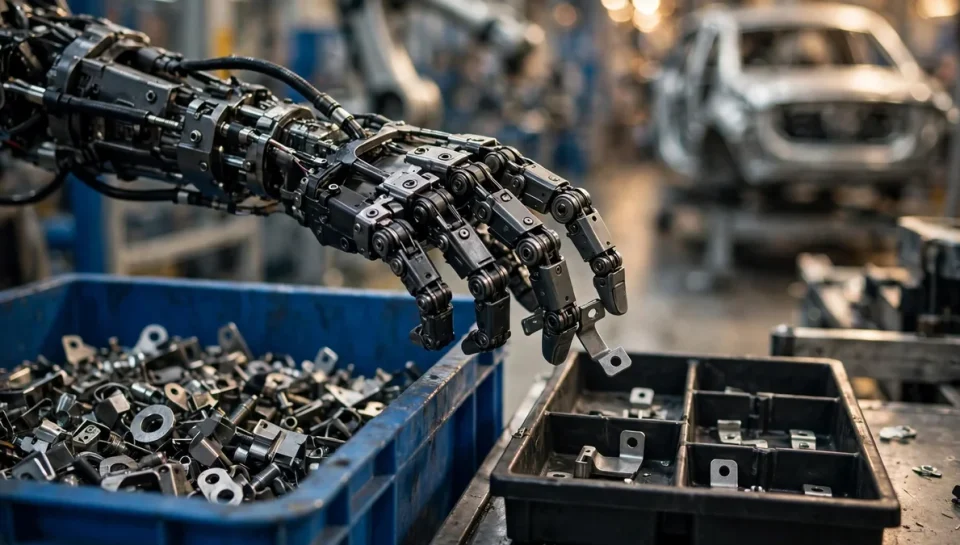
Google DeepMind has introduced Gemini Robotics 2.5, its most capable vision-language-action model so far, and the release comes with something robotics announcements often lack: a working test on live factory lines. Apptronik Apollo 2 humanoid robots running the model have been sorting automotive parts on active Mercedes-Benz production lines in Hungary and Germany, and DeepMind reports a 96 percent success rate for the task.
The announcement, published by DeepMind on 10 November 2026, frames the release around three claims: broader dexterity, real-world reliability, and stronger physical safety. Here is what the primary source confirms, and what readers should treat with care.
What Gemini Robotics 2.5 is
A vision-language-action model takes camera input and a language instruction and turns them into physical movement. DeepMind says Gemini Robotics 2.5 widens both the range of skills a robot can learn and the speed at which it learns them. The model was evaluated across more than 200 distinct tasks, including serving food with tongs, tying a bow on a gift box, and pipetting liquid, which are the kinds of jobs that combine tool use, deformable objects, and fine control.
Against its previous baselines, DeepMind reports success rates 30 percent to 100 percent higher depending on the task type, with tasks completed 20 percent to 30 percent faster. Those are the company’s own evaluation figures, published without an independent replication, and they should be read as vendor results rather than settled measurements.
The model works across different robot bodies. DeepMind names Apptronik’s Apollo 2 humanoid, fitted with a five-finger, 22 degree-of-freedom SharpaWave hand, and the Franka Duo platform with two-finger parallel grippers. Gemini Robotics 2.5 is rolling out to DeepMind’s robotics partners rather than going on general sale.
The Mercedes-Benz pilot, in DeepMind’s own account
The factory work took place with Apptronik and Mercedes-Benz on active automotive production lines in Kecskemét, Hungary, and Sindelfingen, Germany. Apollo 2 performs automotive kitting: reaching into bulk bins, picking up individual parts such as metal brackets, and placing them into sequencing trays in the exact order each vehicle on the line needs.
Kitting is repetitive and physically taxing, which is precisely why it is a credible first factory job for a humanoid. DeepMind describes the run as a proof of concept and reports that Apollo 2 picked and packed the parts with a 96 percent success rate. The embodied reasoning model, Gemini Robotics ER, tracks the workflow while the 2.5 actions model controls the arms and hands, correcting for gaps as it works.
Two cautions belong with that headline figure. First, DeepMind does not publish the number of trials behind the 96 percent, so it cannot yet be compared with human error rates or with rival systems. Second, a proof of concept on two lines is not a production contract. What the pilot does establish is narrower and still significant: a generalist model, not a hard-coded routine, held up on real lines in two countries.
Safety work shipped alongside the model
DeepMind says the model uses inference-time reasoning guidance to steer around physical hazards in real time, and reports that this improved safe task completion around obstacles by 33 percent and around nearby people by 43 percent in its evaluations.
The release also includes ASIMOV-Jailbreak, an open-source benchmark of hundreds of prompts that disguise unsafe requests across dozens of scenes. One figure needs careful reading: the 99.5 percent jailbreak resistance score belongs to Gemini 4 Argon, the reasoning model, against an 82 percent rate for the earlier Gemini Robotics ER 2 baseline. DeepMind does not publish an ASIMOV-Jailbreak score for the Robotics 2.5 actions model itself, so the 99.5 percent should not be quoted as the robot controller’s score.
Argon also played a development role. DeepMind says it acted as a simulation engine, generating varied practice runs and digital twins from real camera scenes, which sped up the work behind 2.5. The same pattern appeared in this week’s AlphaProof Code work, where DeepMind used AI agents to verify Signal’s encryption code, covered in our report on AlphaProof Code and the Signal encryption proof.
Why this release matters beyond robotics labs
Robotics is moving from scripted cells to generalist models, and the constraint is shifting from hardware to learning speed and reliability data. A model that can be evaluated across 200 tasks and then hold a 96 percent success rate in a partner’s factory, even as a proof of concept, gives manufacturers a concrete reference point when they evaluate their own pilots. Our earlier guide to Gemini 4 Carbon for business and cybersecurity covers the sibling model line this release builds on.
What is still missing is the operational fine print: trial counts, human intervention rates, cycle times against human kitting crews, and any commercial terms between the partners. Until those appear, the honest summary is that Gemini Robotics 2.5 is a well-documented step forward with one strong factory data point, not proof that humanoid labour is solved.
Sources and Further Reading
- Google DeepMind, “Gemini Robotics 2.5: Accelerating Physical Intelligence”, 10 November 2026: deepmind.google