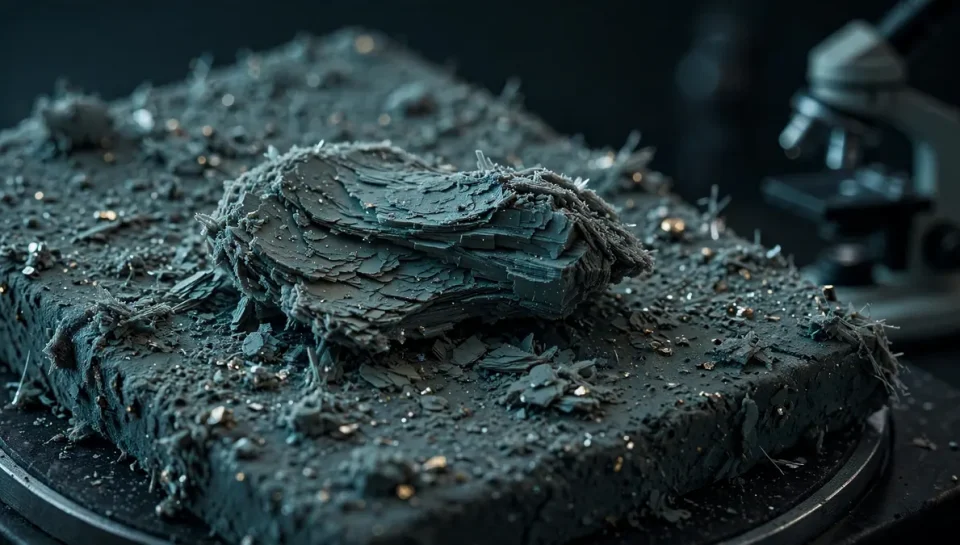
Twelve microscopic grains of dust collected high above Earth carry the chemical fingerprint of a primordial Kuiper Belt heavy water reservoir, according to a study published in Science Advances on 11 November 2026. The grains, each 10 to 30 micrometres across, were gathered from the stratosphere by high-altitude NASA aircraft and traced to the Kuiper Belt, the ring of icy bodies beyond Neptune. Their minerals show they were once altered by liquid water rich in heavy oxygen isotopes, water that stayed largely separate from the material that built the inner planets.
Key takeaways
- Twelve hydrated dust particles, each 10 to 30 micrometres across, were collected from Earth’s stratosphere by high-altitude NASA aircraft.
- Radiation-track densities about 100 times higher than dust from the asteroid belt or Jupiter-family comets point to a Kuiper Belt origin.
- Hydrated clay minerals, mainly saponite with minor serpentine, show liquid water once flowed inside the grains’ parent bodies.
- The original water’s oxygen-18 was roughly 15 percent above Earth’s ocean standard, a model-based upper limit, not a direct measurement.
- “Heavy” here means heavy oxygen isotopes, oxygen-17 and oxygen-18, not deuterium.
- The reservoir stayed largely isolated from inner solar system material, most likely held back by Saturn.
What the study found
The study was led by Lindsay P. Keller of NASA’s Johnson Space Center, with Christopher J. Snead, Ming-Chang Liu and Kevin D. McKeegan. It appears in Science Advances as “A Primordial Heavy Water Reservoir in the Outer Solar System” (DOI 10.1126/sciadv.aeg1602). The team examined 12 track-rich hydrated interplanetary dust particles drawn from NASA’s cosmic dust collection, curated at the Johnson Space Center.
The grains are dominated by hydrated clay minerals, mainly well-crystallised saponite with minor serpentine, plus iron-nickel sulfides, carbonates and carbon-rich material. Their carbon content is about four times that of CI chondrites, the most primitive meteorites. The mineralogy matters because clays like saponite form only when liquid water reacts with dry rock at low temperatures, so their presence means water once flowed inside the parent bodies of these grains, even though the Kuiper Belt is frozen solid today.
The team measured the oxygen isotopes at the University of California, Los Angeles, using a CAMECA ims-1290 ion microprobe. Working backwards through the clay-forming reactions, they estimated that the water which altered the grains had a δ18O of about +155 per mil, roughly 15 percent above the standard for Earth’s ocean water. The paper is careful about that number: it is an upper limit, because only the structural hydroxyl in the clays was counted, while loosely bound water held between the clay layers is lost before measurement.
How dust from the Kuiper Belt reaches Earth
Interplanetary dust particles are specks of rock and carbon shed by asteroids and comets. They drift through space, slowly spiral towards the Sun under the drag of sunlight, and eventually rain down on Earth. Many survive the fall as unmelted micrometeorites, and high-altitude NASA aircraft collect them from the stratosphere.
The clue to where these 12 grains began lies in scars inside their crystals. Energetic particles from the Sun leave tracks in minerals such as olivine and pyroxene during the long journey inward. The grains in this study carry track densities of about 10^10 to 10^11 per square centimetre, around two orders of magnitude higher than expected for dust from main-belt asteroids or Jupiter-family comets. Earlier research linked exactly this signature to objects in the Edgeworth-Kuiper Belt, the largest dust source beyond the gas giant planets. Keller and co-author George Flynn estimated in 2022 that as much as a quarter of the interplanetary dust entering the inner solar system may have travelled from the Kuiper Belt.
It is a long journey. The Kuiper Belt begins beyond Neptune’s orbit, roughly 30 astronomical units from the Sun. Voyager 1, now more than a light-day from Earth, is the only spacecraft to have crossed that region and kept going, which is why dust collected in our own atmosphere is such a valuable sample of a place no mission has visited.
What Kuiper Belt heavy water means
Oxygen has three stable isotopes. The common form, oxygen-16, has eight protons and eight neutrons. Oxygen-17 has nine neutrons and oxygen-18 has ten. Water built from the heavier isotopes is a kind of heavy water, but it is not the deuterium-rich heavy water used in nuclear reactors. That distinction matters, and the study’s authors make it plain.
Scientists have long predicted that ice in the outer solar system would be enriched in heavy oxygen. Evidence was thin, though. The strongest hints came from cosmic symplectite, a rare mineral intergrowth in the Acfer 094 meteorite, and from the Rosetta mission, which found the water in comet 67P depleted in oxygen-16. Neither sample came from a body of known Kuiper Belt origin. The new grains change that: the water inferred from them averages about +62 per mil in Δ17O, against roughly +3 to +7 per mil for water inferred from carbonaceous chondrites. That gap is the fingerprint of a different reservoir, one that formed further out and stayed apart.
Why the reservoir stayed separate
The paper argues that the heavy water reservoir was isolated from the inner regions, most likely by Saturn, in combination with the ice giants Uranus and Neptune. Hydrodynamic simulations predict a pressure bump exterior to Saturn within the first few million years of the solar system, a feature that would have slowed or stopped the inward drift of outer solar system particles past Saturn’s orbit.
The chemistry supports the picture. The grains differ from CI chondrites and from the material returned from asteroids Bennu and Ryugu, and their carbon-rich compositions point to an origin outside the region where carbonaceous chondrites formed. The scarcity of 16O-poor material like these grains in hydrated meteorites suggests limited mixing between the two formation regions. That separation is the finding’s real weight: the outer solar system kept its own water chemistry from the earliest days of planet formation, rather than blending into a single well-mixed supply.
What this does not mean
Three limits deserve to be stated plainly, because the paper states them plainly too. First, this is not evidence that Kuiper Belt water seeded Earth’s oceans. The finding points the other way: the outer reservoir stayed separate, so Earth’s water came from elsewhere. Second, the sample is small. Twelve grains is a small number from which to describe a reservoir spanning billions of kilometres, even though the authors selected them at random from NASA’s catalogues. Third, the water itself was never measured directly. It is long gone. Its composition was reconstructed by mass balance, assuming a single main clay-forming reaction, and the values are upper limits. The Kuiper Belt origin also rests on radiation-track counts, not on an orbit traced back to a source body. Only material collected at the source could test the idea directly, and no mission has sampled a Kuiper Belt object.
Why it matters
Until now, the predicted heavy-oxygen reservoir in the outer solar system was a theory with scattered hints. This study gives it its strongest evidence yet, from samples whose origin can be pinned down by their radiation scars and whose chemistry was measured grain by grain. It sharpens the picture of how the early solar system was divided into chemical zones, and it gives future missions a clearer idea of what to look for. NASA’s twin ESCAPADE probes are now heading for Mars after a flyby of Earth, and a nuclear-powered rover is being built to hunt for ice at the Moon’s south pole. Each mission tests a piece of the same story, and the Kuiper Belt has now added its own chapter, written in twelve specks of dust carrying the signature of Kuiper Belt heavy water.
Frequently asked questions
Is this the same heavy water used in nuclear reactors?
No. Reactor heavy water is rich in deuterium, a heavy form of hydrogen. The water in this study is heavy because of its oxygen, enriched in oxygen-17 and oxygen-18. The two are different substances with different properties.
Did Kuiper Belt water seed Earth’s oceans?
There is no evidence for that in this study, and the finding points the other way. The heavy water reservoir appears to have stayed largely isolated from the inner solar system, most likely held back by Saturn, so Earth’s water came from a different source.
How do scientists know the dust came from the Kuiper Belt?
From radiation tracks. Energetic particles from the Sun scar the crystals inside dust grains during their long journey inward. The 12 grains carry track densities about 100 times higher than dust from the asteroid belt or Jupiter-family comets, a signature earlier research linked to objects in the Edgeworth-Kuiper Belt. Only twelve grains were suitable because hydrated, track-rich particles of Kuiper Belt origin are rare, and each must be sliced to about 50 to 70 nanometres thick and analysed grain by grain.
Sources and Further Reading
- Keller, L. P., Snead, C. J., Liu, M.-C., and McKeegan, K. D., “A Primordial Heavy Water Reservoir in the Outer Solar System”, Science Advances, 11 November 2026. https://www.science.org/doi/10.1126/sciadv.aeg1602
- Kasal, K., “Space dust particles point to ancient heavy-oxygen water reservoir in the Kuiper belt”, phys.org, 12 November 2026. https://phys.org/news/2026-11-space-particles-ancient-heavy-oxygen.html
- “Scientists Find Evidence of Primordial Water Hidden at The Edge of The Solar System”, ScienceAlert, 11 November 2026. https://www.sciencealert.com/breaking-scientists-find-evidence-of-primordial-water-hidden-at-the-edge-of-the-solar-system