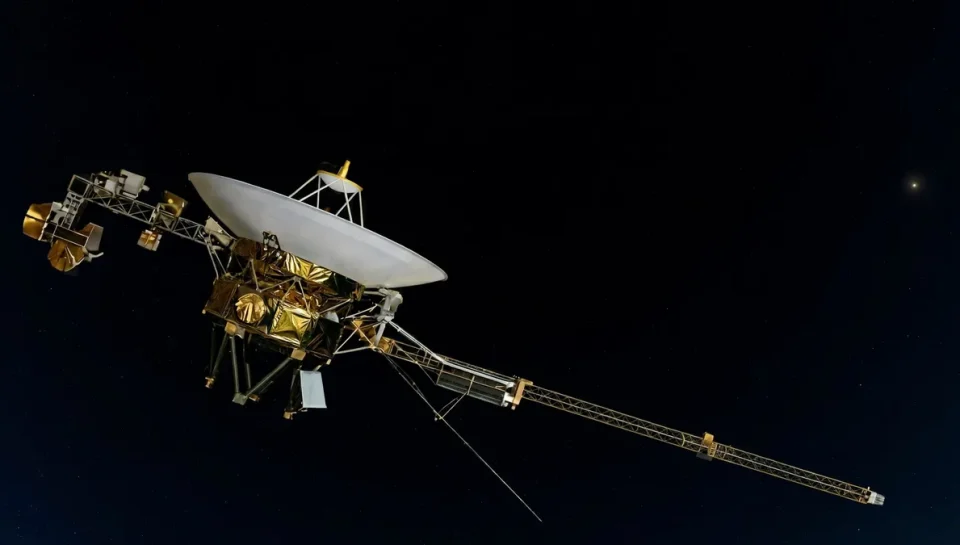
NASA’s Voyager 1 will become the first human-made object to reach one light-day from Earth on Wednesday 18 November 2026, at 5:16:07 a.m. EST (10:16:07 UTC, 3:16:07 p.m. PKT). The Voyager 1 one light-day milestone arrives 49 years, two months and 11 days after launch, with the spacecraft 25.902 billion kilometres (16.094 billion miles, 173.14 astronomical units) from home. From that moment, a radio command from Earth will take a full day to reach it, and its reply will take another full day to come back. Nothing will change aboard the spacecraft itself. The crossing is a human milestone, not a physical one. NASA marks it the night before by asking people worldwide to shine a light at the sky.
Key takeaways
- The moment: Wednesday 18 November 2026 at 5:16:07 a.m. EST (10:16:07 UTC, 3:16:07 p.m. PKT).
- The distance: 25.902 billion kilometres, or 16.094 billion miles, from Earth.
- The wait: a signal takes 24 hours each way, making a command and its reply a two-day round trip.
- The celebration: NASA’s Shine Bright for Voyager’s Light-Day event takes place after sunset on Tuesday 17 November.
What the Voyager 1 one light-day milestone means
A light-day is a distance, not a time. It is the distance light travels in 24 hours: about 25.9 billion kilometres. Light from the Sun takes roughly eight minutes to reach Earth, so Voyager 1 is now about 173 times farther from the Sun than Earth is. It crossed the heliopause into interstellar space in August 2012. The one-light-day line is a marker humans chose, not a boundary the spacecraft will feel. NASA has said plainly that nothing aboard will switch, no instrument will change state and no new kind of space begins at the crossing.
What changes is the conversation. The Deep Space Network’s giant antennas already wait most of a day for a reply; from 18 November the wait becomes a full day each way, so the JPL engineers who send commands about once a week will plan each instruction knowing the answer arrives two days later.
How to take part in Shine Bright
After sunset on Tuesday 17 November, NASA invites everyone to point a flashlight, glow stick, solar lantern, bike light or phone at the sky and flash V-G-R, Voyager’s call sign, in Morse code. V is three quick flashes and one long flash. G is two long flashes and one quick flash. R is one quick flash, one long flash and one quick flash. Repeat the sequence for about a minute. NASA has built an automated flasher that does the code for you, at go.nasa.gov/vgr, with full instructions at go.nasa.gov/shinebright.
The gesture is symbolic: no torch on Earth can reach a spacecraft 25.9 billion kilometres away. Participants are invited to photograph or film their signal and share it, tagging @NASA. Fittingly, Voyager already knows Morse code: the Golden Record aboard both spacecraft includes the message “Ad astra per aspera”, Latin for “through struggle to the stars”.
Forty-nine years to the edge of the Sun’s influence
Voyager 1 launched on 5 September 1977, two weeks before its twin, on a mission planned to last about five years and visit Jupiter and Saturn. It flew past Jupiter in 1979 and Saturn in 1980, then kept going. In February 1990 it took the Pale Blue Dot photograph, showing Earth as a single pale speck in a band of sunlight. In August 2012 it crossed the heliopause and entered interstellar space. It has now travelled for 49 years, two months and 11 days at about 61,000 kilometres per hour, heading toward Gliese 445, more than 17 light-years away. At its present speed, NASA estimates it will take about another 18,000 years to cover a full light-year, and more than twice as long to come near another star.
NASA’s newer missions are still early in their journeys: ESCAPADE arrived at Mars in November after an 11-month journey, and a CHAPEA crew spent 378 days in a simulated Mars habitat.
A spacecraft running on borrowed time
Keeping Voyager 1 alive is an exercise in patience and thrift. Its plutonium generators lose output year by year, so engineers switch instruments off to stretch what remains; in April 2026 they switched off the low-energy charged particle experiment. A small flight team at JPL sends commands about once a week. In October 2026 the Deep Space Network missed two scheduled contacts, on 18 and 19 October; the signal returned on 20 October after a thruster group went offline and backup thrusters activated automatically. JPL reported the cause is under investigation. NASA expects to stay in contact into the 2030s. Voyager 2 took a different path and is not expected to reach one light-day until November 2035, and whether it is still operating then is not certain.
Spacecraft do not last forever: Swift ended in a fiery reentry after a failed rescue, while a nuclear-powered rover is being prepared for the Moon’s darkest craters. Voyager 1 has outlasted every expectation placed on it.
What happens next
The Planetary Society plans an online celebration at 8 p.m. ET on Wednesday 18 November. On Thursday 19 November at 12 p.m. EST (9 a.m. PST), JPL will host a moderated discussion with mission officials and NASA leadership, including Nicky Fox, Jonathan Lunine, Suzanne Dodd, Kareem Badaruddin and Jamie Rankin. It will cover the status of both Voyagers, the science they still gather and the challenge of operating spacecraft at such distances, with questions from the audience. NASA will also preview its Voyager documentary, planned for NASA+ in 2027 for the mission’s 50th anniversary, and the event will stream on NASA’s live page.
The farthest reach, and the longest wait
The Voyager 1 one light-day crossing is a reminder of how far a machine built in the 1970s has carried human curiosity, and how patient deep-space exploration has become. Every command takes a day to arrive and another day to answer. Project manager Suzanne Dodd calls Voyager 1 Earth’s ambassador, giving people back home a sense of wonder. On Tuesday night, the world answers that wonder with a flash of light. The spacecraft will not see it; that was never the point. The point is that, 49 years after launch, people are still watching, still listening, and still counting the distance.
Frequently asked questions
When exactly does Voyager 1 reach one light-day?
Wednesday 18 November 2026 at 5:16:07 a.m. EST (10:16:07 UTC, 3:16:07 p.m. PKT).
What is a light-day?
The distance light travels in 24 hours, about 25.9 billion kilometres. Voyager 1 is the first human-made object to reach that distance from Earth.
Can a flashlight really send a message to Voyager 1?
No. The Shine Bright event is symbolic: a torch beam spreads and fades within metres, and Voyager 1 is 25.9 billion kilometres away.
Will anything change on Voyager 1 when it crosses one light-day?
No. NASA says nothing aboard will switch and no new region of space begins.
How much longer can NASA stay in touch with Voyager 1?
NASA expects contact into the 2030s as its plutonium power declines. Voyager 2 is not expected to reach one light-day until November 2035.
Sources and Further Reading
- NASA, “NASA Invites Media, Public to Join Voyager 1 One-Light Day Activities”, 10 November 2026, updated 13 November 2026
- NASA Science, “Shine Bright for Voyager’s Light-Day”
- NASA Science, Voyager mission
- Smithsonian Magazine, “Voyager 1 Is the Farthest Human-Made Object in the Universe, and the Spacecraft Is About to Reach One Light-Day From Earth”, 10 November 2026
- The Hindu, “NASA’s Voyager 1 closes in on a light-day in interstellar space for new distance record”, 15 November 2026
- The Register, “NASA asks Earthlings to wave as Voyager 1 reaches a light-day away”, 11 November 2026
- IFLScience, “NASA Wants the World to Send a Message to Voyager 1 as It Reaches One Light-Day From Earth on November 18”