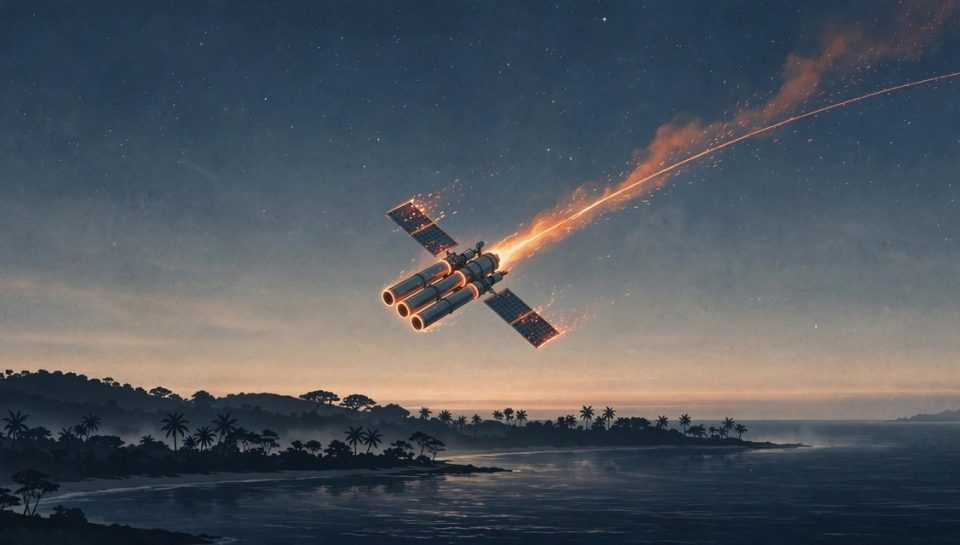
NASA’s Neil Gehrels Swift Observatory burned up over Indonesia on November 4, 2026, closing a mission that lasted nearly 22 years after being designed for only two. The United States Space Force confirmed reentry at 7:39 a.m. Eastern Time, or 12:39 p.m. UTC, over the North Sumatra region, and NASA reported no damage or injuries on the ground at the time of the first reports.
Swift was a gamma-ray burst hunter, built to catch the brightest explosions in the universe within seconds and alert other telescopes. It observed more than 2,000 gamma-ray bursts and more than 1,400 supernovae, and its data fed about 7,000 papers. Its end was expected, but not in this way: a commercial rescue spacecraft sent to lift Swift higher failed in summer 2026, leaving it to fall.
In short, Swift’s fall was expected, its rescue was not, and its legacy is secure: a two-year telescope that worked for 22 years, caught thousands of cosmic explosions, and left an archive that will outlive the spacecraft itself, while no current mission fully replaces its rapid response.
Key takeaways
- Swift reentered at 7:39 a.m. Eastern Time on November 4, 2026, over North Sumatra, Indonesia, at about 22 times the speed of sound.
- Most of the 1,452 kilogram spacecraft was expected to burn up; the chance of debris harming anyone was about 1 in 2,100.
- Swift had no engine, and stronger solar activity thickened the upper atmosphere and increased the drag pulling it down.
- The 30 million dollar Katalyst LINK rescue failed in August 2026 after losing orientation control.
- Swift’s archive stays open, but no current observatory fully replaces its rapid-response role.
What happened on November 4
The reentry point reported by the United States Space Force was near 3 degrees north latitude and 99 degrees east longitude, over western Indonesia. Other reports of the same NASA update gave the more precise figures of 3.4 degrees north and 98.6 degrees east. That point marks where Swift entered the atmosphere, not a confirmed impact point for any surviving debris, a distinction that matters because most of the spacecraft was expected to disintegrate high above the surface.
In local terms, that was 5:39 p.m. Pakistan Time and 7:39 p.m. Western Indonesian Time. Reuters reported Swift streaking in at about 22 times the speed of sound, roughly 200 miles north of the equator, inside the Space Force forecast window of 6:42 a.m. to 8:42 a.m. Eastern Time. Scientific American noted that sparse sensor coverage across the broad tropical band probably delayed confirmation until Wednesday afternoon in the United States.
Why Swift fell when it did
Swift never had its own propulsion system, so it could not fight the slow drag of the thin upper atmosphere. It made its final observation on October 20, 2026, from about 171 miles, or 275 kilometres, above Earth. At that height, drag made it impossible to hold its telescopes steady enough for useful observations, and NASA ended operations. For comparison, the International Space Station orbits at about 250 miles, so Swift was already well below the station by the time it stopped observing.
Stronger solar activity over the previous two years had puffed up the upper atmosphere, increasing drag beyond NASA’s expectations. NASA had warned on October 23 that reentry was expected within weeks, so the team knew Swift was coming down; only the timing and place along a wide tropical band were open.
The rescue mission that failed
In September 2025, NASA signed a 30 million dollar contract with Katalyst Space Technologies, a company based in Arizona, to build a robotic servicing spacecraft called LINK. The plan was for LINK to rendezvous with Swift, latch onto a telescope that had never been designed to be grabbed, and tug it to a higher, more sustainable orbit, buying years of extra science.
LINK launched on July 3, 2026, on a Pegasus XL rocket. Within weeks, it lost control of its orientation: two of its three reaction wheels, the spinning flywheels a spacecraft uses to control which way it points, stopped working, and its thruster system was only partly functional. A revised software package in August slowed the spin but never restored the precise pointing needed to capture Swift. On August 19, 2026, NASA and Katalyst called off the capture, and LINK itself reentered the atmosphere in late September, before Swift did.
The failure did not cause Swift’s decline, already under way from drag and lack of propulsion; it removed the one route that might have reversed it. It also matters beyond one telescope, as a first fixed-price, fast-built commercial rescue of a satellite never designed for servicing. A servicing vehicle must first survive as a spacecraft itself, and LINK did not clear that hurdle.
How Swift worked, and why speed mattered
Swift was the first observatory of its kind: a multiwavelength telescope that could react to a cosmic explosion on its own, without waiting for a human operator to send new instructions. Its Burst Alert Telescope watched a wide patch of sky for gamma rays. When it caught a burst, the spacecraft swung its other two telescopes toward the same spot within about a minute, so that the X-Ray Telescope and the Ultraviolet and Optical Telescope could record the fading afterglow while it was still bright. Its alerts also went out to observatories around the world within seconds, so ground-based telescopes could follow up.
What Swift discovered in 22 years
Swift launched on November 20, 2004, from Cape Canaveral on a Delta 2 rocket, with a two-year design life and a 500 million dollar price tag. It outlived that plan by two decades. Three episodes explain why its headline totals, more than 2,000 bursts and about 7,000 papers, matter more than a simple count.
First, in May 2005, Swift caught the afterglow of a short burst, GRB 050509B, lasting only about 0.03 seconds. It was the first X-ray afterglow from a short burst, in an old galaxy without star formation, pointing toward neutron-star mergers rather than collapsing massive stars as the cause.
Second, in August 2017, Swift played a central follow-up role in the first neutron-star merger seen through gravitational waves, GW170817. It did not detect the initial burst, which Fermi and INTEGRAL recorded; instead it observed ultraviolet light from the kilonova, the glowing debris cloud where heavy elements including gold are forged.
Third, Swift caught GRB 221009A in October 2022, later described as the brightest gamma-ray burst ever recorded. Reports of its final stretch also credit Swift with detecting hydroxyl emission from 3I/ATLAS, only the third interstellar object confirmed passing through the solar system.
Was anyone on the ground at risk
The short answer, on the evidence reported so far, is that the risk was real but small, and no harm was reported. NASA put the chance of debris harming anyone on the ground at about 1 in 2,100. Most of the spacecraft was expected to burn up, with only a handful of small, scorched fragments expected to survive, according to an aerospace engineer quoted by Reuters before reentry. In nearly 70 years of spaceflight, Reuters quoted the same engineer as noting, no one has ever been killed by falling debris.
That history is reassuring, but not a guarantee. The reentry band stretched nearly 1,500 miles in latitude either side of the equator, although most of the likely profile was over remote ocean. The confirmed point was over land in North Sumatra, a province of about 16 million people, with its capital Medan home to about 2.5 million; Reuters noted it was not immediately clear how close the point was to Medan. Until any debris is found, which had not been reported at the time of the first November 4 reports, the honest statement is that most of Swift burned up, some fragments may have survived, and no damage or injuries had been reported.
What remains after Swift
Swift’s data do not burn up with the spacecraft. NASA describes a public archive of about 12 terabytes, covering nearly 22 years of brightness measurements and multiwavelength spectra, plus more than 1.5 million images from the Ultraviolet and Optical Telescope. That archive stays available to researchers, and papers will keep drawing on Swift observations for years, just as they drew on them during its life.
What does not automatically continue is the rapid-response role. Scientific American reported that Swift’s departure leaves a hole in NASA’s space science fleet unlikely to be filled anytime soon: no current satellite fully replaces its ability to detect a burst and swing its own follow-up telescopes onto it within about a minute. Other missions cover parts of the job, but the combined, autonomous package was Swift’s alone. See also our CHAPEA Mars coverage, CERN particle physics coverage and Project Suncatcher coverage.
Frequently asked questions
Did Swift debris hit Indonesia
No debris strike had been reported at the time of the first November 4 reports. The confirmed coordinates describe the reentry point, not a confirmed debris impact site.
Why did the LINK rescue fail
LINK lost orientation control in July 2026 when two of its three reaction wheels failed. A software update slowed the spin but did not restore the pointing needed to capture Swift, so the capture was abandoned on August 19, 2026.
What replaces Swift now
No like-for-like replacement was named in the November 4 reports reviewed here. Other observatories still detect bursts and follow them up from the ground, but none fully replicates Swift’s combined autonomous detection and rapid follow-up, according to Scientific American.
Conclusion
Swift ended as many long-lived satellites do, in a streak of fire over a part of the world that never saw it work. What sets this ending apart is what came before: a two-year mission that ran for 22, a telescope that taught astronomy to move at the speed of an explosion, and a rescue attempt that showed how hard it is to save a spacecraft never built to be saved. The telescope is gone; its archive and the alert network it helped create are not.
Sources and Further Reading
- Reuters, November 4, 2026: NASA’s 22-year-old Swift satellite telescope falls from orbit in fiery finale
- Spaceflight Now, November 4, 2026: NASA’s Neil Gehrels Swift Observatory reenters over Western Indonesia
- Scientific American, November 4, 2026: NASA’s Swift telescope plunges back to Earth
- USA Today, November 2, 2026: Aging NASA telescope crashing to Earth after rescue mission fails
- The Hindu BusinessLine, November 4, 2026: NASA’s 500 million dollar Swift space telescope set for fiery re-entry after failed rescue
- WebReOn: NASA CHAPEA Crew Emerges After 378 Days in Simulated Mars Habitat
- WebReOn: CERN Finds Evidence of Rarest Particle Decay After 42 Years
- WebReOn: Project Suncatcher, Google’s First AI Reply From Orbit Explained