


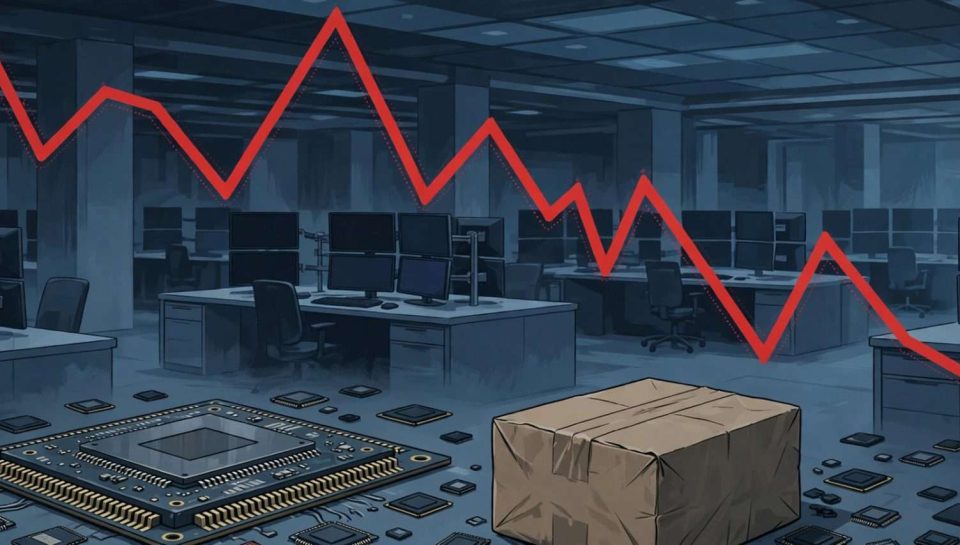
On Friday, October 30, 2026, the artificial intelligence trade had its worst day since June — and the message was not that AI had stopped working, but that it had started costing too much, too fast, for investors to ignore. Intel crashed about 30 per cent in a single session, Amazon missed profit and revenue expectations, the Nasdaq fell 2.86 per cent to 25,437, and OpenAI reportedly cut its latest funding target by $10 billion.
None of this means AI is going away: Amazon’s cloud business grew 39 per cent and Intel’s data-centre revenue jumped 78 per cent. What changed was the question the market is asking. For two years it was how fast AI could grow. Now it is what all that growth costs — and who pays for it. For any business buying computers or renting cloud capacity, that shift matters more than any single share price.
This article is not investment advice. One brutal week does not settle whether AI spending will pay off, but the earnings reports behind Friday’s rout contain hard facts about hardware prices, cloud costs, and vendor finances worth understanding before your next budget, hardware refresh, or AI renewal.
What happened on Friday
The selloff capped a week in which optimism from Anthropic’s IPO filing ran into earnings reports pointing the same way: AI infrastructure spending is rising faster than the cash it generates. AFP’s account of Friday’s trading quoted XTB research director Kathleen Brooks: “The end of the week is dominated by a continuation of the recent AI sell-off on disappointing earnings, and concerns about the safety of crypto.” Bitcoin fell about 5 per cent in the same session.
| Index or stock | Friday’s move | What drove it |
|---|---|---|
| Nasdaq Composite | Down 2.86% to 25,437 | Worst day since June; month down 5.3% |
| S&P 500 | Down 1.82% to 7,580 | Below 100-day average |
| Intel | Down about 30% | Weak outlook; PC memory crunch |
| Amazon | Down 5.5% at the open | Q3 miss; $220bn capex held |
| Nvidia / AMD / Micron | Down 4.6% / 11.7% / 5.9% | Semiconductor rout |
For the month, the Nasdaq fell 5.3 per cent — its steepest since March 2025 — while the Dow gained 1.7 per cent as investors rotated into defensive names. The pain was sharpest in leveraged “neocloud” operators: CoreWeave slumped 37 per cent in October, Nebius nearly 35 per cent. Money did not leave the market on Friday; it left the AI trade.
Intel: a strong quarter buried by a weak forecast
Intel’s crash looks puzzling until you read the report, because the quarter itself was good: revenue rose 21 per cent year on year to $16.5 billion, adjusted earnings of $0.52 per share beat the consensus of around $0.41, data-centre and AI revenue surged 78 per cent to $7.3 billion, and the foundry business grew 58 per cent to $6.7 billion.
The problem was the PC business and the next quarter: client computing revenue fell 5 per cent to $8.1 billion, and Intel forecast fourth-quarter revenue of only $15–16 billion against roughly $17 billion expected, with adjusted earnings of $0.25 per share versus a $0.43 consensus. After falling over 20 per cent in after-hours trading on Thursday, Friday’s roughly 30 per cent plunge left Intel down more than 45 per cent for October — its biggest ever one-month drop in Bloomberg data going back 40 years.
Why memory prices are suddenly a PC problem
The mechanism will show up in your next hardware quote. Samsung, SK hynix and Micron — the three largest memory makers — have shifted production toward high-bandwidth memory (HBM) for AI servers, leaving less capacity for ordinary PC memory. PC memory prices have soared, computer makers are cutting orders, and demand for Intel’s PC processors has fallen with them.
Chief executive Lip-Bu Tan told analysts the PC correction has accelerated over the last two months, with the market expected to contract about 12 per cent in 2026 and a further 10 per cent in 2027, weak at least through the first half of next year. Add raw-material shortages and an October 14 explosion at Intel’s Fab 28 plant in Israel — Reuters reported it could cost about $600 million in revenue over two quarters — and the forecast looks less like pessimism than arithmetic. See Seoul Economic Daily’s account of the memory crunch. If a device refresh is due in the next two quarters, expect higher prices, longer lead times, or both.
Amazon: the cloud is booming and the cash is burning
Amazon’s report illustrates the new question best, because both halves are true at once. Amazon Web Services grew revenue 39 per cent year on year to $46 billion — its fastest pace in nearly five years — with operating income up 55 per cent to $17.8 billion, a contracted backlog of $578 billion (more than double a year earlier), and chief executive Andy Jassy guiding to growth above 40 per cent in both 2027 and 2028. By any operating measure, AWS is booming.
And yet the stock fell. Total revenue of $201.9 billion, up 12 per cent, narrowly missed expectations of about $202.2 billion, and earnings per share of $1.89 missed the consensus of about $1.97. But spending overwhelmed everything: Amazon bought about $77.3 billion of property and equipment in Q3 alone, far above the roughly $57.5 billion expected, reaffirmed about $220 billion of 2026 capital expenditure — almost entirely data centres and AI — and warned 2027 spending will be “meaningfully more.”
The cash consequence is stark: Amazon’s trailing twelve-month free cash flow swung to a $42.4 billion outflow, from a positive $14.8 billion a year earlier. Alphabet, reporting a day earlier, also posted negative free cash flow of $9.07 billion. Two of the world’s most profitable companies now spend more cash than they generate on AI capacity. That is not necessarily a mistake — the $578 billion backlog suggests customers have committed to much of it — but it is the kind of bet that unnerves investors when every report in the same week points the same way.
For businesses renting cloud capacity, the read-across is double-edged: hyperscalers are building AI capacity at extraordinary scale, which should keep powerful tools available and improving. But today’s generous AI pricing is subsidised by companies now under pressure to show returns. As we reported earlier this month, AI model prices have already fallen about 80 per cent in four months — great for buyers while it lasts, but not forever if sellers are burning cash.
OpenAI reportedly cuts its funding target by $10 billion
The third leg came not from earnings but from Reuters, citing the Financial Times: OpenAI has cut its latest funding target by $10 billion, from $30 billion to about $20 billion, with its desired valuation down from $1.4 trillion to $1.25 trillion. The report said OpenAI set a Friday deadline for investor commitments, but that the “first close” is expected to raise less than $20 billion after some investors reduced their allocations. A UAE consortium including state-backed fund MGX is expected to lead the round, reportedly with an option for OpenAI to lease new regional computing capacity. OpenAI did not immediately respond to comment, per the report.
Three cautions apply. First, this is a report about a private round, not a confirmed announcement, and the final close could differ. Second, even reduced, a $20 billion round at $1.25 trillion would still rank among the largest private financings in history; smaller is not failed. Third, timing matters: OpenAI is reportedly keen to close before Anthropic’s expected listing, after Anthropic’s filing revealed $16.3 billion in revenue, an $80.7 billion loss, and $269 billion in compute commitments over six months. Meanwhile S&P has taken an early step toward potentially downgrading Meta’s credit rating within two years amid its AI spending. AI funding is not closed — but it is no longer unconditional, and that will filter down to the startups and tools businesses rely on.
Why the market suddenly cares about cost
The speed of the mood change is itself the story. Earlier in October, Anthropic’s IPO filing drew optimism and Alphabet and Microsoft reported enormous AI-driven growth. But the core businesses funding the buildout — advertising, consumer spending, retail — are slowing even as collective AI spending by America’s tech giants reaches roughly $750 billion this year, as MyBroadband’s roundup notes.
That is why Friday hit almost everything AI-adjacent at once, including companies whose numbers were fine. The broader semiconductor index fell 7.2 per cent, taking monthly losses past 15 per cent. In a rout driven by one question — “when does this spending pay?” — individual results matter less than shared exposure. Optimists cite AWS’s growth and backlog as proof demand is real; sceptics cite negative free cash flow and OpenAI’s funding cut as proof the buildout outruns returns. Both use the same numbers. What Friday settled is narrower: growth alone no longer answers the cost question.
What this means for your business: five practical takeaways
- Budget hardware now, not later. AI servers are consuming memory capacity, so if a refresh is due soon, get firm quotes early and avoid over-specifying memory you do not need. Expect entry-level business machines to get pricier or thinner through 2027.
- Lock in AI pricing where you can. Model prices crashed this year, but vendors cutting them face new pressure to show returns. Negotiate multi-year rates and price caps while vendors still compete hard — and read renewal terms, not just headline rates.
- Diversify your AI vendors. One memory shortage hits every PC maker; one funding wobble touches the whole sector. If you depend on a single model provider or cloud, build a fallback now, while switching is a choice rather than an emergency.
- Ask vendors about their funding runway, especially smaller AI tools. A vendor burning cash to subsidise your subscription is a risk if its next round comes in smaller or later than planned. Prefer vendors with real revenue and transparent pricing — and keep data exportable.
- Do not confuse a market correction with a technology verdict. The Nasdaq is 7.8 per cent below its October 6 record, not in a different era, and AI tools keep improving. The sensible response is discipline in procurement and contracts, not abandoning AI.
Re-evaluating subscriptions? Start free: our best free AI tools guide, WebReOn’s free browser tools, and WebReOn Chat let you test what your team actually uses before renewing.
What to watch next
Three near-term events will show whether Friday was a reset or something longer. Apple and Palantir report after Monday’s close, testing whether the selloff spreads to apparent safe havens — Apple has already retaken the most-valuable title from Nvidia. Tuesday’s US midterms will shape the policy backdrop for AI spending and regulation. And the next funding closes — OpenAI’s first close and Anthropic’s expected mid-November listing — will show whether private capital is repricing AI or merely pausing.
For business owners, the more useful watchlist is closer to home: your next hardware quote, cloud bill, and AI renewal. Those three documents will tell you, faster than any index, whether Friday’s cost pressures are reaching your business.
Frequently asked questions
Does the selloff mean AI is a bubble about to burst?
Not on this week’s evidence. Demand is real — AWS grew 39 per cent, Intel’s data-centre revenue 78 per cent, AWS holds $578 billion in backlog. The selloff questions the pace and price of the buildout, not demand itself. Funding terms are tightening.
Should I delay buying new computers?
Probably the opposite, if a refresh is planned: memory-driven price rises and Intel’s contraction forecast through early 2027 suggest waiting may cost more. Get firm quotes and standardise on in-stock configurations.
Will AI tool prices go up?
Eventually, they may. Model prices have fallen roughly 80 per cent in four months — unsustainable for vendors burning cash. Expect quieter tightening: smaller free tiers, pricier premium tiers, fewer promotions. Locking in rates on tools you genuinely use is prudent; panic-buying tools you do not need is not.
Is my business at risk if a big AI vendor stumbles?
Only if you depend on a single vendor with no fallback. Large labs and hyperscalers are unlikely to disappear, but their products, prices, and terms can change quickly. Keep prompts, data, and workflows portable, keep a second provider for critical tasks, and avoid core processes on a tool that cannot export your work.
The bottom line
Friday, October 30, 2026, was the day the AI trade stopped being graded on growth alone. Intel’s crash, Amazon’s miss, and OpenAI’s reported funding cut share one theme: the bill for the AI buildout has arrived, larger than the market expected. For businesses, the lesson is not to fear or flee AI — it is to buy hardware and AI services with normal major-cost discipline: firm quotes, locked-in terms, diversified suppliers, and a clear-eyed view of vendor finances. The companies building AI are still building. They are just no longer building on unlimited credit — and neither should you.
Market events and earnings figures here are as published by the sources cited; this is not investment or financial advice.



1 Comment
Hormuz On A Knife’s Edge: The Draft Deal, The Disputed
November 07, 2026[…] Treat any “deal announced” headline as unverified until both governments confirm it — markets have already had a brutal week on AI-spending doubts, and a false dawn on Hormuz could whipsaw prices just as […]