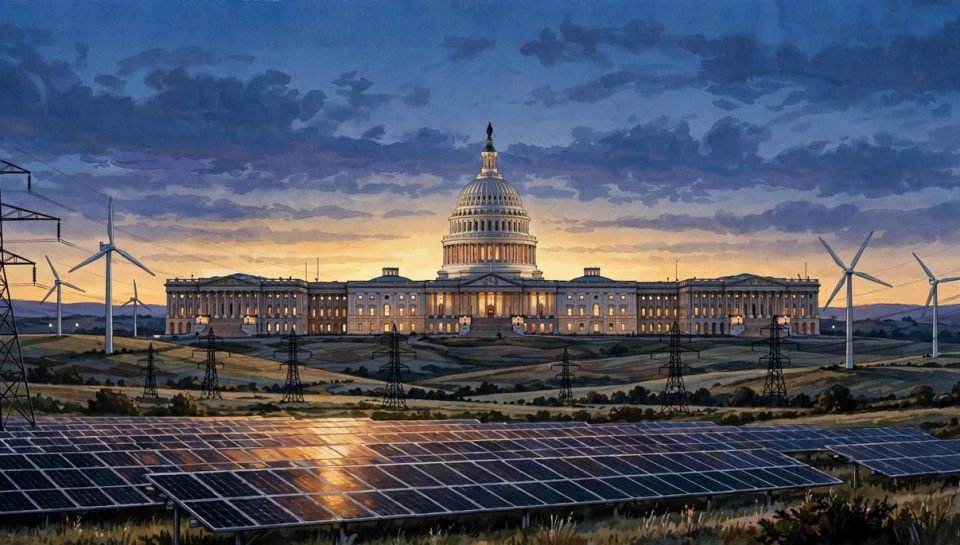
The United States Senate voted 73-25 on Monday evening to take up a sweeping energy permitting bill, the first major legislative action since last week’s midterm elections delivered a sharp rebuke to President Donald Trump and congressional Republicans. The vote clears the way for debate on the Bipartisan American Affordability and Jobs Act, known as BAAJA, a nearly 500-page overhaul of how the country approves pipelines, power lines, power plants, mines and data centres.
The vote was procedural, not final. Senators agreed to begin considering the bill; a second 60-vote hurdle, floor amendments and a House vote still stand between the measure and the president’s desk. But the margin, with 22 Democrats joining most Republicans, showed that a bill pairing faster fossil fuel approvals with new rules forcing data centres to pay for their own power can command a broad coalition, even in a Congress reshaped by last week’s results.
Summary: The Senate voted 73-25 on 9 November to advance BAAJA, a bipartisan bill that would shorten environmental reviews, limit legal challenges to energy projects and make data centre developers pay for the electricity they use. President Trump says he will sign it, but the House, tribal groups and environmental organisations all pose obstacles before it can become law.
Key takeaways
- The Senate voted 73-25 on Monday 9 November to formally take up the BAAJA permitting bill, with 22 Democrats voting in favour.
- The bill would shorten National Environmental Policy Act reviews, narrow the window for legal challenges and protect existing permits from being revoked.
- Data centre developers would have to pay the full cost of powering their facilities, rather than passing those costs to households.
- President Trump has said he will sign the bill, but he also said on Monday that he would not approve wind turbines.
- The bill still needs a second 60-vote Senate vote, floor amendments and House approval before the current Congress ends in January 2027.
What the Senate actually voted on
Monday’s vote was a cloture motion on the motion to proceed, held at 5.30 p.m. Eastern time. It needed 60 votes to pass and received 73. The vote formally opened debate on the bill, which is moving as an amendment to the legislative vehicle H.R. 2347, and allows senators to offer amendments before a final floor vote expected in the coming days or weeks. That final vote will again require 60 votes, which is why Monday’s margin matters and also why it guarantees nothing.
The bill, formally Senate bill S. 5653, was introduced on 30 September by the four senators who lead the chamber’s energy and environment panels: Republicans Shelley Moore Capito of West Virginia and Mike Lee of Utah, and Democrats Sheldon Whitehouse of Rhode Island and Martin Heinrich of New Mexico. The group negotiated the deal for weeks before the election, then released a 494-page manager’s amendment on Saturday 7 November designed to shore up support.
That amendment softened some of the bill’s most contested language. One provision, Section 1401, would bar agencies from revoking, suspending or changing any permit in effect on or after 6 November 2026, except in narrow circumstances. The revised text dropped a requirement that agencies prove their case by “clear and convincing evidence”, but critics say the core protection for existing permits remains.
The 25 senators who voted no included 23 Democrats, independent Senator Bernie Sanders and one Republican, Senator Mike Rounds of South Dakota. Several Democrats who voted to proceed, including Senator Catherine Cortez Masto of Nevada, have said they are withholding support for the current version of the bill.
What the bill would change
At its core, BAAJA rewrites the rules for getting big energy and infrastructure projects built in the United States. Its supporters say federal permitting now takes years, with environmental reviews, litigation and shifting agency decisions strangling projects that could lower electricity prices. Its critics say it strips safeguards that protect communities, tribes and wildlife.
| Area | What changes | Who it affects |
|---|---|---|
| Environmental review | Shorter timelines for National Environmental Policy Act reviews of energy and infrastructure projects | Energy and infrastructure developers |
| Legal challenges | Narrower window to file court challenges against project approvals | Communities, environmental groups and tribes |
| Existing permits | Agencies barred from revoking, suspending or changing permits in effect on or after 6 November 2026, except in narrow cases | Projects holding federal permits |
| Data centre power | Developers must pay the full cost of powering their facilities | Data centre operators and households |
| Wildlife protection | Changes to the Endangered Species Act, including the “best available science” standard | Agencies, developers and conservation groups |
| Offshore wind | Ends the administration’s practice of paying developers to relinquish wind leases | Offshore wind developers and the Treasury |
The environmental review changes are the heart of the bill. The National Environmental Policy Act, known as NEPA, requires agencies to consider a project’s possible impacts and allows the public to be heard before approval. Supporters of an overhaul say that process causes years of delay; opponents say it is one of the few tools communities have to challenge harmful projects. The bill also reaches into the Endangered Species Act: Sara Amundson, president of the Humane World Action Fund, said the proposed rewrite of the “best available science” standard could give agencies new grounds to dismiss credible research, including science showing that stronger protections are needed for species at risk.
The data centre rule, and why it is in an energy bill
The most politically charged provision may be the one that has least to do with pipelines. BAAJA would require data centre developers to pay for the costs of powering their facilities, rather than letting those costs fall on other electricity customers. It lands in a fierce argument about artificial intelligence: data centres consume ever more electricity, and anger over the giant, energy-hungry structures and rising power bills helped elect a wave of Democrats who pledged to clamp down on them.
The scale of the power demand is the context. Anthropic has reportedly agreed to pay 3.4 billion dollars for 1.7 GW of gas-fired generators for its own AI data centres, a deal that shows how far AI companies are going to secure electricity. Heinrich, one of the bill’s sponsors, said that if the bill passes it will “force big corporations to pay their full share for data centres instead of pushing energy costs on consumers”, alongside saving households billions on electricity costs. That savings figure is the sponsors’ claim, not an independently verified estimate.
Who supports the bill, and who is fighting it
The bill’s coalition is unusual. Major industry groups representing both clean energy and oil and gas developers support it, including the American Clean Power Association and the American Petroleum Institute. President Trump urged senators to vote for it, calling it a “BIG WIN for US ENERGY INDEPENDENCE and DOMINANCE” in a social media post on Sunday, and saying the bill will “ensure that we can build Pipelines, Mines, and Power Plants faster than ever before, lowering Energy Costs for American Families”. On 8 November he said he would sign the bill if it reached his desk.
The opposition is organised and vocal. The Sierra Club and the National Wildlife Federation have strongly opposed the measure, citing its limits on judicial review and its changes to NEPA and the Endangered Species Act. The National Congress of American Indians urged senators to vote no on 8 November. Heinrich said he had worked to incorporate tribal leaders’ feedback, and the amended version requires agencies to consult with tribes on projects affecting important cultural sites, extends the window for objections to agency reports and strengthens opportunities for states to weigh in.
Bradley Campbell, president of the Conservation Law Foundation, said it would be a “terrible mistake” to proceed with the bill in the waning days of the current Congress, arguing that it maintains “a veneer of federal safeguards while in fact stripping the power of federal agencies, states, tribes and communities to identify and prevent serious harm to health and the environment”.
Why the midterms changed the maths
The vote took place six days after an election in which Democrats won sweeping victories, a result the Associated Press described as soundly repudiating President Trump and congressional Republicans. That result cuts both ways. The bill’s Democratic sponsors argue it strengthens their hand: Whitehouse told a press conference with Heinrich on Monday that the bill is “the floor, not the ceiling, of our climate and environmental aspirations”, and said Trump’s support should help it move toward a vote in the House.
Other Democrats say the party should use its stronger position in the next Congress to pass legislation that produces needed clean energy while limiting expansion of oil, natural gas and mining. Critics have warned the bill as proposed could lead to a vast increase in liquefied natural gas exports and facilitate a “reckless” build-out of data centres powered by natural gas. That tension is sharpest in the House, where Minority Leader Hakeem Jeffries, a New York Democrat who is expected to become speaker in January, criticised the bill last week, with his office saying it “falls short” in a number of areas.
Capito, the bill’s lead Republican sponsor, framed the moment as one that should not be wasted. Calling the bill “a win for America”, she said: “We cannot let this moment pass by. The reality is this, over the next several years, we will have no choice but to increase our national energy production.” Heinrich added: “Americans can’t afford to wait for lower electricity prices. We need to pass this bill now.”
The wind problem
One fault line runs through the bill’s treatment of wind energy. Trump promotes expanding oil, natural gas and coal production, and he particularly dislikes offshore wind. His administration has spent nearly 4 billion dollars paying energy companies to walk away from offshore wind projects under development, according to the Associated Press. Whitehouse said a provision in the bill would end the buyouts, so the administration could no longer use public money to pay clean energy developers to relinquish wind leases.
But Trump told reporters on Monday that he still opposes wind energy. When told that wind is part of the bill, he replied: “Well, the bill hasn’t been fully negotiated. I will not approve wind turbines because wind turbines are a major loser.” That remark cost the bill at least one vote: Democratic Senator Chris Van Hollen of Maryland voted against moving the legislation forward, saying the bill does not fully address the administration’s efforts to block Maryland’s pending offshore wind project, which he said would lower energy costs for households across the state and create thousands of jobs.
What happens next
The bill now moves to floor debate, where senators can offer amendments before a final vote expected in the coming days or weeks. A second cloture vote, again requiring 60 votes, will be needed to end debate. If the Senate approves the bill, it must still pass the House, where some Democrats have said they will oppose it, and where questions remain about whether enough lawmakers who lost their re-election bids will return for the vote. The current Congress ends in January 2027, so the calendar is tight.
Three things to watch: whether the amendment process strengthens or weakens the tribal consultation and judicial review provisions; whether the House leadership schedules a vote at all; and whether Trump’s wind comments harden into a veto threat over a bill he has already promised to sign. Any one of those could decide whether BAAJA becomes law or becomes a rehearsal for the next Congress.
Frequently asked questions
Is the permitting bill now law?
No. The Senate has only voted to begin considering the bill. It still needs floor debate, amendments, a second 60-vote procedural vote, a final Senate vote and approval by the House of Representatives before the president can sign it into law.
What is BAAJA?
BAAJA is the Bipartisan American Affordability and Jobs Act, Senate bill S. 5653, introduced on 30 September 2026 by Senators Shelley Moore Capito, Mike Lee, Sheldon Whitehouse and Martin Heinrich. It would overhaul federal permitting for energy and infrastructure projects, shortening environmental reviews and requiring data centre developers to pay for their own power.
Do data centres have to pay for their own power under the bill?
The bill would require data centre developers to pay the costs of powering their facilities, rather than passing those costs to other electricity customers. Its final wording will be decided during Senate floor debate.
What is NEPA, and why does it matter here?
The National Environmental Policy Act requires federal agencies to consider a project’s possible environmental impacts and allows the public to be heard before approval. The bill would shorten NEPA review timelines and narrow the window for legal challenges, which supporters say ends years of delay and critics say removes a key safeguard.
Why did some Democrats oppose the bill?
The 25 senators who voted against advancing the bill included 23 Democrats, independent Bernie Sanders and Republican Mike Rounds. Their concerns included tribal consultation, renewable energy, limits on judicial review and fossil fuel expansion.
Conclusion
Monday’s 73-25 vote was a procedural step, but also a signal: after an election fought in part over electricity prices and AI data centres, the Senate’s first major act was a bill that tries to answer both. BAAJA promises faster energy projects, cheaper power and a fairer split of data centre costs. Its opponents say the price is weakened environmental law, weaker tribal consultation and a lock-in of fossil fuel development.
Both claims will now be tested in the open, on the Senate floor and then, if the bill survives, in the House. The vote showed that a bipartisan permitting deal can clear 60 votes. The weeks ahead will show whether it can clear the politics that come next.
Sources and Further Reading
- Associated Press via The Week, “Senate advances sweeping energy legislation in first major action since midterm elections”, 10 November 2026 — theweek.in
- Engineering News-Record, “Permitting Reform Inches Closer to Passage with Senate Vote”, 9 November 2026 — enr.com
- NationWire, “Senate Advances BAAJA Permitting Bill 73-25”, 9 November 2026 — nationwire.us
- Political.org, “Senate Advances Bipartisan Permitting Reform Bill in 73-25 Vote, Clearing First Filibuster Hurdle”, 9 November 2026 — political.org
- American Resolve News, “Mike Rounds joins 23 Democrats and Bernie Sanders against permitting bill”, 9 November 2026 — americanresolvenews.com
- WebReOn, “US Midterm Results 2026” — webreon.agency
- WebReOn, “Anthropic Buys 1.7 GW of Gas Generators to Power Claude Data Centres” — webreon.agency
- WebReOn, “COP31 Begins in Antalya as Guterres Warns of New Climate Extremes” — webreon.agency