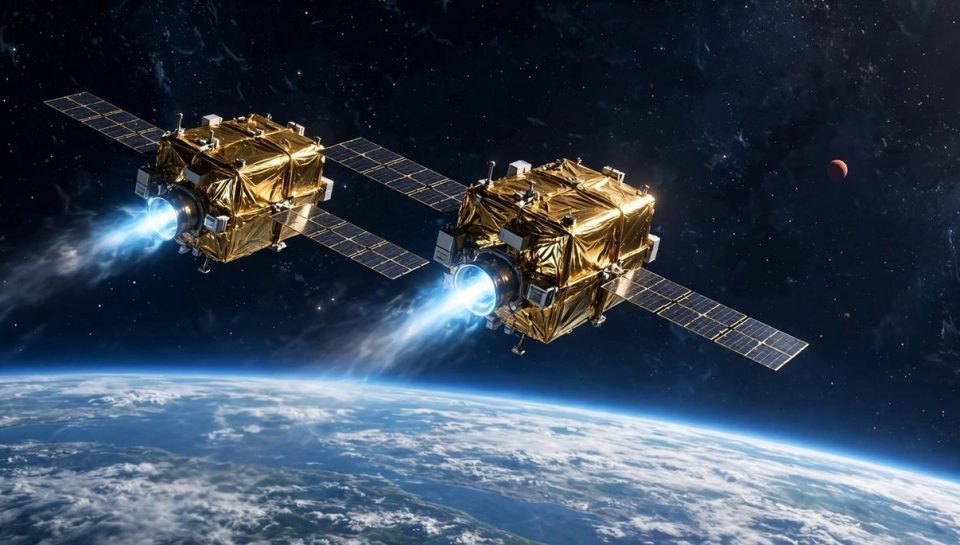
NASA twin ESCAPADE spacecraft have completed powered flybys of Earth on 7 and 9 November, using the planet gravity and their own engines to slingshot themselves onto a ten-month cruise to Mars. It is the first time NASA has used a powered Earth flyby to send a spacecraft to Mars, and both burns worked the first time.
NASA confirmed on 9 November that the two orbiters, together known as ESCAPADE, are now on course to reach Mars on 7 and 9 September 2027. Once there, they will spend about eleven months studying the Martian magnetosphere from two vantage points at once, measuring how the solar wind strips away the planet atmosphere. The mission addresses one of the oldest questions in planetary science: why a world that once had thick air and flowing water is now cold and dry.
Key takeaways
- The first ESCAPADE spacecraft flew past Earth on 7 November at 10:58 a.m. EST, firing its engine for about eight minutes at a closest approach of 1,984 miles.
- The second followed on 9 November at 4:09 a.m. EST, with a nine-minute burn at 1,993 miles above Earth.
- Both spacecraft are now on transfer trajectories to Mars, arriving on 7 and 9 September 2027.
- They will study how the solar wind interacts with the Martian magnetic environment and drives atmospheric escape.
- It is the first powered Earth flyby NASA has used to propel a spacecraft toward Mars.
Two flybys in two days
ESCAPADE stands for Escape and Plasma Acceleration and Dynamics Explorers. The mission is a pair of identical refrigerator-sized spacecraft, nicknamed Blue and Gold after the colours of the University of California, Berkeley, which leads the mission. They were built by Rocket Lab and launched together on 13 November 2025 aboard the second flight of Blue Origin New Glenn from Cape Canaveral Space Force Station in Florida.
Rather than flying straight to Mars, the pair spent almost a year loitering in a wide orbit near the Earth-Sun L2 region, about a million miles from Earth, studying space weather while they waited for the transfer window to open. The wait ended this weekend. Each spacecraft dived back toward Earth, skimmed past the planet and fired its engine at the closest point, where a burn delivers the most benefit. The flybys cap a busy period for NASA missions, after the Swift space telescope re-entered over Indonesia earlier in November.
| Spacecraft | Flyby | Closest approach | Engine burn | Mars arrival |
|---|---|---|---|---|
| First spacecraft | 7 November, 10:58 a.m. EST (8:58 p.m. PKT) | 1,984 miles (3,193 km) | About 8 minutes | 7 September 2027 |
| Second spacecraft | 9 November, 4:09 a.m. EST (2:09 p.m. PKT) | 1,993 miles (3,208 km) | About 9 minutes | 9 September 2027 |
Telemetry relayed through NASA Deep Space Network confirmed both burns delivered the precise velocity change required. Asal Naseri, acting associate flight director for the Heliophysics Division at NASA Headquarters, said: “This is the first time NASA has used a powered Earth flyby to propel a spacecraft toward Mars, and we’ve now executed this maneuver twice, flawlessly, in just two days.”
The stakes were unusually high. The burns had to work the first time. As principal investigator Rob Lillis of UC Berkeley told Space.com before the flybys, if the engines failed to light, the spacecraft would miss the interplanetary transfer window and have to wait two more years for another chance to reach Mars.
How a powered flyby works
A gravity assist is one of the oldest tricks in spaceflight: a spacecraft steals a tiny amount of a planet orbital momentum as it swings past, gaining speed without spending fuel. A powered flyby adds an engine burn at the closest approach, where the spacecraft is moving fastest and the burn is most efficient. The combination delivered more than 1,000 mph of extra speed to each ESCAPADE spacecraft, committing them to their Mars transfer trajectories.
Unpowered flybys are routine. NASA Cassini spacecraft used them around Venus and Earth on its way to Saturn, and the Parker Solar Probe still uses Venus flybys to tighten its orbit around the Sun. What makes ESCAPADE different is the combination of a gravity assist and a sustained propulsive burn, used as the trans-Mars injection itself. NASA had never done it that way before.
The two spacecraft did not fly past at the same distance. The first passed about 1,984 miles above Earth, the second about 1,993 miles, each close enough that the burn counted, but high enough to stay well clear of the atmosphere and of the satellites in low Earth orbit.
Why two spacecraft are better than one
Mars was not always the cold desert it is today. Evidence from orbiters and rovers shows liquid water once flowed across its surface, which means the planet once held a far thicker atmosphere. Over billions of years, most of that air was lost to space, and the solar wind, the stream of charged particles flowing from the Sun, is the prime suspect.
The problem for scientists is that Mars has no global magnetic field like Earth. Instead it has patchy, localised magnetic fields frozen into its crust, and a weak induced magnetosphere that offers little protection. The solar wind can reach deep into the upper atmosphere and strip ions away, a process that continues today at a measurable rate.
NASA MAVEN orbiter has measured that loss from a single spacecraft since 2014, but one spacecraft can only be in one place at a time. It cannot tell whether a change it records is a change over time or a difference between two locations. ESCAPADE solves that problem by flying two identical spacecraft carrying identical instruments. With one upstream in the solar wind and the other inside the magnetosphere, scientists can separate changes in time from changes in space for the first time at Mars.
The three instruments aboard each spacecraft are mWISE, which measures ions; EESA, an electron analyser; and EMAG, a magnetometer that maps the magnetic field. Together they will track how solar wind energy enters the Martian system, how it accelerates particles, and how much atmosphere escapes as a result.
That matters beyond Mars. The same physics governs how atmospheres survive, or fail to survive, around other planets, including the rocky exoplanets now being found around other stars. Understanding exactly how Mars lost its air is one of the best guides available to whether those worlds could stay habitable. The appetite for measuring rare, faint processes runs across physics: researchers at CERN recently observed the rarest particle decay ever recorded.
A year of waiting in deep space
ESCAPADE long road to Mars began with a launch that was itself a milestone. The 13 November 2025 launch was only the second flight of Blue Origin New Glenn, and it carried both spacecraft into a staging orbit that curved out toward the Earth-Sun L2 Lagrange point, a gravitationally stable spot about a million miles from Earth in the direction away from the Sun.
The cruise was not entirely smooth. During a course correction in December 2025, one spacecraft engine delivered less thrust than planned. The manoeuvre was completed on 6 January 2026, and NASA said at the time there were no long-term impacts on the mission. By 25 February 2026, NASA reported that all the science instruments on both spacecraft were working.
| Date | Milestone |
|---|---|
| 13 November 2025 | Launch aboard Blue Origin New Glenn flight 2 from Cape Canaveral |
| December 2025 to January 2026 | Course correction completed after one engine underperformed; no long-term impact |
| 25 February 2026 | All science instruments confirmed working |
| 7 November 2026 | First powered Earth flyby, about eight-minute burn |
| 9 November 2026 | Second powered Earth flyby, about nine-minute burn |
| 7 and 9 September 2027 | Mars orbit insertion |
| Autumn 2027 | Science operations begin after about two months of instrument checkout |
The mission is part of NASA SIMPLEx programme for small, low-cost planetary missions, and it is led by the Space Sciences Laboratory at UC Berkeley. Partners include Rocket Lab, which built the twin spacecraft, NASA Goddard Space Flight Center, Embry-Riddle Aeronautical University, Advanced Space and Blue Origin.
What happens next
The two spacecraft now face a ten-month cruise, with one major and several minor course corrections on the way. Each will fire its engine for about eleven minutes to be captured into a long, highly elliptical orbit around Mars, then lower its orbit step by step.
After arrival, the spacecraft need about two months to check out their science instruments before the science phase begins in autumn 2027. The science phase lasts about one Earth year, with the pair orbiting Mars for around eleven months, studying the planet magnetosphere and atmosphere from two different vantage points.
ESCAPADE will not be alone at Mars. Japan Martian Moons eXploration mission, known as MMX, launched on 20 October 2026 and is also bound for Mars in 2027, aiming to study the moons Phobos and Deimos. The two missions will arrive within weeks of each other, making 2027 one of the busiest years for Mars exploration in a decade. Closer to home, NASA is also preparing a nuclear-powered rover for the Moon south pole.
For now, the hard part is done. Two spacecraft that waited a year in deep space for a window measured in days have both threaded it, flawlessly, two days apart. The next time they fire their engines in earnest, Mars will be waiting.
Frequently asked questions
What is the NASA ESCAPADE mission?
ESCAPADE, short for Escape and Plasma Acceleration and Dynamics Explorers, is a NASA mission of two identical spacecraft that will orbit Mars together to study how the solar wind strips away the planet atmosphere. It is led by the University of California, Berkeley, and the spacecraft were built by Rocket Lab.
When will ESCAPADE arrive at Mars?
The first spacecraft is expected to arrive on 7 September 2027 and the second on 9 September 2027. After about two months of instrument checkout, science operations begin in autumn 2027 and last about one Earth year.
What is a powered Earth flyby?
A powered flyby combines a gravity assist, where a spacecraft gains speed by swinging past a planet, with an engine burn at the closest approach, where the burn is most efficient. ESCAPADE is the first time NASA has used this technique to send a spacecraft to Mars.
Why did ESCAPADE wait a year before heading to Mars?
The spacecraft launched in November 2025, when Earth and Mars were on opposite sides of the Sun, so they loitered near the Earth-Sun L2 point until the transfer window opened in November 2026. Missing the window would have meant waiting about two more years.