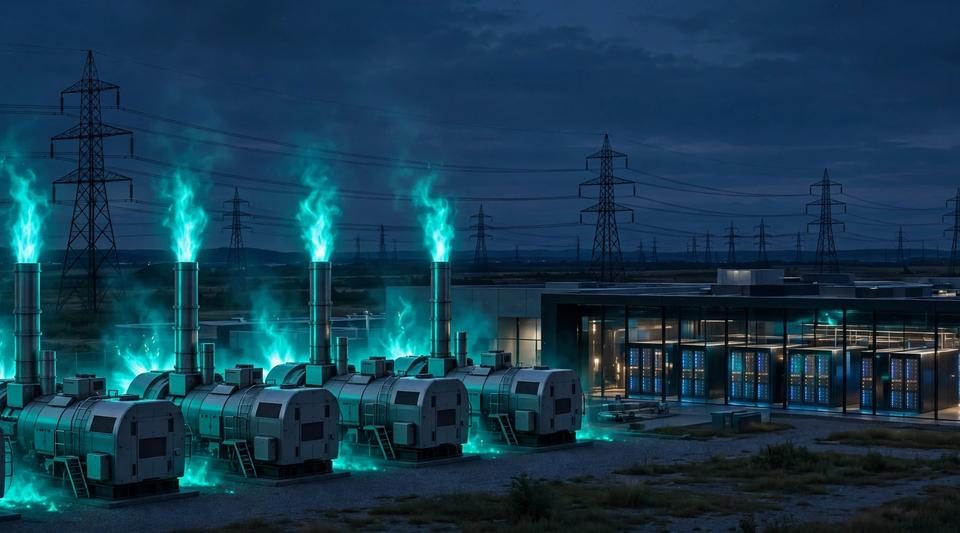
Anthropic has reportedly agreed to pay about 3.4 billion dollars for 1.7 gigawatts of gas-fired generators to power its AI data centres, the Financial Times reported on 8 November. The agreement, signed in late September with Texas equipment supplier OnePWR Solutions, would be the largest known single purchase of power-generation equipment by an AI company. Neither Anthropic nor OnePWR has confirmed the deal, and Reuters said it could not independently verify the report, but the shape of it matches what Anthropic told investors in its own IPO filing.
In short: the company behind Claude is buying its own power plants because the electricity grid cannot keep up with AI. The generators are second-hand queue positions as much as machines, the fuel bill has no cap, and the news lands in the same week Anthropic is expected to start its IPO roadshow.
Key takeaways
- Anthropic reportedly took over 1.7 GW of Caterpillar gas generator orders from OnePWR Solutions for about 3.4 billion dollars.
- The real asset is a place in the manufacturing queue: the generators were ordered about two years ago, and new orders now face lead times of years.
- Anthropic’s IPO filing warns it bears fuel costs “on a pass-through basis without cost caps” and that a site could be delayed or abandoned if gas supply cannot be secured.
- Global data-centre electricity demand is set to nearly double by 2030, according to the International Energy Agency.
- Voters are pushing back on data centres, and who pays for the power has become a political question in the United States.
What Anthropic reportedly bought
The Financial Times reported on Sunday 8 November that Anthropic bought commitments for 1.7 gigawatts of heavy-duty generators in late September from OnePWR Solutions, a San Antonio, Texas, company that supplies power equipment and builds microgrids and on-site power plants. The report, citing a person familiar with the matter, put the package at about 3.4 billion dollars and described it as the largest known single purchase of power-generation equipment by an AI laboratory.
Reuters carried the report the same day and said it could not immediately verify the transaction. Anthropic and OnePWR did not respond to requests for comment. That matters: everything in this article about the deal itself is reported, not confirmed, and the two companies named in it have so far said nothing at all.
What is reported is specific. Anthropic did not buy OnePWR itself, and none of the supplier’s employees moved across. The deal did include the engineering and construction capacity needed to install the generators. The machines were not fresh orders: OnePWR ordered them from Caterpillar about two years ago and needed financing to complete the purchase. Anthropic had first planned to buy electricity from OnePWR, then took over the orders instead.
There is one piece of corroboration that does not depend on the Financial Times. Investment bank Piper Sandler, which advised OnePWR, lists a 3.4 billion dollar sale of the supplier’s “power generation platform” to an unnamed frontier AI laboratory in September 2026. The figure and the month match the newspaper’s account, even though the buyer is not named.
Two details remain open, and both are worth watching. The sites where the generators will be installed have not been named, and no operating schedule has been confirmed. And OnePWR’s own announcement in February 2026 counted more than 400 megawatts of equipment in inventory and more than 800 megawatts expected over the next 24 months, about 1.2 gigawatts in total. The reported 1.7 gigawatts runs roughly 500 megawatts above that count, and neither document explains the difference.
| Claim | Status | Basis |
|---|---|---|
| Anthropic agreed a deal worth about 3.4 billion dollars for 1.7 GW of gas generators | Reported, unconfirmed | Financial Times, 8 November 2026, citing a person familiar with the matter |
| Generators came from OnePWR Solutions, ordered from Caterpillar about two years ago | Reported, unconfirmed | Financial Times, 8 November 2026 |
| No acquisition of OnePWR; no employees transferred; installation capacity included | Reported, unconfirmed | Financial Times, 8 November 2026 |
| A 3.4 billion dollar OnePWR power-generation platform sale to an unnamed frontier AI lab in September 2026 | Confirmed as listed | Piper Sandler transaction record, September 2026 |
| Anthropic bears fuel costs for on-site gas generation without caps | Confirmed | Anthropic Form S-1, filed 26 October 2026 |
| Certain planned Anthropic data centres rely on dedicated on-site natural gas-fired generation | Confirmed | Anthropic Form S-1, filed 26 October 2026 |
| Where the generators will be installed and when they will run | Not public | No statement from Anthropic, OnePWR or Caterpillar |
Why gas, and why now
The bottleneck in the AI race is no longer just chips. It is power. Grid connections for large data centres now take years in many US markets, and the equipment to generate power on site is itself scarce. Anthropic’s own IPO prospectus warns that generators, turbines, substations and transmission parts have faced “extended delivery timelines, price increases, tariffs” and rationing as data-centre operators compete for them.
That is why buying someone else’s two-year-old orders is worth 3.4 billion dollars. A generator ordered today sits at the back of a queue that stretches years; a generator ordered two years ago is near the front. The queue position is the asset, and the machines come with it.
Anthropic is far from alone in going around the grid. Cleanview, an energy research firm, estimated this month that 110 gigawatts of on-site gas projects are now under way in the United States, up from 20 gigawatts last summer. OpenAI has been scrambling for compute on the same terms, reportedly buying Google’s AI chips to ease its own capacity crunch, and said last week it would keep expanding its US data centres. Google announced on 4 November that it will invest 15 billion dollars in Malaysia over 2027 and 2028, including new data-centre campuses and more than a gigawatt of clean energy capacity for the national grid. The contrast is instructive: Google’s Malaysia plan pairs its campuses with new clean energy and a promise to pay for all the power they use, while Anthropic’s reported deal is gas first, at least for these sites.
The deal also fits a promise Anthropic made in public nine months ago. On 11 February 2026 the company committed to pay for 100 percent of the grid upgrades needed to connect its data centres and to bring net-new power generation online to match their electricity needs. On-site generators are the second half of that pledge in physical form: new capacity arrives with the campus instead of drawing on a grid built for slower growth.
The IPO filing warned investors about exactly this
Anthropic filed publicly for a Nasdaq listing on 26 October 2026, with an amended filing on 2 November. The prospectus is unusually candid about power. It tells investors that certain planned data-centre facilities rely on dedicated on-site natural gas-fired generation, and that Anthropic bears the fuel cost “on a pass-through basis without cost caps”. A planned site could be delayed or abandoned if firm gas supply and pipeline transportation cannot be secured, the filing says, and the company expects more competition for gas wherever on-site generation is allowed.
Anthropic disclosed about 895.4 billion dollars in aggregate committed spending in purchase and lease arrangements, substantially related to computing resources and infrastructure, as of and after 30 September. Reuters reported in September that the company expects to spend more than 500 billion dollars over the next ten years building AI infrastructure. The generators are a small line next to those figures, but they are the first concrete power purchase to surface in public.
Timing adds another layer. CNBC reported on 6 November that Anthropic was still expected to begin its IPO roadshow in the week of 9 November, and that some investors were lowering their valuation expectations after the technology sell-off, with one putting a more likely range at 1 trillion to 1.25 trillion dollars. Earlier reports had spoken of ambitions as high as 2 trillion dollars. The roadshow is where investors will now be able to ask, in person, who operates these plants, who carries the fuel-price risk, and what happens to contracted capacity if a site is delayed. Anthropic’s own filing names that last outcome as a risk, so the answer should already exist.
The climate cost of AI power
Gas-fired generation locks in carbon emissions. The International Energy Agency’s report Powering Artificial Intelligence, published on 14 October 2026, projects that worldwide data-centre electricity consumption will rise from about 485 terawatt-hours in 2025 to 950 terawatt-hours by 2030. Emissions associated with data-centre electricity are currently about 150 million tonnes of carbon dioxide a year and could reach about 350 million tonnes by 2035 under the agency’s central scenario. Data-centre electricity demand rose 17 percent in 2025 alone.
Anthropic’s February pledge is about paying for upgrades, not about clean energy specifically, and the reported generator deal shows the trade-off in practice: speed and certainty of supply, bought with fossil fuel. That tension is now part of the company’s public story in the same week that the COP31 climate summit opens in Antalya, Türkiye, where negotiators will spend twelve days debating electrification and climate finance, including a push to raise electricity’s share of final energy consumption to 35 percent by 2035.
Who pays for the power is now a political question
The generator deal also lands in a changed political landscape. On 3 November, voters in the United States went to the polls in midterm elections that cost Republicans control of both chambers of Congress, and data centres were on the ballot in their own right. Latitude Media counted at least 40 local ballot initiatives dealing with reining in data-centre development, about half of them in Ohio, and 24 had been approved when the outlet reported on 4 November.
The underlying sentiment is measurable. A survey from the advocacy group Climate Power found 28 percent support for a generic new data centre in respondents’ communities, rising to 56 percent when the facility ran on clean energy that the company paid for. A company-paid gas plant meets the first condition and falls outside the second. Texas, which accounts for roughly a quarter of planned US data-centre development over the next five years, has seen calls for a moratorium on new data centres and statutory protection for customer power rates.
Anthropic’s pledge to pay for grid upgrades answers the “who pays” question more directly than most of its rivals have, but on-site generation changes which approval comes first. Grid-tied supply runs through public utility commissions and rate cases; behind-the-meter generation faces a separate set of permitting, air-quality and siting requirements. The company’s own filing notes that opposition to data-centre development has become more organised across jurisdictions. The generators may solve the queue problem. The permit problem is next.
What to watch next
Four things will decide how this story develops. First, confirmation: whether Anthropic, OnePWR or Caterpillar say anything at all, and whether site names and air permits follow. Second, the IPO roadshow this week, and whether investors press the company on power costs and the uncapped fuel bill its own filing discloses. Third, whether other AI labs follow with generator purchases of their own, as the Financial Times suggests they might, with AI companies moving to control equipment production directly as demand soars and lead times stretch. And fourth, the local politics: the first air permit application will test whether the organised opposition the filing warns about can slow a project the grid queue could not.
For now, the deal is a reported fact with an unconfirmed buyer, a confirmed filing that explains why it makes sense, and an unanswered question about where the machines will run. The scrutiny is not limited to Anthropic: Nvidia’s board opened an independent investigation into chief executive Jensen Huang this week, over reports he was targeted by a Chinese intelligence effort. In the AI race, power has become the product. Anthropic has just spent 3.4 billion dollars to make sure it has some.
Frequently asked questions
Did Anthropic confirm the 3.4 billion dollar generator deal?
No. The deal was reported by the Financial Times on 8 November 2026, citing a person familiar with the matter. Reuters said it could not independently verify the report, and Anthropic and OnePWR did not respond to requests for comment.
What is OnePWR Solutions?
OnePWR Solutions is a San Antonio, Texas, equipment supplier that builds microgrids and on-site power plants. It ordered the Caterpillar generators about two years ago and needed financing to complete the purchase, according to the Financial Times report.
Why does an AI company need gas generators?
Grid connections for large data centres can take years, and gas turbines and generators themselves have lead times of years. On-site generation brings new power capacity with the campus instead of waiting for the grid, which is why Anthropic pledged in February 2026 to bring net-new power online to match its data centres’ needs.
How much power is 1.7 gigawatts?
It is roughly the output of a single large nuclear reactor, and it is enough to run very large data-centre campuses. The Financial Times described the package as the largest known single purchase of power-generation equipment by an AI company.
Does this mean Anthropic’s data centres will run on gas?
Its IPO filing says certain planned facilities rely on dedicated on-site natural gas-fired generation, and that Anthropic bears the fuel cost without caps. The mix across its whole estate is not public, and the sites for these generators have not been named.
When does Anthropic’s IPO roadshow start?
CNBC reported on 6 November that the roadshow was still expected to begin in the week of 9 November, with some investors lowering valuation expectations after the technology sell-off.
Sources and Further Reading
- Financial Times, 8 November 2026, report on Anthropic’s generator purchase, as reported by Reuters: Anthropic secures 3.4 billion dollar generator deal for AI data centers, FT reports
- Shashi Bellamkonda, “Anthropic Reportedly Locks In 1.7 Gigawatts of Gas Generators as Voters Press Data Centers on Who Pays”, 8 November 2026: shashi.co
- The Neuron, “Anthropic’s 3.4B Gas Generator Deal Explained”, 9 November 2026: theneuron.ai
- Anthropic, “Covering Electricity Price Increases”, 11 February 2026: anthropic.com
- Anthropic, PBC, Form S-1 Registration Statement, US Securities and Exchange Commission, 26 October 2026: sec.gov
- International Energy Agency, “Powering Artificial Intelligence”, 14 October 2026, as reported by DIG.watch: dig.watch
- Google, “Google Announces Digital Infrastructure Expansion with US 15 Billion Dollar Malaysia Investment”, 4 November 2026: blog.google
- Mad Robot, “Anthropic strikes 3.4bn deal for gas generators, FT says”, 8 November 2026: madrobot.blog