The Legend of Zelda: Ocarina of Time remake launches on November 5, 2026, exclusively for Nintendo Switch 2. Nintendo describes it as a classic tale built from the ground up for the new console, with overhauled visuals, orchestral music, voice acting, and expanded cutscenes. It is not a simple port of the 1998 Nintendo 64 original, and it will not run on the original Switch.
Summary: The Zelda Ocarina of Time remake arrives on November 5, 2026, for Switch 2 only. It rebuilds the 1998 adventure with modern controls, voiced cutscenes, a boss rematch room, and a microphone option for playing the ocarina, with store listings reporting a price of 59.99 dollars digital and 69.99 dollars physical.
Key takeaways:
- Release date: November 5, 2026, exclusively on Nintendo Switch 2.
- New in the remake: voiced cutscenes, a dedicated jump button, free camera control, and the Hall of Fallen Foes.
- Play ocarina songs with buttons, or by humming or playing an instrument into the Switch 2 microphone.
- Reported price: 59.99 dollars digital and 69.99 dollars physical in the United States, with an estimated 27 GB download.
- Digital buyers before November 23, 2026, at 11:59 p.m. Pacific Time receive a 40th anniversary wallpaper bonus from Nintendo.
What is launching on November 5
Nintendo confirmed the November 5 date during its Legend of Zelda 40th Anniversary Direct on September 8, 2026, after first revealing the remake in June 2026. Series producer Eiji Aonuma presented live gameplay in that broadcast, starting in Kokiri Forest with Young Link and moving into the Great Deku Tree, the first dungeon. The remake is the centrepiece of the 40th anniversary celebrations, which also include a special edition Switch 2 console that arrived on October 29, 2026, with the game sold separately.
The story is unchanged at its core. Ganondorf schemes to steal the Triforce from the Sacred Realm, and Link must become the Hero of Time to save Hyrule. Players travel between childhood and adulthood, explore Kokiri Forest, Hyrule Castle Town, Zora’s River, Goron City, and Kakariko Village, and learn ocarina songs that open new areas and change time itself.
That structure is why the original mattered. Released in Japan on November 21, 1998, and in North America on November 23, 1998, it was the first Zelda game in 3D, and it sold 7.6 million copies worldwide on Nintendo 64. For new players it is designed as an entry point. For returning players, the question is whether the new features justify a replay.
What is new in the remake
The visual rebuild is the most obvious change. Nintendo calls the approach stylised realism, and the September footage was measured by Digital Foundry at 1080p and 60 frames per second, up from roughly 20 frames per second in the original. Nintendo has not confirmed a docked resolution, so that figure should be treated as a measurement from preview footage, not a final specification for every display mode.
Controls have been reworked in small ways that add up. Link now has a dedicated jump button instead of leaping automatically at ledges, and players can dash after rolling. The camera can be moved freely, and slingshots, bows, and other tools can be aimed with motion controls. Hyrule Castle Town is no longer viewed through a fixed camera and can be explored freely in 3D, and time now flows throughout the game, so night can fall while Link is in town.
One deliberate throwback remains: Nintendo has kept loading screens between certain areas. Aonuma has said this preserves the feel of the original. It is a useful warning for players expecting a seamless open world. This is a faithful rebuild of a 1998 map, not a redesign of Hyrule as one continuous landscape.
Voiced cutscenes, with Link still silent
Major cutscenes are now fully voiced. Zelda, Saria, Darunia, Ruto, and Ganondorf speak, while Link remains silent, in keeping with series tradition. Nintendo has not announced the voice cast. Expanded dialogue for supporting characters and a symphonic orchestral soundtrack complete the presentation change,.
How the ocarina works now
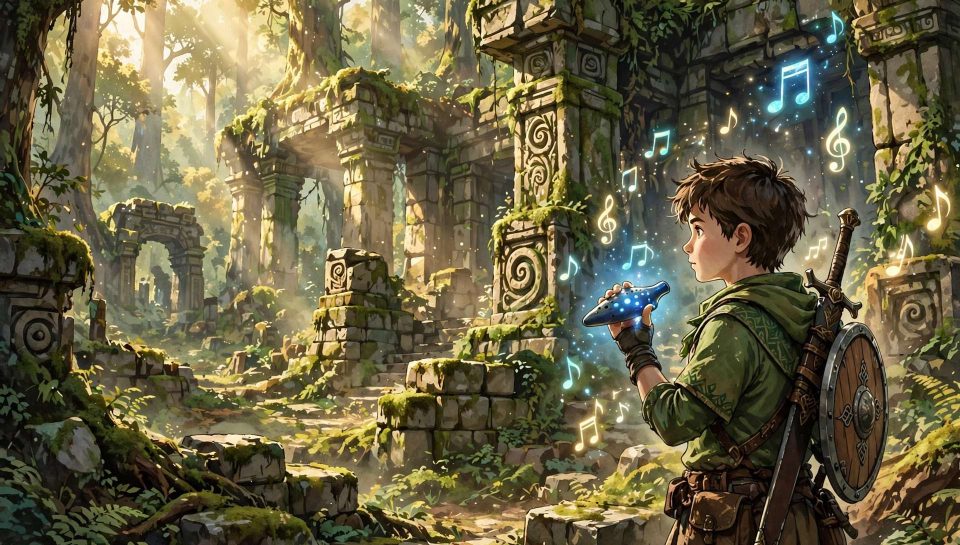
The ocarina is both a musical instrument and a tool, and Nintendo now offers three ways to play it. Traditional button controls remain. Players can also hum a melody, or play their own instrument, into the Switch 2 microphone, and Link will perform the matching in-game song automatically. That option is listed on Nintendo’s official store page.
Two companion features sit alongside it. Zelda Notes, a service in the Nintendo Switch app on compatible smart devices, shows daily accomplishments, lets players search for locations from images, and includes a virtual ocarina. Reporting also describes a daily quiz in Zelda Notes, but treat that detail as reported, since the store page highlights location challenges and the virtual ocarina.
The second system is Trails of Time, described in Nintendo’s Japanese social posts as a feature that lets players confirm their next objective and look back over their adventure. As the adventure progresses, a large tapestry painting gradually fills up. For first-time players, this is the most practical addition: the original could leave players unsure where to go next, and a built-in guide reduces that friction without, on the evidence so far, changing the puzzles themselves.
Hall of Fallen Foes: boss rematches with a timer
An overview trailer released on October 14, 2026, revealed the Hall of Fallen Foes, a museum-style room exclusive to the remake. Examining a statue shows a description of the enemy and where to find it, and bosses can be fought again, with the game tracking the player’s best time. Nintendo has not confirmed whether mini-bosses such as Dark Link, shown in a Japanese television commercial as the Water Temple mini-boss, can also be fought again in the hall. For returning players, this is the clearest reason to replay beyond nostalgia, since the original offered no boss rematch mode.
Price, editions, and what to buy
Store listings report the game at 59.99 dollars digital and 69.99 dollars physical in the United States, with an estimated 27 GB download that Nintendo notes may change before launch. The first physical print run arrives in special packaging with textured foil cover art while supplies last. Nintendo’s own store page, as read for this article, did not display a price in its main text, so the dollar figures are reported store listings, not a price quoted from that page. Readers in other regions should check their local store, since the British listing reported by Radio Times gives 49.99 pounds.
The game supports TV, tabletop, and handheld modes on Switch 2, and Nintendo Account family-group lending is supported. Digital buyers who purchase before November 23, 2026, at 11:59 p.m. Pacific Time receive a Legend of Zelda 40th Anniversary digital wallpaper bonus, delivered through a My Nintendo link after the promotion ends. Amiibo support is also in place: tapping any Zelda series amiibo figure gives in-game extras, and the new Young Link and Young Zelda figures, coming in 2027, will unlock retro-style cosmetic masks.
| Detail | Confirmed position |
|---|---|
| Release date | November 5, 2026 |
| Platform | Nintendo Switch 2 only |
| Reported United States price | 59.99 dollars digital, 69.99 dollars physical |
| Estimated download size | 27 GB, subject to change |
| Play modes | TV, tabletop, and handheld |
| Major new features | Voiced cutscenes, Hall of Fallen Foes, Trails of Time, microphone ocarina input |
| Early purchase bonus deadline | November 23, 2026, at 11:59 p.m. Pacific Time |
Source line: Nintendo official store page, Notebookcheck on October 18, 2026, and GameDaily on September 8, 2026, with price figures from store listings as reported by those outlets.
Should you buy it, and who is it for
If you own a Switch 2 and have never played Ocarina of Time, this is the most accessible way to play one of the most influential games ever made. If you own a Switch 2 and played the original, the remake offers voiced scenes, boss rematches, and a rebuilt Hyrule Castle Town, but no new story. If you do not own a Switch 2, the remake alone is not a reason to buy a console unless you also want the wider Switch 2 library, since Nintendo has announced no version for the original Switch.
Free about 27 GB before launch day, and decide between digital and physical early if you want the foil first print run or the digital-only wallpaper bonus.
A spoiler warning is also worth stating plainly. On November 1, 2026, TheGamer reported that a social media user had posted a picture appearing to show the game running days before launch. Nintendo has not confirmed that report, and it should not be treated as an official early release. Players who want to discover the remake fresh should be cautious with social media in launch week. GameDaily also noted November 5 places the remake two weeks ahead of Grand Theft Auto VI, reported for November 19, 2026.
It is worth comparing the remake with other recent hardware launches covered on this site. Apple’s first touchscreen MacBook Pro showed how a familiar product can change through one major input change, and the microphone ocarina is a similar idea in gaming. Google’s Genie 4 world model showed how interactive worlds are becoming a design goal across technology, and the freely explorable Hyrule Castle Town is a small version of that idea inside a classic game. In each case, check the platform, price, and storage before launch day.
Frequently asked questions
Is the Zelda Ocarina of Time remake only on Switch 2
Yes. Nintendo lists the game exclusively for Nintendo Switch 2, with TV, tabletop, and handheld modes. No version for the original Switch has been announced.
Is Link voiced in the remake
No. Major cutscenes are fully voiced for characters such as Zelda, Saria, Darunia, Ruto, and Ganondorf, while Link remains silent. Nintendo has not announced the voice cast.
Do I need to have played the original to enjoy the remake
No. Nintendo presents the remake as an entry point, with reworked controls, expanded dialogue, and the Trails of Time guidance system.
Can I really play the ocarina by humming
Yes, according to Nintendo’s store page. Players can use button controls, or hum or play an instrument into the Switch 2 microphone, and Link will perform the matching song.
Conclusion
The remake arrives on November 5 as a careful rebuild rather than a reinvention: the same Hero of Time story, with voiced cutscenes, modern controls, a microphone ocarina, and a boss rematch room. Check the platform, confirm the local price, and free up storage before launch day.
Sources and Further Reading
- Nintendo official store page for The Legend of Zelda: Ocarina of Time on Switch 2 – release date November 5, 2026, Switch 2 exclusivity, overhauled visuals, orchestral music, voice acting, expanded cutscenes, microphone ocarina input, Zelda Notes, amiibo details, 27 GB estimate, and wallpaper bonus deadline.
- Notebookcheck, October 18, 2026 – performance measurement from September footage, jump button, motion aiming, freely explorable Hyrule Castle Town, Hall of Fallen Foes, and reported price and console date.
- GameDaily, September 8, 2026 – September Direct confirmation, live demo detail, loading screens kept, and November 19 Grand Theft Auto VI scheduling context.
- Nintendo Wire, October 14, 2026 – overview trailer and Hall of Fallen Foes detail.
- Radio Times, September 14, 2026 – release date confirmation and British price listing.
- Screen Rant, October 18, 2026 – Trails of Time feature detail from Nintendo’s Japanese social posts.
- TheGamer, November 1, 2026 – unconfirmed social media report of early play, reported here only as unconfirmed.
- The Legend of Zelda: Ocarina of Time, Wikipedia – original release dates in Japan, North America, and Europe, and 7.6 million worldwide sales on Nintendo 64.