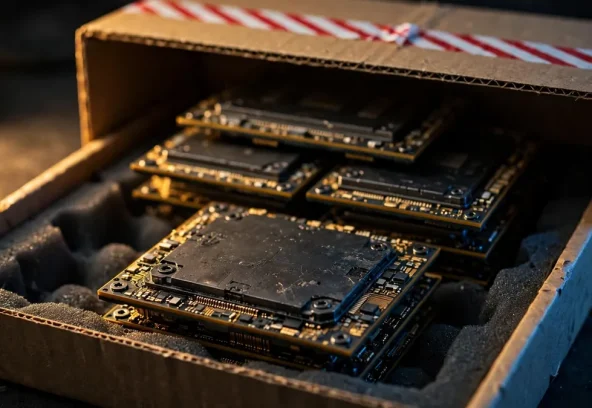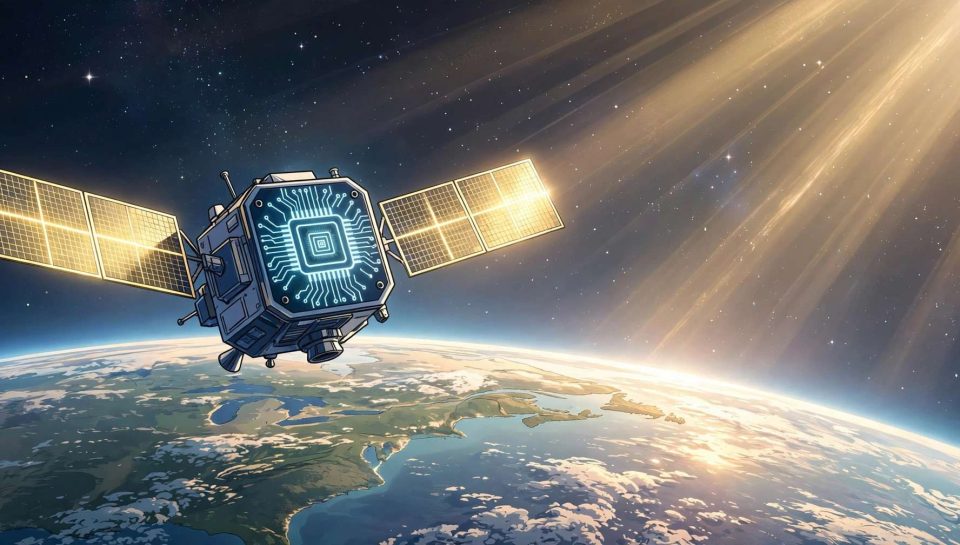
Google’s Project Suncatcher satellite has answered its first prompt from orbit. On 30 October 2026, the company said a Tensor Processing Unit, or TPU, aboard its prototype satellite ran its open Gemma 4 model and sent back a haiku about being in space. Google calls the result the first AI response from a data centre class TPU in orbit, and its chief executive, Sundar Pichai, called it a “hello world” milestone for the project.
In short: a data centre chip has run an AI model in space and returned a complete answer to Earth, but this is a research test, not a working space data centre. The hardest tests on heat and radiation are still ahead, and Google has published no speed or cost figures from orbit.
Key takeaways
- Google’s Project Suncatcher prototype launched on 1 October 2026 aboard SpaceX’s Transporter-18 rideshare mission, built with Planet.
- On 30 October, Google said the satellite’s TPU ran Gemma 4 and returned a haiku via Svalbard, Norway.
- TechCrunch reports the satellite generates up to 1 kilowatt and runs one of its four TPUs at a time, for about 20 minutes.
- Google says heat and radiation tests come next, then twin interconnected satellites in 2027.
- Nothing announced is a product businesses can buy: Suncatcher remains research aimed at the 2030s.
What happened: a haiku from orbit
The test followed a simple loop, and its simplicity is the point. During a ground station pass, Google’s team uplinked a prompt to the onboard Gemma 4 model, asking for a haiku about being in space. The satellite’s TPU ran the model, and the answer came down as the spacecraft passed over Svalbard, Norway. Google published the reply in full:
Blue marble below
Data streams in silent grace
Starlight feeds my core.
Google then tried further prompts, including space themed limericks and requests asking the model to report the payload’s technical status. The announcement came from Travis Beals, senior director of Google’s Paradigms of Intelligence group, in a Google blog post dated 30 October. Pichai echoed the news the same day. Reports differ slightly on the exact prompt wording, but the answer is not in dispute. What the test proved is the chain: prompt up, model run on a data centre class chip in orbit, answer down.
How the test worked, step by step
Project Suncatcher did not begin with the haiku. Google set out its research plan in November 2025, asking whether machine learning infrastructure could one day run in space on solar power. The prototype, built with Planet, launched on 1 October 2026 on a SpaceX Falcon 9 as part of the Transporter-18 rideshare mission. Google says the following weeks were spent commissioning the spacecraft: powering up the host computer and the TPU trays, then running early machine learning tests.
| Date | Milestone |
|---|---|
| November 2025 | Google publishes the Suncatcher research plan: solar powered machine learning in space. |
| 1 October 2026 | Prototype launches on SpaceX Transporter-18, built with Planet. |
| October 2026 | Commissioning: host and TPU trays powered up, early tests run. |
| 30 October 2026 | First AI response from orbit: Gemma 4 on a TPU returns a haiku via Svalbard. |
| Next | Thermal stress and radiation tests on the TPUs in orbit. |
| 2027 | Planned twin interconnected satellites, higher power, linked spacecraft. |
The model matters as much as the chip. Gemma 4 is Google DeepMind’s open model family, which developers can download and build with. The satellite ran a publicly available model, not a secret system, on silicon that would normally sit in a liquid cooled rack.
Why Google wants AI in space at all
Google’s argument starts with sunlight and scale. A satellite in the right orbit can see the Sun almost constantly, while a data centre on Earth must buy land, draw grid power and cool its hardware. In Google’s 2025 research sketch, satellites flying close together in a dawn to dusk sun synchronous orbit could form clusters, sharing workloads over high speed links. The idea is not to replace ground data centres, but to test whether some future AI computing could run where sunlight is abundant and heat can radiate into space.
That argument is easy to state and hard to prove. Launching hardware is expensive and repairing it is usually impossible, and a satellite cannot draw on a larger power supply when demand rises. Google’s own researchers have framed the economics as dependent on much cheaper launches in future, and no orbital test so far says anything about cost per unit of computing. Suncatcher is a long range bet: if launch costs fall and chips prove durable in orbit, space could become one more place to put computing.
What the prototype does not prove
The honest limits are the most interesting part of this story. First, power is tight. TechCrunch reports that the satellite generates up to 1 kilowatt, roughly the draw of a microwave oven, and can therefore run only one of its four TPUs at a time, for about 20 minutes. Google’s own announcement gives no power, TPU count or run time figures, so those numbers should be read as reported, not confirmed by Google. A single chip running in short bursts is a boot test, not a benchmark.
Second, Google has published no figures for speed, throughput, latency, power consumption or error rates. A haiku is a tiny output, and it tells us nothing about sustained workloads, large models or continuous traffic. Third, the hardest environmental tests have not happened yet. Radiation can flip a stored bit, silently corrupting data without tripping the usual monitoring. Google says ground tests suggest this matters less for inference, answering prompts with a finished model, than for training, but only orbital testing will show how the chips behave over months in space. Heat is the companion problem: without air to carry heat away, a satellite must radiate it.
Fourth, there is no independent reproduction yet. The result rests on Google’s announcement and reporting from outlets including TechCrunch and The Verge. That is normal for a company research milestone, but it is not peer reviewed evidence. Treat the claim, first AI response from a data centre class TPU in orbit, as Google’s description of its own test, which other reporting has so far repeated rather than independently verified.
What happens next: two satellites in 2027
Google says the next phase will test the TPUs under thermal stress and radiation in orbit. If the chips hold up, twin interconnected satellites follow in 2027, with higher power and optical links. Flying two linked satellites tests the distributed part of the idea: whether workloads can be shared across spacecraft, rather than running on one isolated chip.
That step will be more informative than the haiku. Linked satellites test timing, coordination and data transfer between moving platforms, which a real orbital cluster would need. It still will not answer the cost question, and Google has announced no commercial service.
What it means for businesses and developers
For most businesses, the direct implication today is close to zero: there is no Suncatcher service to buy, no pricing and no availability date. The indirect implications are more useful. The test underlines how central Google’s TPU programme has become to its AI strategy, with the same chips now appearing in ground data centres and in rival companies’ production systems. Readers following that story can see how the ecosystem is widening in our earlier reporting on Meta running Google TPUs in production and on reports that OpenAI is buying Google TPU chips. A third useful thread is Google’s Gemini 4 Carbon security model, which shows the same company pushing specialised models alongside specialised hardware.
For developers, the watch items are the 2027 twin satellite results, any published data on radiation induced errors during inference, and whether Google releases orbital performance figures rather than milestone announcements. For satellite or remote sensing companies, the nearer opportunity is not orbital data centres but the pattern behind this test: small models running on constrained hardware at the edge, where connectivity is intermittent and power is scarce.
Frequently asked questions
What is Google Project Suncatcher?
Project Suncatcher is a Google research programme exploring whether machine learning infrastructure could one day run on solar powered satellites carrying TPU chips. It is research, not a product, aimed at the 2030s.
Is this a space data centre I can use?
No. The prototype is a single experimental satellite that has answered a handful of test prompts. Google has announced no commercial service, pricing or availability.
What model ran in orbit, and what are the limits?
Gemma 4, Google DeepMind’s open model, returned the haiku via Svalbard. TechCrunch reports up to 1 kilowatt of power and one of four TPUs at a time for about 20 minutes, with heat and radiation tests still to come.
When will the next Suncatcher satellites launch?
Google says twin interconnected satellites are planned for 2027, with higher power and links between spacecraft. No month or launch vehicle has been announced.
Conclusion
A haiku is a deliberately modest first answer. It proves the full loop works: a prompt can go up, a data centre class chip can run a model in orbit, and an answer can come back down. It does not prove that orbital data centres are practical, affordable or durable. Those questions turn on the thermal and radiation tests now under way, and on the twin satellite experiment planned for 2027. Until those results appear, Project Suncatcher deserves attention as an engineering experiment, and scepticism as a business proposition.
Sources and Further Reading
- Google blog post by Travis Beals, senior director, Paradigms of Intelligence, 30 October 2026: announcement of the first AI response from a data centre class TPU in orbit, the Gemma 4 haiku, Svalbard downlink, and the 2027 twin satellite plan, as reported by the sources below.
- The Economic Times, “Google’s Project Suncatcher achieves first successful AI response from space”, 31 October 2026
- Skimwire, “Google Project Suncatcher satellite sends first AI response”, 30 October 2026
- Hardware Busters, “Project Suncatcher’s orbiting TPU sends back its first AI answer”, 30 October 2026
- Space Launch Agency, “Google Suncatcher online: space data center lessons”
- The Economic Times, “Google’s space AI just wrote a haiku from orbit”, 31 October 2026